|
|

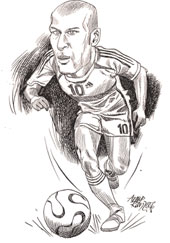
Eight years ago, on a summer evening at a stadium in the Parisian suburbs, the balding pate of a 26-year-old Zinedine Zidane rose above a sea of Brazilian defenders ? not once but twice ? to elevate France to the apex of footballing glory. Last week, on the threshold of a second possible French Fifa World Cup victory in neighbouring Germany, the same head ? with the bald patch now significantly larger ? came down on a peevish Italian defender to squander it all away. Greatness gave way to shame, praise made way for criticism, and Zidane walked off the football pitch to enter the pages of sporting history. And France lost the World Cup to Italy, but that was besides the point.
The 2006 World Cup final was the last football match Zidane was slated to play. And though speculation is currently rife that he may cross the Atlantic to earn himself a living in the American soccer league, it’s clear that Zidane won’t return to rule international ? or even European ? football with the same ?lan that he exhibited during his decade-long stay at the top. In that context, being red-carded for a nasty head-butt to Marco Materazzi was perhaps a sad way to go. But then, in the world of sport, endings are not always known to be happy.
And while it was not wholly desired, the abrupt flash of violence on Zidane’s part was not what analysts would call unexpected either. For despite his greatness, Zidane has been known to lose his head in the most unlikely of situations. He lost it once in the very World Cup that he eventually won for his country in 1998, stamping on a Saudi Arabian player and being duly sent off in the early stages of the tournament. Later, while playing for Italian club Juventus in a European Champions’ League match, he head-butted a Hamburger SV player and was given marching orders by the referee yet again. Greatness, for the player who is often compared to footballing legends like Pele and Maradona, wasn’t uniform ? it did have its patches of indignity.
But duality is what marks the life of Zidane, both on and off the pitch. Born in Marseille on June 23, 1972, Zinedine Yazid Zidane was raised in La Castellane, a government sponsored housing colony home to many immigrants from Algeria. His parents were of Kabyle Algerian descent and immigrants from the village of Aguemone in Algeria. Zidane ? who calls himself a non-practicing Muslim ? spent his childhood in ghetto surroundings, where he learnt to play football when he was not fighting with other children. As a child, he admired the Uruguayan football legend Enzo Francescoli ? not surprisingly, the first of Zidane’s four children is named Enzo.
Zidane’s career as a professional footballer began at 15, with the French club AS Cannes. He soon moved to Bordeaux and played out a successful stint there, before walking into Italian giants Juventus in 1996. Meanwhile, he earned his first international cap for France on August 17, 1994. Having dual citizenship, he also had the option of playing for Algeria, but Algerian coach Abdelhamid Kermali denied Zidane a position in the team since he didn’t consider him fast enough.
It’s not something others would agree with. “His elegant dribbling, balance, passing ability and shot accuracy have carved his name in the history of football. When we don’t know what to do, we just give the ball to Zizou and he works something out,” former French defender Bixente Lizarazu once said.
Two years after leading France to its maiden World Cup victory in 1998, Zidane helped his country to a second major championship, wresting the Euro 2000 title out of an adamant Italy. His transfer from Juventus ? where he scored 24 goals in 151 matches ? to Spanish powerhouse Real Madrid came a year later, for a record fee of $81 million ? the highest ever. Zidane soon justified the tag by scoring the winning goal in a 2-1 victory of German club Bayer Leverkusen to help Real Madrid clinch the 2002 Champions League title.
Off the field, Zidane ? otherwise shy and soft-spoken ? had a brief stint with politics during the 2002 French presidential elections. After his allegiance to a multicultural and multiracial France was questioned by the right wing Front National (FN) party, Zidane publicly appealed to the French to reject FN candidate Jean-Marie Le Pen, known for his xenophobic ways, and root for Jacques Chirac. Chirac went on to win the elections, and appointed Zidane a ‘Chevalier’ (knight) of the Legion d’honneur two years later.
Zidane soon hung up his boots, but was forced to come out of retirement after France received early jolts in their 2006 World Cup qualifying matches. Wearing the captain’s armband, he vaulted the team into the final tournament and rallied it all the way to the final before letting his teammates down with that single act of assault on Materazzi. The reputation that Zidane had built over years was tarnished in a flash.
Of course, the episode has not diminished his admirers’ fascination with his game. “The issue of Zidane’s head-butt to floor Materazzi has been blown out of proportion,” says Shibaji Banerjee, former India team goalkeeper. Banerjee maintains that the issue should be put to rest and Zidane given due respect for his game. Agrees former India coach Amal Dutta, “I think the incident has only made his image brighter than it was since no human being is perfect. He remains a great player no matter what.”
That is only a reminder of the fact that football, despite being called the beautiful game, will continue to be ruled by the bad boys. Just like it has always been. Zizou, take a bow.