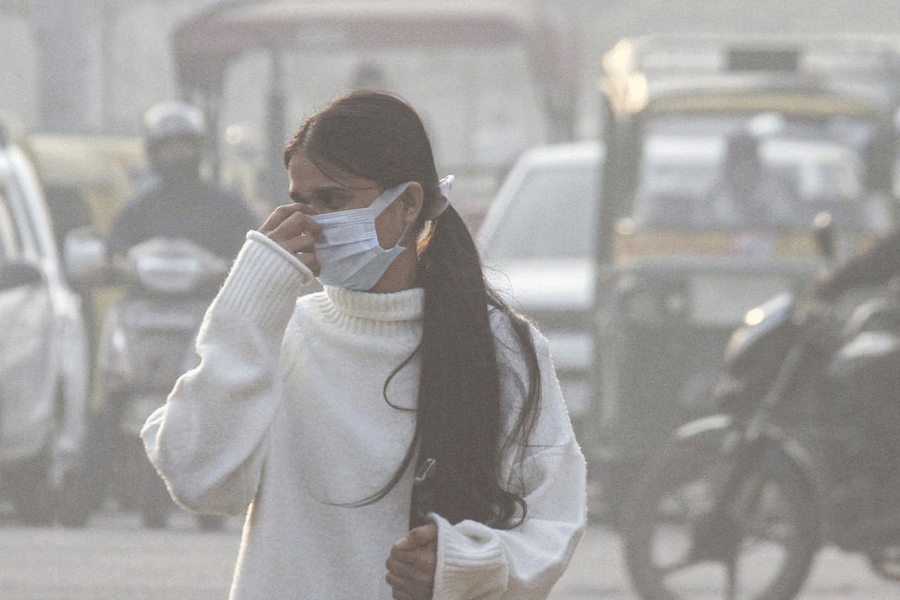
The latest global air quality assessment reveals a troubling, yet familiar, picture. India is the sixth-most polluted country in the world, with Loni in Uttar Pradesh being the most polluted city globally, according to the 2025 World Air Quality Report that was released by IQAir, a Swiss air quality technology company, which analysed data from 9,446 cities across 143 countries. Even though India’s particulate matter (PM2.5) concentrations were at a three-year low — at 48.9 µg/m³, it is a 3% decrease and a 10% decline from the corresponding numbers for 2024 and 2023, respectively — it still ranked sixth in the index. Incidentally, the World Health Organization recommends an annual average PM2.5 level of no more than 5 µg/m³ as protection against severe health risks. However, a vast majority of Indian cities continue to exceed safe PM2.5 thresholds. Delhi remained the world’s most polluted capital for the eighth year in a row while 17 of the world’s 20 most polluted cities are in Central and South Asia. A combination of factors — transgressions — such as unchecked industrial emissions,
vehicular pollution, construction dust as well as seasonal phenomenon like crop burning and temperature inversions is responsible for the worsening standards.
Even where there appears to be relative improvement, the data demand caution. Calcutta, often perceived as less polluted than Delhi, ranked 49th among 259 Indian cities in the AQI standings, exceeding the WHO guidelines by more than 10 times. And it is not just India’s metropolises that bear the brunt of urbanisation-induced pollution spikes. The report notes that suburban areas around Calcutta, like Madhyamgram, Rishra, Barrackpore, and Howrah, have high PM2.5 levels too. India’s response to this challenge has largely been reactive and fragmented. The Centre’s flagship National Clean Air Programme, for instance, continues to be limited in its scope: it covers only a fraction of polluted cities and more than 60% of its funds are directed toward road dust reduction. Structural impediments — vehicular emissions, industrial output, coal dependence, and agricultural burning — remain inadequately addressed. Emergency measures in cities, like school closures or construction bans, are episodic optics. To do better, India must shift from crisis management to systemic reform. Pollution control must be regionally coordinated and urban planning must integrate air quality considerations. Reliable monitoring and transparency in data can end up boosting both policy and behavioural change.