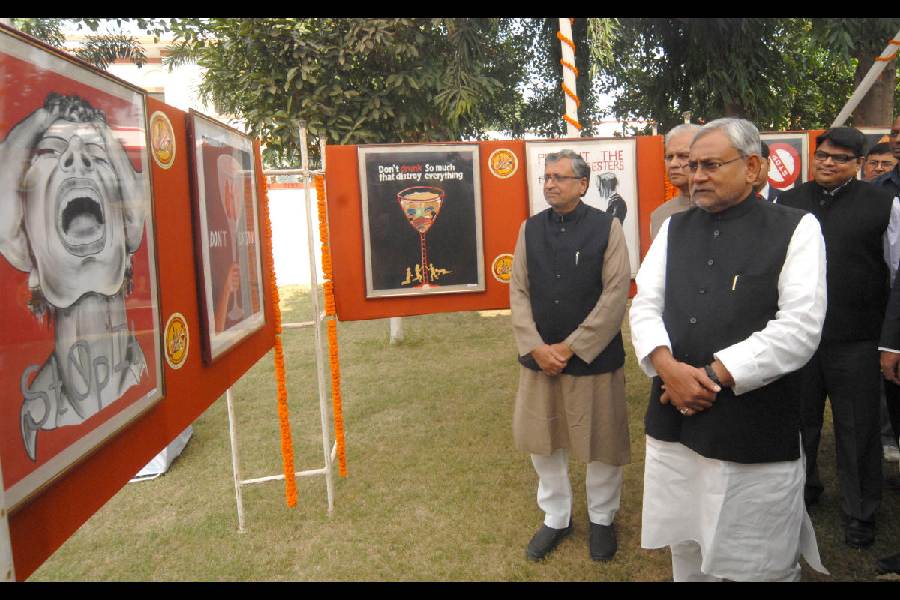
Ten years ago, Bihar embarked on an ambitious and morally-charged experiment — complete prohibition. Conceived as a transformative social reform aimed at curbing alcohol abuse, empowering women, and fostering public health, the policy was hailed as a bold assertion of political will. Ten years on, however, the moment calls less for celebration and more for introspection.
The origins of this policy lie in the political churn of 2015 when the then chief minister, Nitish Kumar, responding to sustained demands from women’s groups, pledged to enforce a complete ban on alcohol if returned to power. True to his word, the government implemented prohibition in phases — initially on April 1, 2016, followed by a comprehensive ban on April 5.
The policy marked a dramatic turn in the state’s fiscal health. In 2005, Bihar’s budget stood at a modest Rs 27,000 crore, with limited revenue streams. To augment income, the government had expanded liquor retail aggressively. The number of liquor outlets rose from 3,436 in 2006-07 to 5,467 in 2012-13, with rural areas witnessing an increase of over 200%. Consequently, excise revenue surged from Rs 500 crore in 2006 to nearly Rs 6,000 crore by 2015.
Prohibition came at a steep economic cost. In 2015–16, Bihar earned Rs 3,142 crore from excise duties. Within a year of the ban, this plummeted to a mere Rs 46 crore, and by 2017-18, it was virtually nil.
Legally, the Bihar Prohibition and Excise Act was among the most stringent in the country. Early provisions included collective fines and even the arrest of all adult family members in a household where alcohol was found. Over time, however, the law underwent three amendments, softening its harshest edges. First-time offenders can now be released upon paying fines ranging from Rs 2,000 to Rs 5,000.
Yet, illicit trade has flourished. The persistence of bootlegging networks and recurrent tragedies involving spurious liquor underscore a critical failure of enforcement.
Equally concerning is the shift in patterns of substance abuse. A 2017 pilot study conducted by a team of doctors revealed that over 25% of habitual drinkers turned to alternatives such as toddy, cannabis, and hashish following the ban. Data from the Narcotics Control Bureau corroborate this trend. Seizures of cannabis in Bihar rose dramatically from 14 kilogrammes in 2015 to 10,800 kg in 2016, and further to 27,395 kg by 2021 — an increase of nearly 2,700%.
The state’s response to rehabilitation has been, at best, modest. Plans to establish de-addiction centres across all 38 districts, each with a capacity of 10 beds, have amounted to a total of just 380 beds. From a social standpoint, the results are equally ambiguous. One of the principal objectives of prohibition was to reduce domestic violence and improve women’s safety. Yet, data offer little evidence of substantive progress. The proportion of women experiencing domestic violence rose marginally, from 40.2% in 2015–16 to 40.6% in 2019–20. Reported crimes against women also increased from 13,891 cases in 2015 to 17,950 in 2021. These trends underscore a crucial point: deep-rooted social issues cannot be resolved through a singular legislative intervention. Moreover, prohibition has had a disproportionate economic impact on marginalised communities. Sections such as the Mahadalits, who were traditionally engaged in the production of local liquor, lost a vital source of livelihood. Instead of integrating these groups into alternative economic frameworks, the policy inadvertently pushed them further to the margins.
Estimates suggest that nearly 17% of men (NFHS-5 data) in Bihar continue to consume alcohol. This disconnect between policy intent and ground reality reveals the inherent limitations of prohibition.
Abhinav Narayan Jha is an advocate and a columnist