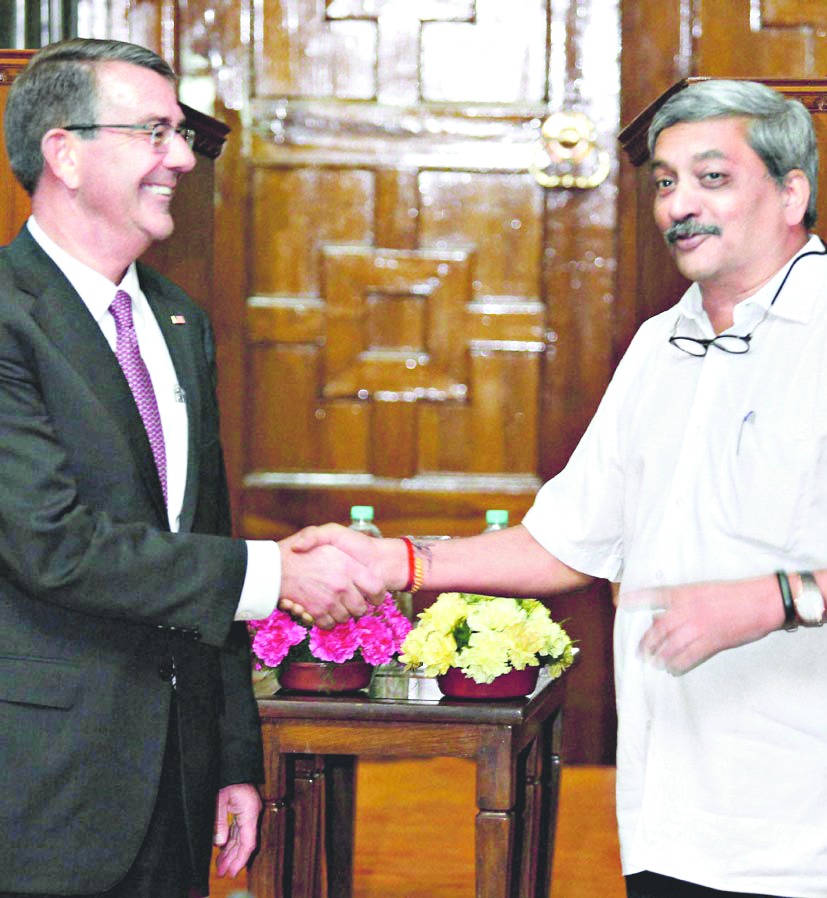

The US-India defence ties have taken another small step towards consolidation with the visit of the secretary of defence of the United States of America, Ashton Carter, to India. The two countries finally managed to agree "in principle" to a logistics agreement, which can now be finalized within weeks. It is expected to help the two militaries coordinate better, including in exercises, and also allow the US to sell fuel or provide spare parts to Indians more easily. A second pact to improve the sharing of information on commercial shipping in a move to beef up security on the seas is also close to realization. There has been, however, no real progress on the joint development of jet engines and aircraft-carrier technologies.
These are good times for US-India defence ties. Carter himself has had a long standing interest in India and in strengthening Indo-US ties. This was his third visit to India since assuming office in 2015. He was a strong supporter of the US-India nuclear deal and as deputy-secretary of defence in 2012 he was the principal architect of the Defense Technology and Trade Initiative to help the flow of advanced American technology to India. This was a key Indian priority strongly resisted by Washington's defence bureaucracy. He has taken this forward with the setting up of the India Rapid Reaction Cell, the only country-specific cell in the department of defence, as part of the DTTI to fast-forward India-related acquisition issues. Carter has emphasized Pentagon's "decision to change its mindset regarding technology transfer to India from a culture of 'presumptive no' to one of 'presumptive yes' in the context of America's changing strategic priorities in the Indo-Pacific."
Carter had come to India at a time when the US-India Defence Technology and Partnership Act was being considered by the US Congress, which encourages the American president "to coordinate with India on an annual basis to develop military contingency plans for addressing threats to mutual security interests of both countries". It also calls for the development of "strategic operational capabilities" that will give the two states "the ability to execute military operations of mutual security interest while sustaining minimal damages and casualties, through the use of military means, possessed in sufficient quantity, including weapons, command, control, communication, intelligence, surveillance, and reconnaissance capabilities." Today, India is interested in co-development opportunities than in simply buying American weapons, especially with the government pushing its 'Make in India' initiative.
Many in India worry that the US wants to make the former a junior partner in its regional alliance network. But Carter has given clear indications that he understands Indian concerns. He has been explicit that India was not likely to be an exclusive partner of the US as he suggested, "Indians are, like many others, also proud. So they want to do things independently. They want to do things their own way. They don't want to do things just with us. They want to do things with all that's fine. So we're not looking for anything exclusive. But we are looking for as close a relationship and a stronger relationship as we can because it's geopolitically grounded."
This geopolitical grounding is provided by the rise of China and all that this means for Indian strategic interests. India reached out to China with the national security advisor and the defence minister both visiting the country in recent weeks. But China has shown no signs that it is willing to change or even moderate its anti-India posture. Insisting that designation of any individual as terrorist by the United Nations is a "serious issue", China blocked the UN from banning the Jaish-e-Mohammad chief and the mastermind of the terror strike at Pathankot, Masood Azhar, by the global body.
To counter the China challenge, the US wants a "network" of countries with "shared values, habits of cooperation, and compatible and complementary capabilities", which will expand the strategic reach of the participating countries, enable them to pool their resources to share the security burden, and, thereby, "help ensure the peace and stability in the region for years to come". New Delhi need not become a part of this network but it needs to articulate the need for a new security architecture in Asia that can successfully take on the challenge posed by a rising and aggressive China.
India and the US have been striving to conclude a series of "foundational" agreements for years now and under the United Progressive Alliance, even the least controversial Logistics Support Agreement could not move forward as the then defence minister, A.K. Antony, under the influence of the Left parties, became convinced about America's dubious motives in pushing it through. With the declaration that the LSA has been finalized, the two nations can now move forward with some confidence about the future of US-India defence ties.
India is in the big league today and so should start thinking big. The old third world rhetoric doesn't do justice to Indian global aspirations. The Narendra Modi government is gradually shedding Indian strategic diffidence but it needs to move faster if India is to avail of the opportunities that present themselves today.
The author is professor of international relations, Department of Defence Studies, King's College, London