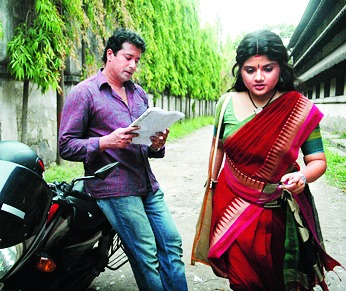

Those who steer clear of the murky yet mesmerizing world of Bengali television serials, but are subjected to this slow and relentless torture everyday of their lives because they are the lifeline of other family members, will have noticed that, of late, certain characters or even the entire cast in these everlasting soaps, who supposedly belong either to times past or places far away from civilization, speak in a certain dialect that jars on our ears used to hearing the standardized " pramita bhasha" popularized by the Tagore family. The Bengali that middle-class Bengalis speak and write (if ever they do) today is a variation of the argot of Krishnagar in Nadia district.
However, there is nothing new about this Bengali serial patois being heard with greater frequency these days. All of us who live in Bengal, in whatever station of life we may be, have heard this dialect that has a character of its own, and although the vocabulary is almost the same, what makes a world of difference is the enunciation and delivery that to our refined ears may be equivalent to butchering the language. We may react to this aural assault in the same way Professor Higgins did when he encountered Eliza Doolittle prattling away in cockney, and dropping her aiches without any compunction.
All of us have certainly heard this Bengali "below stairs", as they used to say at a time when this was the place designated for the servants. For this is not the language of genteel folk. It is a rustic cant, a working class lingo. Once the "Bangals" - one-time residents of "Purba Banga" or East Bengal - used to pull the leg of the "Ghotis" or West Bengal indigenes for the supposedly laughable way they mouthed words like " luchi" and "lebu". Ghotis replaced the "l" with "n" - the fried, radiantly white, puffed-up flour bread, considered a flower of Bengali cuisine, became " nuchi", and the Bengali word for lime transmogrified into "nebu". Ghotis took it out on Bangals by creating stock comic characters in jatras, plays and films who mouthed the myriad dialects of the East. The actor, Bhanu Bandyopadhyay, personified Bangal bhasha.
But this is a matter of class. The patter heard in Bengali soaps is coarse and provincial, something that culture-mad Bengalis would reject without even thinking. But defying the barriers of class, caste and geography, this has become the lingua franca of the zamindar, the unlettered matriarch in a modern joint family, Sundarbans villagers, and even the upcountry courtesan in certain serials, although few get the accent right.
David McCutchion, a Scotsman who used to teach Comparative Literature at Jadavpur University and is remembered for his extensive photographic documentation of terracotta temples in Bengal villages, had once aptly described urban baul performances as "Ballygunjian". One could say the same about the way this Bengali serial lingo is articulated. What we hear comes close to plebeian patter, but not quite. How can actors, mostly city dwellers, help not twisting their tongues when they try to grasp this unfamiliar dialect? It sounds even more unconvincing because the exaggerated body language that goes with it is absent. Actors with the necessary mimetic talent are scarce today.
But why did the producers of these serials introduce this dialect in the first place? Probably to increase the audience base as much as possible. For the higher the TRP of a Bengali serial, the longer it lasts, and this demotic drivel is the easiest way of achieving that goal.