Is it appropriate to claim that the Islamic traditions that have evolved historically in the Indian context are inseparable elements of what is now officially described as the Indian knowledge systems?
One finds two very interesting positions on this seemingly modest question.
For the adherents of Ganga-Jamuna tehzeeb, Indian knowledge systems embody an India-specific, syncretic culture that has assimilated Islamic traditions, resulting in a composite and inclusive repository of knowledge. This ‘Nehruvian line’ has endured over the years. Indeed, the notion of composite nationalism has been one of the decisive factors shaping Indian cultural policy after Independence.
Despite representing a constructive official approach to define Indian knowledge systems in a pluralistic manner, syncretic nationalism has not been able to shed its elitist leanings. Take, for example, the representation of the Taj Mahal. This building is memorialised as a symbol of India not only to celebrate Shah Jahan’s love for his queen, Mumtaz Mahal, but also to underline the creative fusion between Islamic principles and Indian artistic sensibilities. This trouble-free and uncomplicated argument suits the English-dominated, elite, secular discourse. ‘Islamic traditions’, in this schema, are intentionally linked to Mughal rule to produce a highly superficial, elitist, and shallow model of national unity.
There is also the well-known ‘Islamic invasion thesis’ that relies on an essential distinction between the Indian and the Islamic world views to assert that Islamic rule in medieval South Asia disrupted the natural progression of Indian knowledge systems and disabled them completely. One can trace the origin of this overtly communal thesis to colonial India. Various versions of the two-nation theory were the outcome of this popular belief that eventually led to the Partition.
This argument has found a new afterlife in recent decades. There is a growing desire to decolonise the ‘Indian mind’ and reclaim authentically Indian modes of knowledge production. From this perspective, Indian Islamic traditions are often interpreted as symbols of slavery and subjugation. Consequently, an unwritten norm has emerged that tends to ignore and gradually render Muslim contributions to the Indian knowledge apparatus invisible. At the same time, one also encounters a more radical proposition: Islamic traditions can be considered Indian only if they are sufficiently ‘Indianised’.
I find these two mutually exclusive positions — elite secularism and rigid nationalism—to be both inadequate and analytically weak. Yet, their failure does not invalidate the underlying question. In today’s transformed and polarised political climate, it is understandable that a layperson might feel apprehensive about how Islam is positioned within the prevailing conceptions of Indian knowledge systems. Interestingly, the English-dominated public discourse does not address anxieties of this kind. On the contrary, intellectuals and activists writing in Indian languages tend to be more sympathetic to these commonsensical concerns.
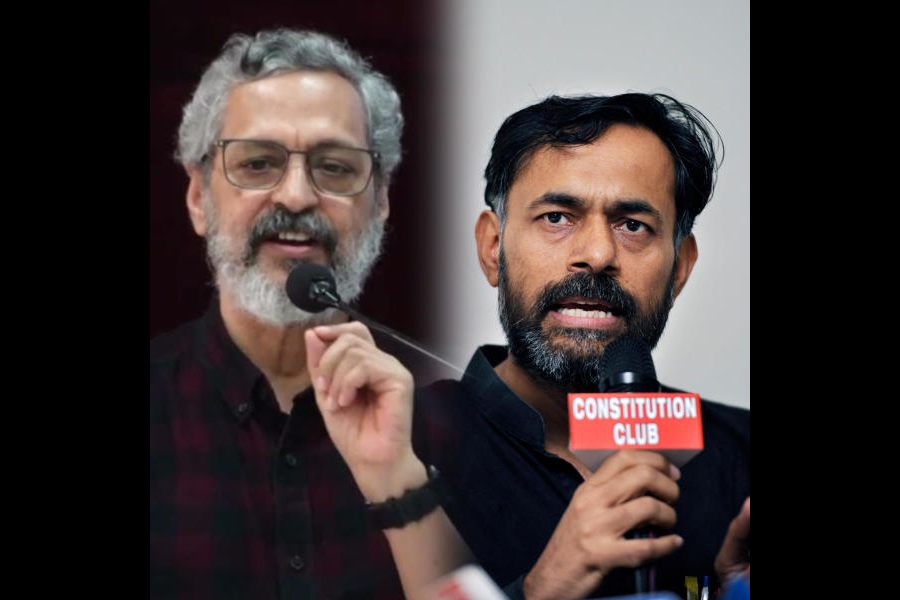
I draw on two recent examples to outline an alternative conception of Indian knowledge and the place of Islamic tradition within it. Manindra Nath Thakur’s Hindi book, Gyan ki Rajniti (2022), dismantles the dominant conceptions about Indian knowledge systems. Thakur distinguishes between Indian and Hindu knowledge. While recognising the contributions of Hindu philosophy, he rejects the claim that India’s past is defined solely by Hindu religious categories. The book traces the diverse intellectual resources that, over centuries, have shaped a uniquely Indian tradition of critical inquiry.
Thakur highlights the significance of intellectual negotiation — an India-specific trajectory to produce knowledge. In his view, “dialogues between philosophies, dialogues between intellectuals and the common people, dialogues between folk tradition and classical tradition, dialogues between the West and the East, dialogues between cultures, dialogues between different religions” can help us understand Indian knowledge systems in its multifaceted entirety. He conceptualises dialogue as a pursuit of truth — an effort to transition from non-knowledge (avidya) to knowledge (vidya). He further contends that the ultimate aim of vidya is the realisation of the most desirable human attribute: emancipation.
Yogendra Yadav’s book, Ganarajya ka Swadharm (2026), advances a similar line of argument in developing a new politics of Indian knowledge. Emphasising India as a ganarajya (republic), Yadav argues that the public is not merely a collection of individuals but a community of equals. This community evolves its own norms — its distinct dharma — which are upheld through the cultivation of civic virtues in a historical manner. The people enforce these norms by holding rulers accountable. Thus, the people are not only the source of power but also a check on it. Hence, the ganarajya can be understood as a confluence of Bharatvarsha, Hindustan, and India. Within this framework, Yadav outlines four sutras of India’s swadharm: maitri, karuna, vinay, and deshachar.
He argues that these virtues have endured historically in India. Maitri, or friendship, is reflected in the medieval notion of Sulah-i-kul and the Gandhian ideal of Sarva Dharma Sambhava. Karuna signifies compassion toward the marginalised communities; ideas such as Raham in Sufi traditions and the assertion of Samata during the anti-colonial struggle extend its scope. Vinay, characterised by modesty, has been enriched over time by related ideas such as adal (justice) and, more recently, loktantra (democracy). The final virtue, deshachar, refers to the respect for and the observance of righteous traditions in order to maintain societal harmony. Yadav argues that Indian federalism (sanghvaad) embodies this political virtue.
Broadly speaking, Thakur and Yadav take us beyond the fashionable debate on the ‘idea of India’. They conceptualise Indian knowledge systems as the ever-evolving result of a dialogue that is not restricted to the elite domains of pandits, maulavis, and modern academics. Their argument is straightforward: seeking exclusively Hindu or Islamic forms of knowledge becomes redundant once the emancipatory potential of Indian knowledge is embraced as a shared national virtue.
Hilal Ahmed is a political scientist and an author. Views are personal