
On July 29, which was Global Tiger Day - as well as Day One of the exhibition organized jointly by the Society for Heritage and Ecological Researches, the Association for Conservation and Tourism and the Indian Museum - there was body art by Sanatan Dinda and Bagh Nritya from Odisha. The exhibition space, the Ashutosh Birth Centenary Hall of the museum, was abuzz with children making origami and clay tigers under the guidance of the museum staff, and a panel discussion on conservation.
On the ensuing days - till August 7 - none of the events was repeated, and the room was so bare and silent that one could not help but wonder why this was all that was on offer at a show titled The Tiger: Timeless Treasures from Indian Museum. The aim may have been to make the exhibition live and interactive, not just a dull show of objects in glass cases. But a substantial display is still necessary for it to be called an exhibition.
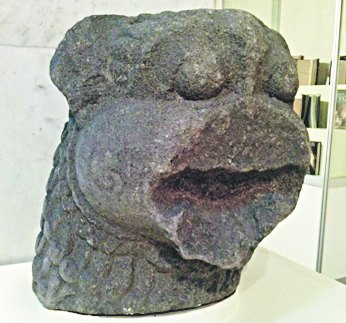
What we got instead were a few data sheets and photographs, books on the tiger in a display cabinet. There were four stone sculptures, or rather, fragments belonging to the 10th and 12th centuries AD, from Java and Bihar, two paper pulp folk dance masks from Malda and Odisha and a tiny toy tiger made of cow dung.
Museum officials explained that other examples of art involving tigers in the museum collection (such as paintings) were considered inappropriate for a celebration because they all depicted tigers hunting or being hunted. But then what is one to make of the Kumaragupta gold coin showing the slaying of a tiger that was on display?
Instead of forcing an "open debate" regarding sardulas, the museum could have explored the whole issue of the yali or vayala, since one of the stone images depicts a gaja on a vayala, and the Indian chimera which decorate several temples and stupas, combining the features of a lion or tiger with those of a horse, elephant or bird to create creatures of great power. The museum could also have concentrated on how the kirtimukha was morphed onto the big cats to create a ferocious face with protruding eyeballs, stout horns, long teeth and a mouth open in a roar.
But nothing beats the exhibition catalogue, which boldly states, "In ancient Indus Valley Civilisation, the supreme goddess Durga, is always depicted riding a tiger [ sic]." The scholar, Shibani Bose, during her recent research on animals, including tigers, in ancient India failed to find a Devi Durga in Harappa, but she said that "the tiger enjoyed a prominence in its own right", many seals depict tigers and in the so-called "Pashupati seal" the tiger is the only one displaying emotion as it snarls, leading to speculations about the lost tiger tales of Harappa.