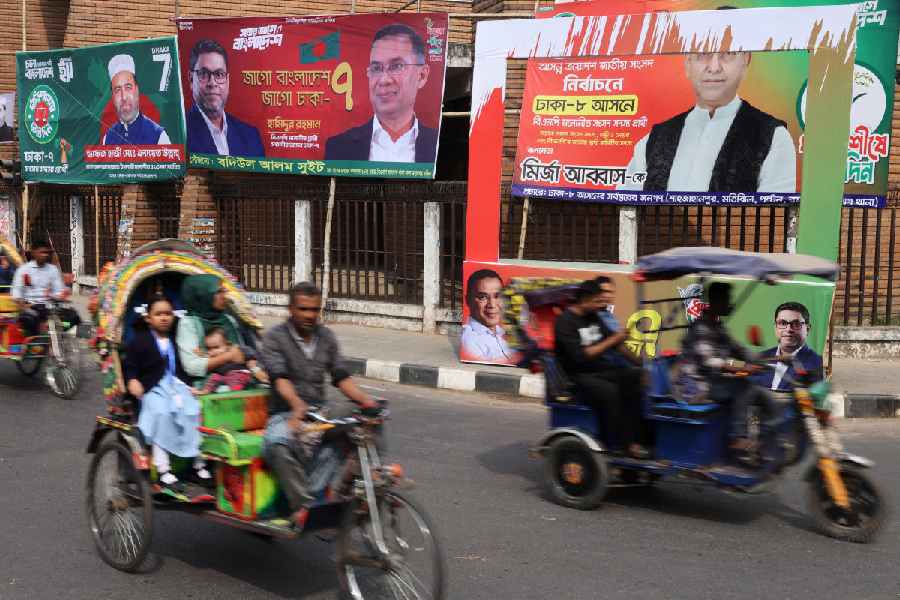
Bangladesh’s election scheduled for tomorrow is of more than usual significance. It should, hopefully, mark the end of the interregnum that has characterised Bangladesh since the ‘Monsoon Revolution’ of July-August 2024. The hybrid that governed Bangladesh will be replaced by an elected government more in line with the country’s Constitution. Underlying the fact that the past one and a half years have marked a radical transition, there is also a referendum, alongside the election, with regard to key constitutional changes aimed at preventing the ‘excesses’ that marked the tenures of earlier Awami League governments. Although the electoral battle and speculation about the outcome are of paramount importance, the issues underwriting the referendum will dominate Bangladesh after the elections.
This election is the first in over three decades without either of Bangladesh’s formidable woman leaders — Begum Khaleda Zia and Sheikh Hasina. The former is dead and the latter is in exile, debarred from contesting, facing a death sentence for ‘crimes against humanity’, with her party, the Awami League, banned. The principal axis of contestation in this election is, therefore, between two fronts headed, respectively, by the Bangladesh Nationalist Party now led by Tarique Rahman, Khaleda Zia’s son and heir, and the Jamaat-e-Islami. The latter is strengthened now by its alliance with the National Citizen Party — made up of the student protagonists in the insurrection that swept away Sheikh Hasina and her party in August 2024.
In elections since 2008, when the Awami League was in power, the BNP and the Jamaat had not contested or had been legally barred from doing so. The present rivalry is novel because they are past allies of some standing. But history alone is not always a good guide. Since the Awami League’s overthrow in 2024, the Jamaat’s presence has grown and it is a major force in this election. Despite its strong, cadre-based organisation, it was never regarded as a major factor in electoral terms. This has also been the historical experience of the Jamaat in Pakistan — Islamist parties can mobilise strongly on specific issues but they rarely do well in multi-issue electoral contests. The expectation this time around is that the Jamaat’s performance will improve significantly; it will be a beneficiary of the deep resentments against the Awami League.
The Jamaat’s role in 1971 remains etched strongly in our memory, particularly its role in targeting minorities. These issues remain, and in general the strengthening of Islamist forces in Bangladesh fills India with concern. It suggests a structural shift with manifestations such as the surfacing with greater intensity of anti-India sentiments, a dilution of the linguistic and the cultural nationalism that had led to the emergence of Bangladesh in 1971, and a greater openness and proximity to Pakistan.
In these circumstances, a straightforward BNP victory would be the optimum outcome for India. But a wider look at Bangladesh and its evolution is necessary instead of relying on perspectives derived from simplistic binaries. Notwithstanding the positive sentiments that 1971 still evokes in India, it is necessary to avoid too excessive a reliance on that narrative alone and the fault lines that produced it. Viewing events in Bangladesh through a half-century-old prism or simply as a zero-sum game
vis-à-vis Pakistan may only end in distorting perspectives and muddy judgement calls.
The obvious point is that Islam had informed a very significant part of Bengal’s identity even before the emergence of the idea of Pakistan or Muslim separatism. By some criteria, Bengali Muslims — together in East and West Bengal — comprise Islam’s second-largest linguistic ethnic group, second only to the Arabs. In our readings of history, this fundamental reality often gets obscured. Thus, in the milestones of modern Bengal and Indian history, such as the Young Bengal Movement, the Bengal Renaissance of the later 19th century, or even the Swadeshi Movement of the early 20th century, the fact of Bengal having such a significant Islamic identity is often overlooked.
To see the assertion of an Islamic identity as identical to support for Pakistan would be erroneous. To assert this is not to deny the dangers that a potential Pakistani ingress into Bangladesh’s ruling structures poses for us.
Bangladesh’s geopolitical location and the long border with India make it the most vital of our neighbourhood relationships. Our eastern borders are far more complex than those on our West. The crystallisation of an adversarial relationship with Bangladesh would be the worst of different possible outcomes.
Avoiding that outcome means avoiding the trap of the self-fulfilling prophecy with regard to Islamists and anti-Indian forces. If we imagine only the worst, then it will almost certainly happen. By the same token, we should avoid steps that encourage or create a joint platform for Bangladesh and Pakistan — the ICC Men’s T20 World Cup being a case in point.
Understanding the complexities of this vital neighbour means for a start being open to the outcomes of the forthcoming election and, then, being clinical in dealing with whatever combination emerges from it. It may also be of use to resist measuring future governments using the Awami League’s long tenure as a kind of litmus test. A well-established principle of neighbourhood diplomacy has to be kept in mind: to create good options and choices for the future, we should be prepared to make initial choices from a menu of only bad options.
Both in neighbouring Myanmar and in Afghanistan, we have chosen from such menus and are perhaps consequently managing their complexities more effectively. These cases are hardly similar to the situation in Bangladesh but the principle is much the same. The point is to accept that politics and geopolitics do not remain static in our neighbourhood. Clinically dealing with unfavourable outcomes or less than favourable outcomes is part of the package. How successful we will be will finally depend also on how much and to what extent we can insulate our external policy from our domestic politics.
T.C.A. Raghavan is a former Indian High Commissioner to Pakistan and Singapore