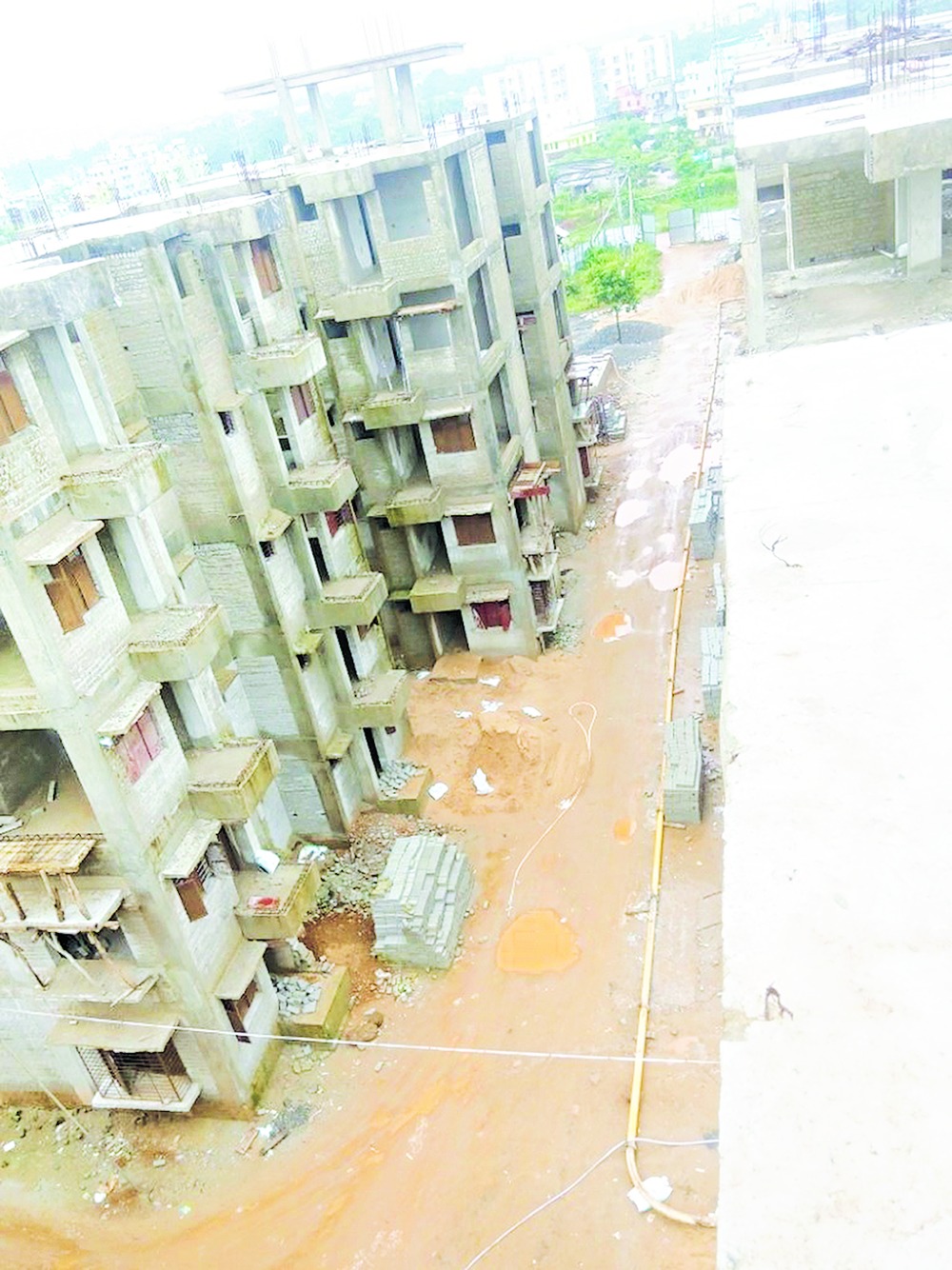


Bhubaneswar, May 9: The low-cost housing project for urban poor under the Rajiv Awas Yojana developed at Rangamatia here is set to become a model for other projects across India for its innovative method of water conservation.
Termed as a zero water discharge housing complex, the Bhubaneswar Municipal Corporation's project at Rangamatia bagged the Hudco Design Award-2015 during the 46th foundation day of housing and urban development corporation limited (Hudco) in New Delhi on April 25.
Architect and consultant associate of the project Tara Prasad Dhal of The Design Group received the award. Mayor Ananta Narayan Jena felicitated him for his innovative project last Saturday.
The Rs 49-crore project is nearing completion and will be handed over to the government in two months, said the architect.
The cluster of five-storey structures, spread over five acres, will have 600 dwelling units in 30 blocks and house nearly 3,000 dwellers. The project will have shopping and community centres, open space and internal roads. Internal infrastructures such as water supply, street lights, transformer and wastewater treatment plants are also part of the project.
However, the major thrust of the project is not only water conservation, but also reduction in water demand. In the complex, the total use of water is divided into two parts - consumption and non-consumption. Consumption includes cooking, drinking, washbasin and bathing, while non-consumption includes flushing, vehicle washing and irrigation.
"The project has neutralised potable consumption of water by rainwater harvesting, and it has further reduced the demand by recycling. The daily water demand of the complex would be 400 kilolitres, while we will supply 200 kilolitres. The used 200 kilolitres of water will be recycled and again utilised," said Dhal.
The complex houses three wastewater treatment plants with the capacity of 110 kilolitres per day (KLD), 100KLD and 90KLD, respectively. An amount of 100KLD water will be recycled and converted for consumption. Around 100KLD water will be used as sub-soil percolation to water plants.
The architect said his team came up with smart solutions in optimising the cost of backfilling (to refill an excavated area). "The wastewater, after treatment, will be allowed to run through sub-soil recharging pits made on the body of the drains, which will finally end at a nearby mango forest and other garden plants in the complex itself," he said.
Jena said the civic body was making all efforts to promote rainwater harvesting in the city buildings, and this project would prove to be an example for others to adopt the water conservation techniques. "Water conservation should be a major concern for all urban planners as the entire country is reeling from acute water shortage. This is a great initiative in the city," said the mayor. The project has come up under the central housing scheme, in which the state government has also a share.