|
 |
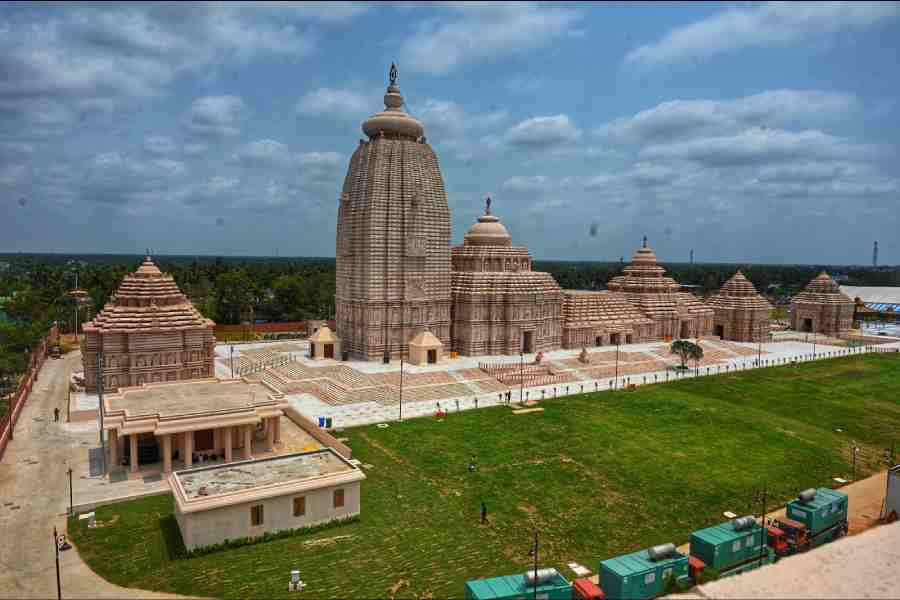
| The ancient temple of Lord Vishnu adjacent to Ananta Vasudev temple in Bhubaneswar. Pictures by Sanjib Mukherjee |
Bhubaneswar, Nov. 15: The devotion of an unknown Ganga dynasty ruler led to the construction of the massive Vishnu temple situated adjacent to the famous Ananta Vasudev temple across the Bindusagar tank in the city.
Today, almost 900 years since it was built, the temple endures a sad fate. The 12th Century monument has been turned into a storehouse.
With a 75-foot elevation, only the dome of the temple is visible to someone standing on Talabazar road. Shops selling prasad crowd the entrance while the main door of the sanctum, which is devoid of a deity, is usually locked.
Goods used in preparation of food offered to Lord Ananta Vasudev, such as grains and pulses as well as clay pots, are usually stored in the sanctum by the priests of Ananda Bazar, situated behind the Vishnu temple.
“Since my childhood, I have never seen a deity here. It has been used a storeroom for a long time. But we try our best to keep the surrounding areas clean,” said Prafulla, a young priest. “We also worship the idols of Parswadevatas (deities seated outside the sanctum),” he said.
An idol of Lord Ram still exists on the wall on the left to the sanctum’s entrance. Similarly, another unique idol, which local residents believe is Lord Ganesh, is situated on the right wall of the Vishnu temple.
Both these stone sculptures are distinctive for the pose and form of the deities and have not been seen in other Kalingan temples.
However, the idol of Lord Ram lies in a broken condition. Though overall the structure is fairly preserved and its surroundings clean, the walls constructed few years ago around it and the pots and bricks piled near the temple threaten its conservation. Also, many parts of the structure, especially the dome, have acquired a growth of wild grasses that need to be cleared.
“The temple was repaired and cleaned few years ago. Overall, the condition of the temple is good since it was built with fine quality sandstone. But since it is used as a storehouse by priests, extra care needs to be taken to look after its preservation,” said a curator at the state archaeology department.
Archaeologists believe that the temple was constructed during the later phase of temple building in Odisha and hence needs to be protected with its individual identity. According to archaeologist B.K. Rath, urban pressures could lead to deterioration of the ancient structure.