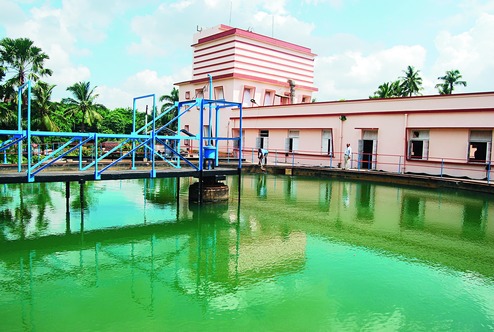


Bhubaneswar, June 11: The Public Health Engineering Organisation (Pheo) will use chlorine dioxide to disinfect potable water in an attempt to supply safe drinking water to city households.
Using chlorine dioxide will treat the problems of odour, iron and other organic and bacteriological impurities present in water. Earlier, Pheo used simple chlorine for the same purpose.
The decision came on the back of an initiative to avoid the spread of water-borne diseases, including jaundice, which has affected residents in the past. More than 50 people were affected by the disease at Jharana Sahi last year. The year 2015 witnessed a similar situation when the disease spread at the CRPF camp here.
Officials said an experiment using chlorine dioxide to disinfect water revealed that 5 per cent of the substance was an effective disinfecting tool in the potable water supply system. Pheo had undertaken this experiment with SVS Aqua Technology, its technical partner.
"We conducted an experiment with chlorine dioxide through a 100kg cylinder, which revealed these figures. We found that the earlier method of injecting chlorine gas was dangerous since there was the threat of leakage, which could have become hazardous," Pheo's superintending engineer C.R. Jena told The Telegraph.
He said their aim was to avoid contamination of water during supply.
Jena also said the United States Environmental Protection Agency had already declared chlorine dioxide as the best germicide. The declaration came after experiments revealed its efficacy against most water-borne pathogens without producing disinfectants as by-products. At present, chlorine dioxide is manufactured in Pune and it is a non-Chinese product.
A Pheo official said the pipelines were a haven for bacteria and micro-organisms.
"Purified water passes through these pipelines, creating a fear that microbiological activities could re-infect the water. Many protozoa and bacterial colonies are hidden behind this, away from the reach of disinfectants such as chlorine," Jena said.
Chlorine dioxide kills all water-borne micro-organisms, including bacteria, virus, yeast, fungus, mould, spores, protozoa, cryptosporidium and cysts, Jena said.
"Chlorine dioxide has been recognised as a replacement for chlorine and chlorine-type disinfectants. We will include chlorine dioxide in the approved list of disinfectants and begin using it extensively across the city," the Pheo official said.
Environmentalists also welcomed the move to take a dynamic approach to disinfect drinking water.
"It is a good move to use chlorine dioxide as an disinfectant. However, it will ensure safe supply of water to households only after contamination through leakages is plugged. There should be efforts to plug the holes in supply lines," said environmentalist Alok Mohanty.