Bhubaneswar is one of the planned new towns in the post-Independence period. German architect-planner Dr Otto Heinrich Koenigsberger prepared the city’s first master plan in 1948, drawn on neighbourhood principles, for a population of 40,000. Over 60 years since its making, the city remains a notable paradigm of modern town planning and architecture in India. But how has the 1950s’ town planning and architecture been understood and accepted by its inhabitants? Bhubaneswar was a varied appearance, from what was originally envisioned, to what was built, to what it has become today.
Such an assessment is particularly relevant because the city, in many ways, appears to be little more than an abandoned remains of a bygone era. Once laden with the vision of the then Prime Minister Jawaharlal Nehru — “the new capital of Odisha would not be a city of big buildings for officers and rich men without relation to common masses. It would accord with idea of reducing differences between the rich and poor. The new capital would embody the beautiful art of Odisha, and it would be a place for beauty…so that life might become an adjunct to beauty”. Koenigsberger also wanted Bhubaneswar to be a modern city. But both their visions remain incomplete. The city is experiencing rapid urbanisation and growth of slums (3.50 lakh population in 377 slums, 2009 slum survey). The urban population growth strains public services and infrastructure.
It is time to review the planning process and planner’s vision for the future growth of Bhubaneswar. The report submitted by Koenigsberger in the initial state of planning (1948) mentions the example of Tennessey valley where the authority schemes were developed and carried out with voluntary and active participation of the local people. To be successful, planning of the new capital of Odisha requires popular collaboration of a similar nature.
In his introductory notes, he said the plans of very few towns in India were laid out by experts from scratch. Odisha was fortunate to be able to build a new town specifically designed for the purpose of a capital to be equally convenient for functioning of the government and everyday life of its inhabitants.
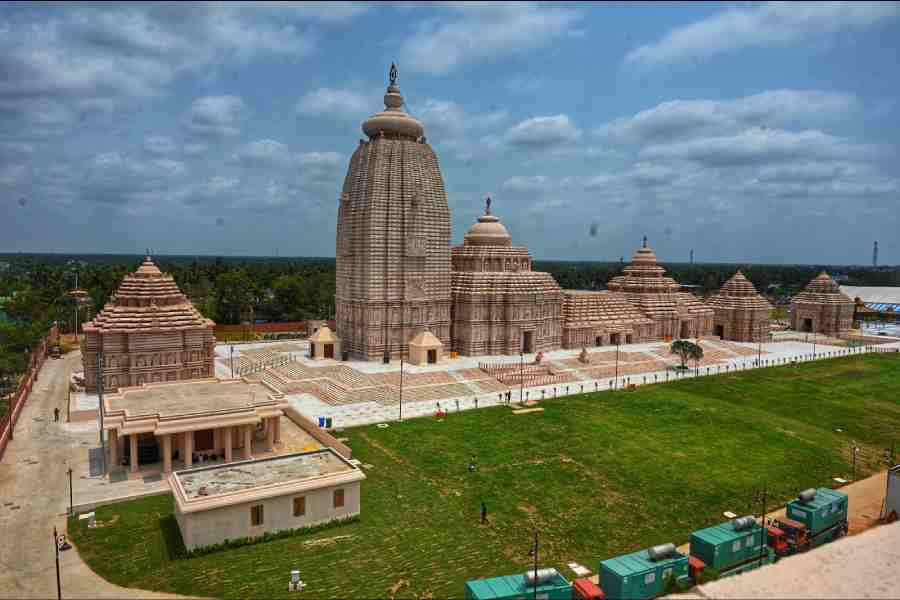
Architect Julius Lazras Vaz played an important role in shaping the skyline of Bhubaneswar. He designed most government buildings. Vaz adopted the Hindu style of architecture with some modifications to take advantage of modern methods of construction and to meet new social needs of the people.
However, Koenigsberger specified a few guiding principles and climatic design features essential for buildings in the city and suggested government buildings not be designed for air conditioning in the initial stage because the weather was agreeable enough. According to his guidelines, most government buildings would have impressive corridors, which were also intended to protect the walls of office rooms from direct sun rays.
Neighbourhood units were designed by Koenigsberger with the best amenities and facilities of urban life, with units placed at short distances to give people easy access to school, hospital and other amenities. He suggested seven types of roads — footpaths, parkways, cycle paths, minor housing streets, major housing streets, main roads and main arteries —for seven groups of users for seven different functions.
He hoped roundabouts, traffic lights and traffic policemen wouldn’t be so necessary in a well-designed, modern road system based on differentiation in road functions. The overall widths of land earmarked for roads and streets was not determined by traffic alone, but by requirements for storm water drainage services like overhead electric lines, telephone, water and the need of adequate light and air to adjoining houses. The overall width of land allotted for road purposes was, therefore, dependent on the height of houses on both sides.
An important consideration was space for avenue trees on roads and necessary provisions were made early in the land allotment scheme and in the estimates. For requirements other than traffic, the allotment of land even for the smallest housing street has been fixed at a minimum of 30 feet. Only about nine feet of these 30 was traffic, the rest for storm water drainage, avenue trees and services and to allow sufficient gap between two rows of houses for a fair share of the cooling sea breeze to every house. The proposed classification of roads of the new capital had no provision for shopping streets to avoid traffic congestion.
The last provision in the master plan called for a memorial for Mahatma Gandhi and that the major public life would centre on buildings around the Gandhi Memorial Pillar as the symbol of that unity of the citizens of India. However, this was not considered by the state government.
Today the dream city of Nehru is faced with problems of urbanisation, high population growth and development of slums. In the past few decades, the structural aspect of the town has been deteriorating. To address changing needs, the city requires more land. Koenigsberger had advised to supplement the master plan for the new capital by a regional development plan including the area from Puri and Khurda to Cuttack. He had said a good master plan for a new town must provide for unlimited expansion, but also organise the town in such a manner that it forms an organic and healthy structure at each stage of its development. Today, many changes have been made in the master plan. The Bhubaneswar Development Authority (BDA) planning and building regulation has also been changing. To accommodate the growing population, the BDA allowed construction of highrise residential and commercial buildings in the city. Many highrises are also constructed in the original master plan area.
The comprehensive development plan for Bhubaneswar Development Planned Area has been prepared by the department of architecture and regional planning, IIT, Kharagpur, in 2006 targeting 2030. To manage and organise the planning, development and control functions, development strategy for both new areas as well as for existing areas, have been integrated.
Care needs to be taken for the physical, infrastructure, city transport planning and environmental considerations of the entire region to prevent haphazard growth and squatter settlements. Open spaces, parks, recreational areas, green belts and plantation should be properly organised in the region to provide environmental functions such as control of microclimate, control of environmental pollution and beautification of the region. This will help in making the city comfortable, safe and enjoyable.
Proper zonal development plans will control population density in the whole region. At the same time, more public participation and consensus for its effective implementation will be meaningful to make it the most beautiful capital city.