
Bhubaneswar, Jan. 3: The trend of holding ticketed theatre shows is slowly catching up here, a concept very common in the West.
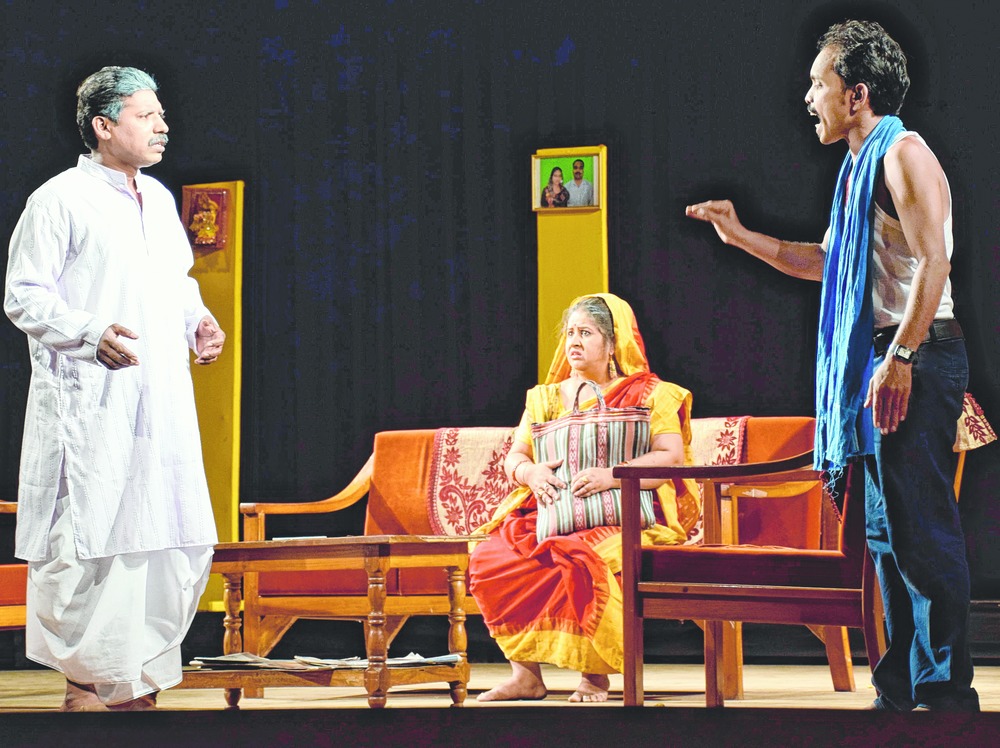
Recently, Abhinna Routray's theatre group Uttar Purush staged Adhe Adhure at Rabindra Mandap and charged the audience Rs 50.
Uttar Purush's play Adhe Adhure, a 1969 drama written by Mohan Rakesh, is one of those plays that are significant event today. The story, which portrays a middle-class family that is about to disintegrate because of the differences among its members, was staged in Odia.
Despite being a ticketed show, the play conducted simultaneously for two days managed to gather crowd in large numbers.
"If theatre groups from outside the state or country stage their shows, people would watch them. It is sad that the same audience refuse to shell out the money for local productions," said Routray.
Many local productions, therefore, have to conduct free shows, but theatre activists feel ticketed shows are the need of the hour.
"Most of the theatre shows around the world are ticketed. It should be applicable here as well if theatre has to grow in the state," said theatre activist Abhinna Routray.
Although the state government forbids staging ticketed shows at auditoriums in the city, Uttar Purush charged the amount on the ground of making the viewers their members and as a donation to generate revenue for better productions.
Like Routray, a number of other theatre artistes such as Ajit Das and Manoj Patnaik, have also conducted ticketed shows in the recent past.
"Theatre groups have to depend on donations from corporate houses and sanctions by central and state governments. However, if we are allowed to conduct paid shows, we could produce quality shows," said Routray.
According to the history of theatre movement in Odisha, veteran theatre companies such as Janata and Annapurna conducted ticketed theatre in the state during the '60s and '70s, recalls theatre activist Subodh Patnaik.
"There used to be a ticket booth and long queues outside them were common. People used to be very enthusiastic to watch the plays," he said.
The trend continued till the 1980s when the success of a play depended on the number of tickets it sold. Theatre groups such as Ebam Ame, Manana, Shatabdira Kalakar and Mukti conducted ticketed shows.
"The more tickets a show sold, the more the play was considered a hit. It was like the golden era of theatre in the state," said Patnaik.
The trend took a nosedive when the Sangeet Natak Akademi started giving grants for theatrical productions during mid 80s. Moreover, the advent of experimental drama and rise of jatra also added to the decline of ticketed shows.
If the theatre groups charge for shows then the government would stop the grants-in-aid provided to the groups.
"The government provides financial assistance of around Rs 20,000 to 30,000 to the theatre groups for selected productions. The problem is, even if we charge for our shows, it is not always possible to meet the production expenses. So, many opt for government grants," said Manoj Patnaik, founder of Manana theatre group.
In 2006, theatre troupes had also asked for concession in booking popular auditoriums. The government agreed with the rider that venue could not be used for commercial purpose.
But, theatre groups want to revive the trend of ticketed theatre and the Odisha Natya Sangh have also written to the state government to allow paid shows to ensure better audience and productions.
"If a play has quality in it, people will not mind buying tickets, even if it is a local play. Ticketed shows are very popular in a number of cities, including Calcutta, Delhi and in a few smaller ones as well. If theatre aims to grow and become productive, ticketed shows is a must," said Haren Sahoo, founder of theatre group Panchamaveda.
The Odisha Sangeet Natak Akademi that manages the auditoriums is pondering on modifying the rules.
Secretary of the academy said that the board had written to the culture department demanding that theatre troupes be allowed to charge for shows at a discounted rate.
"We have found out that if the shows are not ticketed, often goons enter the hall and create ruckus. So, we asked the department to consider the situation and charge a nominal amount for watching the shows," he said.
A discussion on the issues has already been held and decision is awaited. "If implemented, the charges will be applicable from next year and each show would cost Rs 20," said Mallick.