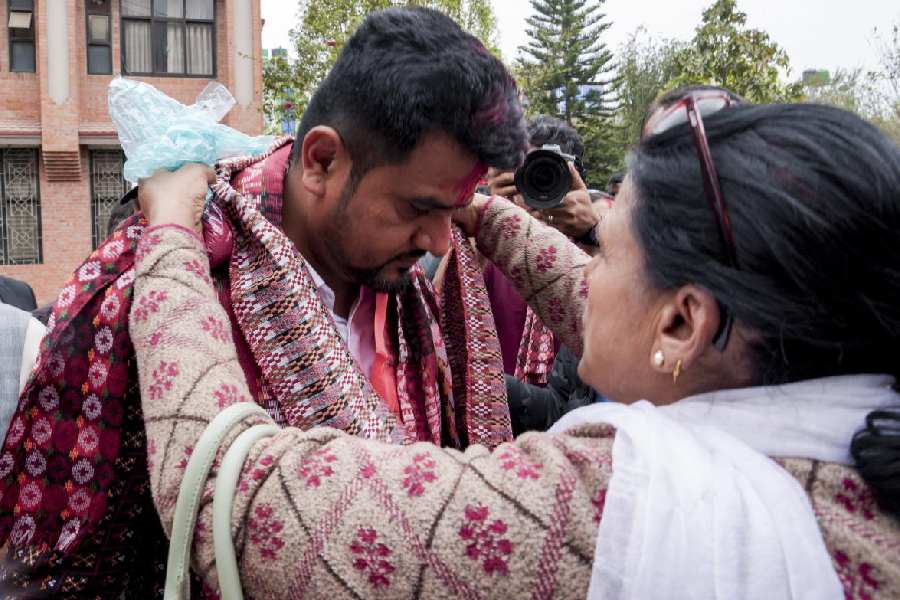
(From left) Prasanta Haldar with wife and son, Amar Maharana and D Ramana with his family. Telegraph pictures  |
Paradip, Oct. 28: Exactly 14 years after the cataclysmic supercyclone ravaged Odisha, the majority of survivors have successfully rebuilt their lives while battling official insensitivity and red tape.
However, memories of the cyclone still haunt them as they observed the death anniversaries after the calamity devoured dear ones on October 29 and 30 in 1999.
For Prasanta Haldar, a native of seaside Dahibar village in Jagatsinghpur district, life has come to a full circle. The death of his parents and siblings followed by a struggle for survival had left him, then 15 years old, in a state of shock. Tiding over adversities, the migrant Bengali, who got married seven years ago, is leading a content life with his wife and two children.
“Tidal waves came crashing and swept all of us away. I lost my entire family in two days. I don’t know how I survived. I found myself at Erasama hospital. I got Rs 3 lakh as an ex gratia, which was a huge amount then. Had there not been this government help and support from my maternal uncle, I would have come to the streets,” Haldar said.
His monthly income from fishing, around Rs 5,000 to Rs 8,000, is adequate for his four-member family. The relief money is deposited in bank and has now tripled.
“The tragedy has made me mentally stronger. At a tender age, I was deprived of love and affection. But the ups and downs of life spurred me to work. I still live in a kutcha house and do not want to exhaust the savings. My plan is to provide good education to my children,” he said.
Like Haldar, many bereaved families have become economically self-sufficient. Gloom that had pervaded during the calamitous hours 14 years ago has given way to happiness and prosperity now. Amar Maharana, 60, of Badahat in Kendrapara wears a sullen expression as he reminisces that fateful day.
“The storm blew away everything in one stroke. I lost my wife, two sons and daughter. I survived by clutching on to an electric pole. No amount of compensation would make up for the loss that I have suffered,” said Maharana, who was a trolley rickshawpuller in Paradip when the storm struck.
Apart from the loss of family members, what has left him shattered, is the government’s insensitivity towards his plight, he said. “My family members did not figure in the official death toll as I was not on the voter list of Paradip. So, the Jagatsinghpur administration did not recognise their death. I knocked on the doors of officials in my home district, Kendrapara. They came to my rescue,” he said.
After a series of communication, the ex gratia was sanctioned. “It came nine years after their death. The bureaucratic functioning left in a state of distress,” he said.
D. Ramana, 62, a traditional fisherman living at Sandhakuda fishing village near Paradip is another survivor. “My five-member family could survive because we did not ignore the cyclone warning. My family had shifted to the safety in the Paradip college building. The Phailin warning earlier this month was taken in all seriousness. Our slum was a zero casualty-zone this time, while over 2,000 had perished in 1999,” Ramana said.
Having paid the price for ignoring the warning in 1999, people from vulnerable pockets have grown strikingly vigilant now. “Alertness to face calamity have evolved from the grassroots level,” said Jagatsinghpur district collector Satya Kumar Mallick.