|
| Devotees worship Maa Budi Santani Thakurani at a pandal in Berhampur on Monday. Picture by Gopal Krishna Reddy |
Berhampur, March 28: The festival of Buddhi Thakurani, popularly known as Thakurani yatra, has come to the Silk City and the streets seem to have come alive.
The yatra, which is celebrated by people here with much pomp and gaiety, began today and will go on till April 11. V. Kartikeya Pandian, collector of Ganjam, recently launched the website http:// thakurani.com.
Buddhi Thakurani of Berhampur or goddess Mahamayee is venerated as much as Biraja is deified in Jajpur, Bhagabati in Banapur and Kataka Chandi in Cuttack. Thakurani yatra in its ancient form is similar to “ghata yatra” or the pots festival of south India.
According to some historians, the cult of Buddhi Thakurani originated along with the establishment of Berhampur town around 1672.
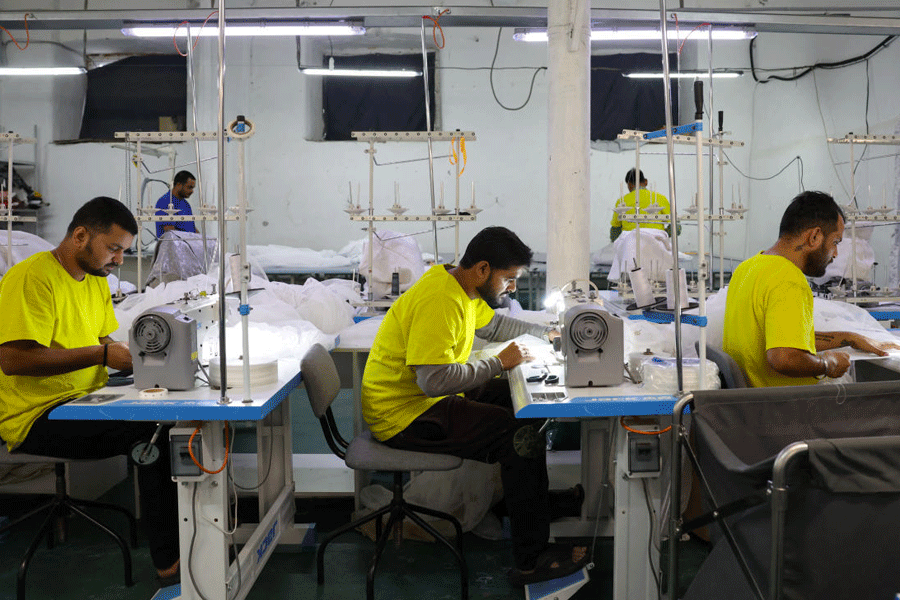
According to historians, Raja Saheb of Mahuri visited Tanjore and Rajmahendri after Ganjam came under the imperial authority of the British in 1766-67. He invited the Telugu lengayat dera (or weaver) community to migrate to his Mahuri estate and take up weaving and also introduce ghata yatra so as to highlight the divinity of Mahamayee Thakurani, the reigning deity of his capital city Berhampur. The chief of the Dera community, Kota Chandramani Kubera Senapati, led his people to Mahuri and its capital Berhampur.
They settled into their hereditary profession of weaving tussar products or patta matha. He also introduced ghata yatra to worship Thakurani as well as to make it a platform for promoting silken products.
Record reveals that the Dera community settled in 18 settlements in the western part of Berhampur. The chief of each settlement was designated senapati. A supreme chief, or desi behera, was elected from among all such senapatis to supervise the puja in the main temple of Buddhi Thakurani and to oversee the conduct of the yatra. Buddhi Thakurani came to be regarded as the clan deity or istadebi of the Telugu-speaking Deras.
“We are hopeful that the district administration will allow us to continue the yatra for a total of 29 days from March 28 to April 25 instead of 15 days. The clan priest has fixed these 29 days as auspicious for the yatra,” said the current desi behera, P. Durga Prasad.
Buddhi Thakurani is considered to be the daughter of the desi behera and the deity stays with her father’s family during the yatra.
Subhakhunti or an auspicious seven-feet bamboo pillar has already been fixed in front of the residence of the desi behera as the first step for constructing a temporary thatched house for the deity. Lakhs of people from different parts of the state and even outside Orissa congregate here to witness Thakurani yatra, sources said. The last biennial festival of Buddhi Thakurani was observed for 27 days in 2009 from April 8 to May 4.
The invitation to the goddesses was offered in the form of etamalliphula on Monday. A bunch of flowers, which falls on the head of the goddess, is kept in the temporary thatched house for worship, symbolising Buddhi Thakurani. During Thakurani yatra, a procession will be taken out in the town from the third day onwards and the devotees, mostly women, will participate in this procession. It is the tradition during the yatra that many dress themselves as mythological characters, monks, witches, police officers and social characters. The main attraction of the dance is a person in a tiger costume or Bagha Nata. The fancy dress carnival attracts tourists in hordes, retired professor P.S.N. Patra said.