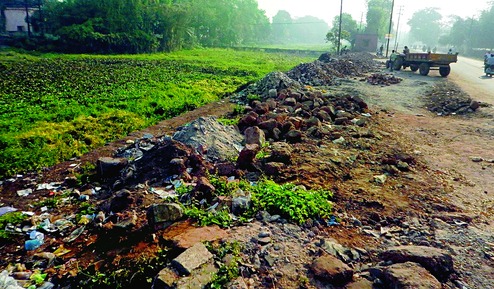

Cuttack, May 4: The Archaeological Survey of India (ASI) stood a helpless bystander as sections of the protected Barabati Fort moat area were demolished and shifted in violation of heritage laws to pave the way for construction of a road.
As custodian of the fort, the ASI failed to save the ancient moat from infringement as walls on its southern side were demolished for the road project.
"What can you do when the state authorities pay little heed to rules related to a protected area," superintendent, ASI (Bhubaneswar Circle), H.A. Naik, told The Telegraph.
The 2.5km stretch of the moat surrounding the 104-acre fort was built during the Ganga period. The moat used to be completely filled with water and was intended to defend the fort from enemy attacks.
"Though any permanent construction is prohibited within 300 metres of a protected heritage site like Barabati Fort, the state public works department's roads and buildings division has gone ahead with road construction," Naik said.
Complaints from the ASI to the roads and buildings (Cuttack division) have fallen on deaf ears, Naik said. However, he ruled out resorting to any legal remedy over the issue.

Barabati Fort was the seat of sovereign powers who ruled Odisha for over five centuries. It was the headquarters of Ganga dynasty's Kalinga Empire (1112-1435), home to Suryavamsi Gajapatis (1436-1540), Bhois (1542 -1560) and Mukundadev, the last great Hindu ruler of Odisha (1560-68).
As part of the city's first four-lane project, widening of the road has been undertaken since January on a 2km stretch from Cantonment Road near Barabati Stadium to Biju Patnaik Chakk.
In the process, stretches of the moat wall on the southern side running to more than 80 metres have been shifted by about six to eight feet by demolishing the old structure and reconstructing it to maintain the 7.5 metres road width on both sides of the median.
"The stretch of the moat wall was in a dilapidated condition and has been shifted by a few feet and reconstructed to maintain the minimum width of the road on portions that belong to the state fishery department," executive engineer, roads and buildings (cuttack division), Pramod Nayak, told The Telegraph.
"Besides, there should be no controversy as the road expansion work has been undertaken on state government land. The ASI officials have so far not been able to come forward with any documentary evidence indicating that construction of the road has been undertaken on land within the protected area," Nayak said.
Intach (Cuttack chapter) convener Pradyumna Mishra said: "There is no harm in strengthening the moat wall, but the original position should not be disturbed in any manner."
The works department aims to complete the Rs 2.17-crore road expansion work between Cantonment Road near Barabati Stadium to Biju Patnaik Chhak by May end. It is the first phase of the four-lane road project taken up in the city.
In the second phase, road expansion will be taken up on the 3km stretch from Biju Patnaik Chhak to Sati Chaura via Kanika Square and Shelter Square.
The road from Biju Patnaik Chhak to Sati Chaura is one of the major thoroughfares of the city.