|
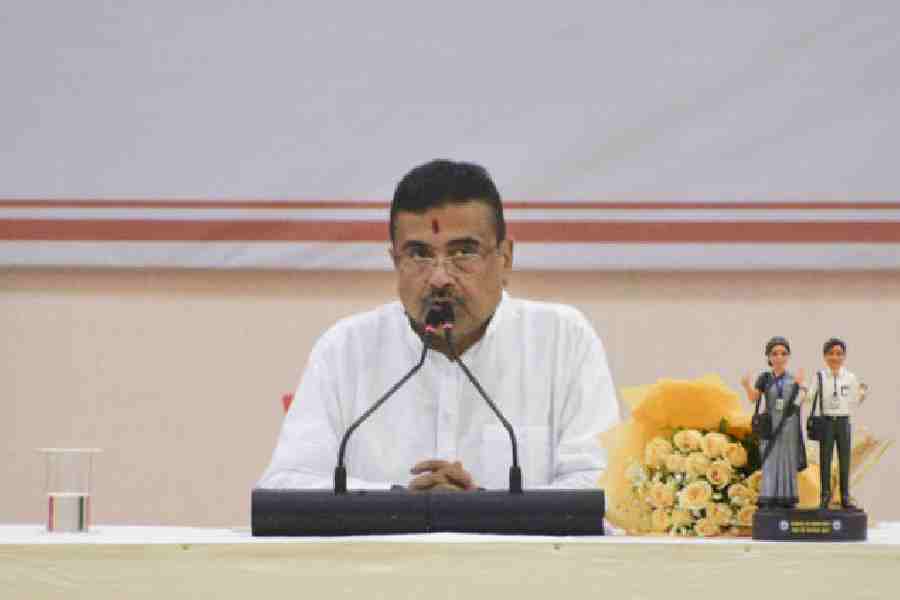
| Artist and designer Paresh Choudhary shares his views on Odia fonts at an interactive session in Bhubaneswar. Telegraph pictures |
Bhubaneswar, Aug. 23: The Kendriya Sahitya Akademi recently recommended the Odia language to be given the classical tag by the ministry of culture, government of India.
Yet, the script and font of the language have hardly been explored or experimented with to create something new that comes handy for designing purposes, said artists at a discussion hosted at the Rotary Club in the city on Wednesday.
“The script is an identity and visual depiction of any language. Odia script is one of the oldest in Indo-Aryan categories and is unique for its distinctive style and characteristic. I believe the form of the ancient script comes from the Odia culture — our food, ancient architecture and dance forms,” said Paresh Choudhary, artist and designer who teaches at a design institute in Pune.
“It is rounded in structure which I feel is an influence of Odissi dance movements or the round arches in Odisha’s ancient temples,” he said.
While Choudhary said he has observed deeply the famous Pipili crafts, pattachitra, elements seen during rath yatra and many such lifestyle-related aspects to conclude that this is why the Odia script is rounded, but veteran artists begged to differ.
“It is a widely accepted fact that Odia people used palm leaves to write in the past. And any horizontal lines would tear the leaf. Hence the script evolved into a rounded form with very few vertical lines,” said eminent artist Asim Basu.
Noted artist Jagannath Panda, the chairman and founder of Utsha Foundation that had organised the discussion, rued that not much research has been done to document the creative and scientific reasons leading to the development of the Odia script. “Also, its time for us to come up with various typefaces and fonts of Odia script that help us in designing using technological devices,” said the artist.
The discussion, “Odia Typography With respect to its culture: An insight and interpretation”, included many other artists such as Ramahari Jena, Jayant Das, Subrat Mallick, Pradosh Kumar Mishra, Meenaketan Patnaik, Veejayant Das and many others.
“The Odia script is an ancient one and evolved many centuries ago. But it is also a set of symbols, which are beautiful works of art. A lot can be done on the artistic aspect of the Odia typography,” said Jayant Das.
“Reforming it to create new fonts could bring a touch of modernity to the classical look which can help gain the attention of the younger generation since they can connect to it,” he added.