
Telegraph picture
Hailakandi, April 28: The Cachar district administration has set October 2, 2018, the birth anniversary of Mahatma Gandhi, to complete Swachh Bharat programme in waste management.
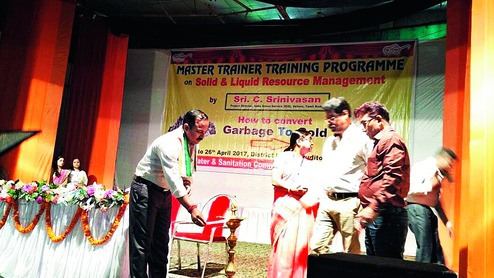
A specialist in converting "garbage to gold" through integrated and sustainable solid and liquid resource management (SLRM) and project director of Indian Green Service, Vellore, C. Srinivasan, is in Silchar to implement the programme based on the Vellore model.
Srinivasan, who has 23 years of experience, has designed and coordinated several environment projects in India and abroad.
For making Swachh Cachar, the door-to-door survey by volunteers will begin in May. The project officer of the District Disaster Management Authority (DDMA), Shamim Ahmed Laskar, said the volunteers would collect data through a door-to-door survey in a specified format with proper road map from the first week of May.
In Cachar, the programme is being implemented by the public health engineering department and the DDMA.
At present, trainings at various levels is under way which includes panchayat members, NGOs, self-help groups and people from select fields.
Cachar deputy commissioner S. Viswanathan inaugurated the mission of Swachh Cachar and said this had been undertaken as part of "My City My Responsibility" campaign of the Cachar district administration, under Swachh Bharat Mission, on March 26.
He said Cachar would be the first district in the state to start door-to-door collection of waste.
Talking to this correspondent, Srinivasan, who has been engaged by the Assam government to conduct the training on waste management, said the people of Silchar were ready to understand the difference between garbage and resources.
At present, most of the garbage is disposed of in drains besides on empty plots and private lands. Srinivasan said with very little effort, garbage could be a source of job creation and endless resource for unemployed youths.
This time, 163 gaon panchayats of the district and 28 wards in urban areas have been selected to implement it.
They are being trained by Srinivasan and other resource persons.
Nearly 44,000 families, 15,000 commercial institutions besides government and private offices would generate 75 tonnes of waste materials in Silchar per day. At present, garbage is disposed of at the dumping ground in a haphazard manner.
Srinivasan said the so-called "waste" is not actually waste and could be a good source of income. According to him, human resource of local self-help groups, BPL families, low-income groups, unemployed youths, among others, may generate a monthly revenue from people's contribution from each household and make the SLRM project a "people's project" where the government should provide support from outside and encourage self-sustainability. He said people must come forward with zeal.
Srinivasan said the group of at least four members with bicycles can collect resource (waste) generated from 250 families from the municipal wards twice a day from 7am to 9am and again from 3.30pm to 5.30pm. He said the waste collected would be divided in two parts - organic and inorganic.
There will be red and green bins and two compartments in the vehicles carrying waste which includes recyclable and non-recyclable.
In the green compartment, there would be organic and in the red inorganic waste, he said.
Srinivasan said the project had been successfully implemented in Vellore, Mysore, and other cities of the country and now "we are looking for a solution to our garbage woes with this concept".
He said the Silchar Medical College and Hospital (SMCH), National Institute of Technology, Silchar, and Assam University had been selected for SLRM campuses according to the instructions of Cachar deputy commissioner Viswanathan. They would manage their own solid and liquid wastes to handle the non-biomedical waste generated in the hospital, he said.
Srinivasan added that garbage would be collected from the wards of the SMCH and transformed into other resources instead of dumping them on trenching ground. He said the major advantage of adopting SLRM concept is that the solid waste garbage will be recycled while plastic and polythene garbage would be sold in market after recycling.
The assistant engineer of the public health engineering department, J.J. Das, who is also a part of the project, said people should come forward for the successful implementation of the project by October 2, 2018.