
Tezpur: Batadrava than (shrine) in Bordowa in Assam's Nagaon district, known for being Xankardeb's birthplace, is also known for its exquisite wood carvings that highlight many interesting facets of Vaishnavite movement led by the saint-reformer.
For many scholars such wood carvings are the "finest specimens of the entire range in the subcontinent". However with the passage of time, some of these have faded and need urgent care.
Professor Robin Kumar Dutta, an expert in traditional dyes and pigments, along with Professor Swapan Kumar Dolui, an expert in adhesives and polymers - both from the department of chemical sciences of Tezpur University - with support from the university administration, are busy restoring the centuries-old priceless life-sized wood carvings of kirtan ghar of Batadrava than to their original look.
They use hengul and haital (vermilion and yellow arsenic) used traditionally in Assam for painting wooden instrument, walls, mukha silpa (mask making) and other pigments. Dutta and Dolui were helped by Naren Kalita, an expert in traditional art forms of Assam.
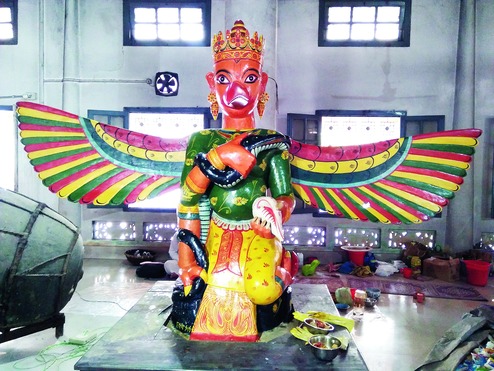
The work, the first of its kind, was also driven by a broader idea of reviving the unique but dying tradition of painted wood carvings with hengul and haital. The largest wooden sculpture is a gadur pakhi, (a bird found in Hindu mythology) which is about two metres tall and three metres wide. It was painted with hengul haital dated 1833.
There are also another similar but slightly smaller gadur pakhi and two wooden sculptures of Hanuman. Though these wood carvings were painted with traditional pigments, all of these have lost sheen with the passage of time. The older gadur and Hanuman were later painted with synthetic enamel paints.
Resource persons from various places, including Majuli, Nagaon, Tezpur were involved in cleaning the wood carvings, preparation of paints by grinding and mixing with gum of elephant apple and water, application of paint, application of a final thin coat of natural sap (la charowa) in three phases.
Niran Kotoki and Prabin Bora from Auniati xatra, Majuli, applied the final thin coat of sap on the sculptures after Badal Das and Dewan Singh of Tezpur finished artwork.
Chitta Ranjan Bora, Mridu Moucham Bora from Nagaon joined the traditional artistes from Auniati in painting the sculptures.
They used traditional paints prepared by them together with Hari Narayan Kowar Ujjal Jyoti Dev Goswami from Batadrava.
A team of chemists, led by Pinku Gogoi and Rajkamal Mohan, PhD students of Tezpur University supervised the entire work including safety while handling the toxic pigments.
Samples of the pigments at different stages have been collected for further research.