
Guwahati, June 29: It showed itself only once and never came back.
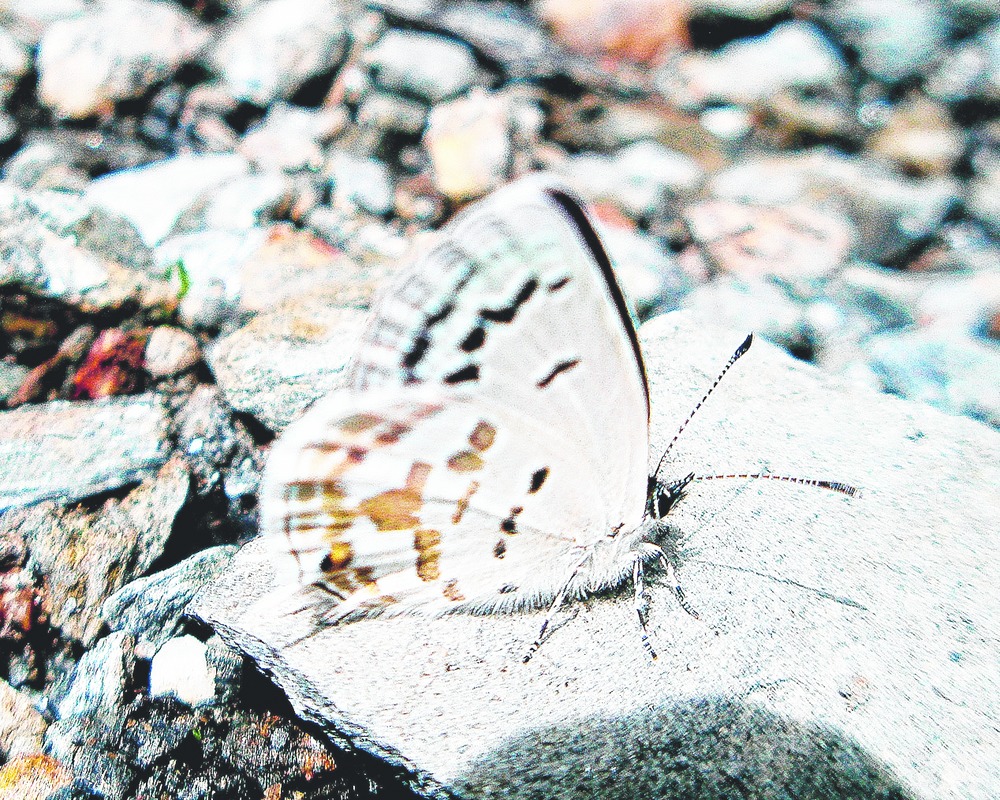
A butterfly species, False Tibetan Cupid ( Tongeia pseudozuthus), has been spotted for the first time in Lower Dibang Valley of Arunachal Pradesh, bringing good news to butterfly lovers in the country.
The discovery has been reported in the latest issue of the Journal of Threatened Taxa.
Seena N. Karimbumkara and Rajkamal Goswami of Ashoka Trust for Research in Ecology and the Environment in Bangalore and the Centre for Ecology, Development and Research in Dehradun had conducted the survey in June 2013.
"During our visit, road improvement and widening activity was going on, which escalated the disturbance levels. The butterfly took off straight, almost vertically upwards, in a single flight movement and although we waited for a good 30 minutes for it to come back, it never returned. We returned to the same spot the next day and searched the adjoining areas, but were not able to locate any individuals of the species," Goswami told The Telegraph .
Only one individual was found and the recorded altitude of the site of collection was 1,450 metres.
Goswami said the first photograph of a live False Tibetan Cupid was taken during this survey, thus establishing the presence of the species in India.
"The specific name of this species is Pseudozuthus and its common English name was coined as False Tibetan Cupid," he said.
The surrounding forest around the stream has been classified as sub-tropical broad-leaved evergreen forests, typical of mid-elevation areas of the eastern Himalayas.
He said the specimen was collected in 1987 by Purnendu Roy (one of the authors of the article) from Arunachal Pradesh and deposited at the lepidoptera collection of the Natural History Museum in London. But its identity was unknown at that time.
H. Huang identified the species as new in 2001 from among some specimens collected in Tibet and named it as Tongeia pseudozuthus.
The only validated Tongeia species known so far from India is Tongeia kala (Black Cupid), which has been reported from the northeastern region (Khasi hills, Naga hills and Manipur), to the south Shan state of Myanmar and is known to be rare throughout its range.
In 2012, Tongeia kala was recorded from Djulekie in Nagaland after more than 100 years.
Goswami said the Upper Dibang Valley, like most parts of Arunachal Pradesh, is remote and remains one of the least explored regions of India in terms of butterfly fauna. Detailed surveys are strongly recommended, particularly within its vast dense forest tracts.