 |
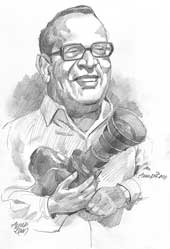
Robin Banerjee (1908-2003)
Many years ago, Robin Banerjee stepped out of his tent in the tropical rainforests of the Amazon to one of the most dreadful sights in his life — a full-grown anaconda enjoying its “breakfast” in all its magnificent glory. Banerjee, though initially scared of one of the most vicious predators in the animal kingdom, was curious enough to go up and put his ear to the snake’s belly and hear the sounds of bones breaking as the anaconda started using its powerful muscles to digest its “breakfast”. For the mesmerised man, it was nature at her most primitive form — yet beautiful and having its own music.
Robin Banerjee loved nature and that is to put it mildly. He trudged through knee-deep snow for hours in Greenland for a glimpse of polar bears, waited three to four hours under a scorching sun on a Pacific Island to capture the Comodo dragons on film. However, it was in Kaziranga that he found a home and in its exotic and endangered denizens of the park, his true friends. It was here that he discovered nature in her pristine glory and it was here he was to breathe his last.
His “affair” with Kaziranga — with Assam to be precise — started in 1952 when as a young British Navy doctor he stepped into a tea estate in Upper Assam. His first reaction to the natural beauty of Assam was: “Such greenery I have never seen”. It was love at first sight.
Banerjee put Kaziranga on the international map, gave it the highpoints of fame it now enjoys. In his initial days in Assam, though, he knew nothing of the one-horned rhino or of Kaziranga. It was only with the passage of time that he gradually learnt of the unique rhino species, the only one of its kind, and the beauty of the park.
With a video camera gifted by a friend, he began documenting Kaziranga and its unique residents. He named his screen venture Kaziranga. In 1962, his documentary was screened on Berlin television and the park was catapulted into the international arena. The sheer beauty of the place and the grandeur of the one-horned rhino caught and held the attention of the world — in most part due to the loving camera work of its maker. The World Wildlife Fund (WWF) recognised the uniqueness of the one-horned rhino and Kaziranga got the status of national park in 1971-72.
Banerjee was always apprehensive that his beloved Kaziranga would one day be destroyed because the kind of dedication and involvement needed to save the park was missing in its caretakers. He often used to say, “the Amazon rainforests may be deep but it is Kaziranga that is truly lovely and complete.” He was also aggrieved that the Assam government did not recognise his efforts.
“If we show love for nature, nature will always love us back and show us affection in ways only it can,” was one of his favourite quotes. His love for nature is captured in 30 documentaries on the flora and fauna of which 20 were award-winners.
His bungalow in Golaghat, on a sprawling 14 bighas, converted into Uncle Robin’s Natural History Museum for Children, is a veritable storehouse of a unique collection of mementos, curios, artefacts, documentaries on nature, rare photographs and a collection of dolls from all over the world. At a point in time it was also home to a cheetah, a python named Vaijayanti, a deer....
Banerjee remained a bachelor throughout his life. It was while serving as a doctor in the British Royal Navy that he fell deeply in love with Anne, a New Zealander. A nurse who played “divine” piano and was a ballet dancer, Anne was unfortunately killed in a bomb blast during World War II. Her loss left him bereft, with a void no woman could ever fill. All through his life, on clear nights, he used to gaze up at the stars “looking for my mother and Anne”.
The ravages of war had left him a shattered man as he lost all faith in humanity, of the generation he was part of. It was in Kaziranga that his tortured soul found solace. A little of his faith in humanity was to return later — discovered in the innocence of children. As he always told them, “think twice before you harm a bird, cut down a tree, crush a butterfly or kill an animal — it could be the last of that species.”In his passing, Assam, nay the world, has been left pitifully poorer.