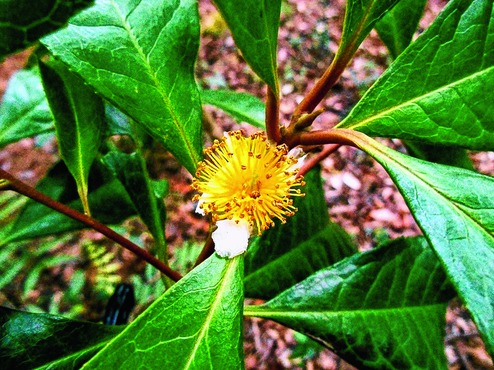

Guwahati, June 5: Cherrapunjee will now be famous for more than just its surfeit of raindrops.
A tree species, Pyrenaria cherrapunjeana, was discovered by a team of researchers from North Eastern Hill University, Shillong, which carried out field explorations in Cherrapunjee and Mawsynram in Meghalaya's Khasi hills from December 2013 to March last year.
The discovery has been published in Telopea: Journal of Plant Systematics.
This is the first time that any plant species has been named after Cherrapunjee, one of the wettest places one arth.
The team of four researchers comprised Krishna Upadhaya and Aabid Hussain Mir of North Eastern Hill University and Dilip Kumar Roy and Nripemo Odyuo of Botanical Survey of India (BSI), Shillong.
"First we identified the genus of the species using standard literature and taxonomic keys. The identification key was followed for all the species in the genus and the species did not match any of the species described earlier, which made it clear that it was new. The authors can give any name to the species. In this case we have given the name after the place of its occurrence," Mir, a researcher at the department of environmental studies, North Eastern Hill University, told The Telegraph.
A World Meteorological Organisation (WMO) panel in 2014 concluded that Cherrapunjee holds the world record for two-day (48-hour) rainfall, with 2,493 millimetres (98.15 inches) recorded on June 15 to June 16, 1995.
The tree species grows in dense subtropical broad-leaved forests of Cherrapunjee and Mawsynram at an altitude of 1,300-1,600 metres. The species has been classified as critically endangered following the IUCN criteria.
The species grows up to 12 metres high and the young branches are light purplish-brown and leaves papery, simple and alternate with a light purplish-brown petiole.
The flowers are fragrant and five green sepals surround the creamy white petals, which are five to six in number. It flowers between December and March and the fruits grow from March to June.
All the collections of the species have been made from Mawmluh and Sohrarim in Cherrapunjee and from Mawrapat in Mawsynram. Ten trees of the species were found and the geographical range of the species is very narrow.
"The restricted distribution of this species makes it prone to events which may reduce the population or eliminate it. The species occurs in highly fragmented forests. In addition, the habitat of the species is threatened by a number of anthropogenic factors including limestone mining, fire, agricultural expansion, extraction of timber and non-timber forest products, as well as encroachment of forest land for human settlement. The species is in urgent need of conservation management. This species requires an accurate survey to determine the geographical range to gain a better understanding of the population size," the study said.