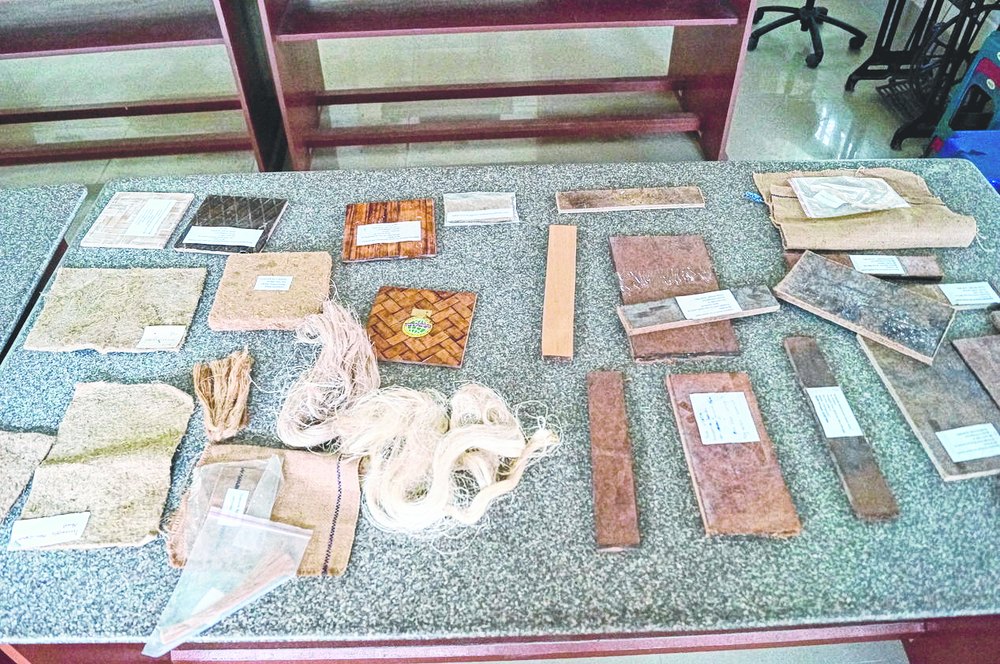

Jorhat, Aug. 29: The department of textile and apparel designing, College of Home Science here, has gone beyond the usual clothes and designs to come up with a green construction material albeit with the same waste fibre which goes into making cloth.
Working on a project funded by United States Agency for International Development and titled development of green composites from agri waste, the department has used jute, banana and pineapple fibre coated with soya bean resin as a binder and a waterproof finish.
Satwinder Kaur, dean, College of Home Science and one of the scientists involved in the project, said a needle punch technique was used to make the boards.
"All the different boards which were made were from banana, pineapple and jute waste. Different permutations and combinations were tried out and this resulted in hard boards of varying tensile strengths," Kaur said.
"The boards which we have made, though not as hard as wood, can replace many office furniture or tops as well as be of use in interiors and automobiles. We have found that the tensile strength measure scientifically in megapascal was quite high and had an unbreakable quality akin to wood," she said.
Jute was found to be the best fibre as it had almost nil water absorption, thus making it resistant to the bad affects of moisture and high humidity in the Northeast.
"In one instance, seven sheets of pineapple fibre were pressed with six layers of jute fabric and was found to be the strongest among all the other experimentation.
"This can be easily moulded into different shapes and designs and be used as cheap sheet spreads under tin roofs," Kaur said.
The USP of the boards was that no chemicals were used. Even the binder used was a product of soya bean and therefore if commercially made, this material could have a market in many countries abroad where eco-friendly material is preferred, she added.
Binita Baishya Kalita, another professor of the department who worked on the project, said banana, pineapple and jute grew extensively in the east and Northeast and the waste of these three products could easily be used to make such boards on a commercial scale.
The pressing of the boards by means of a hydraulic heat press was done at the North East Institute of Science and Technology here with the help of scientist Dipul Kalita.