 |
| The Supreme Court |
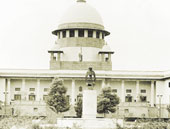
If the Supreme Court bench in Guwahati does materialise, access to the apex court will not remain a mere dream for the common man
There has been a long felt demand among the people of the Northeast for a Supreme Court bench in Guwahati. This demand has been focussed upon from time to time by the All Assam Lawyers Association and a resolution to this effect were adopted at its ninth biennial conference held in February 2003.
Memorandums were also sent to the President and the Union law minister. This demand was upheld by eminent jurist and former attorney general of India, Fali S. Nariman, while delivering the second Keshav Chandra Gogoi memorial lecture on the Role of Courts in Harmonious Functioning of the Executive, Legislature and Judiciary in India, in March 2003 in Guwahati.
The jurist made a plea that there should be a bench of the Supreme Court in Guwahati to cater to the needs of the litigants belonging to the seven northeastern states of Assam, Nagaland, Meghalaya, Manipur, Tripura, Mizoram and Arunachal Pradesh. The matter was again taken up by the All Assam Lawyers Association at its meeting held on December 23, 2004, in Guwahati and another memorandum was submitted to President A.P.J. Abdul Kalam during his recent visit to Guwahati.
Though the demand for a Supreme Court bench in Guwahati seems to be justified, the matter needs to be carefully examined, as the demand for similar benches will increase from all corners of our country. In fact, the southern states of Tamil Nadu, Andhra Pradesh and Karnataka have been demanding a bench of the Supreme Court for many years in their respective state capitals. There is a similar demand of the Calcutta High Court Bar Association for a bench in Calcutta.
On November 26, 1982, at a function of the Supreme Court Bar Association, the then Chief Justice of the Supreme Court, Justice Y.V. Chandrachud, in his address said, ?There is persistent talk about the formation of a bench of the Supreme Court in the south. I am unable to understand how a bench of the Supreme Court can be established in a southern region unless, in the first place, the strength of the court is suitably increased. If a bench is to be established, it shall have to have at least five judges, which means that the five judges shall have to be appointed over and above the 25 which, as I have said, is absolutely necessary in order to deal satisfactorily with the work pending at this point of time. It is true that a large part of the new work, which will come from the southern region, may go before the southern bench. But that will not mitigate against the requirement of sufficient number of judges for disposing of the work which is already pending in this court.
?The transfer of pending matters to the southern bench will create numerous difficulties and complications, one of which will be that a litigant who has paid his lawyer already in Delhi may have to engage another lawyer practising before the southern bench and pay the fees all over again. These consequences have to be avoided because they will defeat the very purpose of establishing a bench in the south.
?While I am on the question of setting up of a bench of the Supreme Court in a southern region, it is necessary to appreciate, before any step is taken in that behalf, that the establishment of a bench in the south is bound to generate the demand for a bench in the eastern and western regions of the country. It might become difficult to appreciate how, if a litigant residing in the south has a good case for setting up of a bench in the south, those residing in the eastern region can have a less plausible case. After all, when we speak of the convenience of the litigating public, we are not speaking of litigants who can afford what is increasingly becoming an impossible luxury of air travel. I don?t think that a man from Guwahati or Arunachal Pradesh finds Delhi more easily accessible than a man from Kerala or Tamil Nadu. Therefore, before a bench is established in the south, one shall have to be prepared for the established of a bench in at least one other region of the country.
?Proliferation of benches creates its own problems, one of which is that it tends to destroy the sense of oneness and cohesion of the court. Experience shows that judges who are allotted to the benches of the court at places other than the principal seat of the court, tend to evolve their own manner and method of work on the touchstone of their individual convenience. The absence of frequent exchange of views on many matters of common interest creates a sense of aloofness, which is detrimental to the functioning of the institution as an integral body. All of these difficulties shall have to be understood and appreciated before any decision is taken for setting up of a bench of the Supreme Court in any region of the country.?
While making the aforesaid observations, Chief Justice Chandrachud made it clear that he was not opposed to the demand for formation of a bench of the Supreme Court in the south but pointed out the difficulties that have to be kept in mind before any decision is taken in this regard.
It is now more than two decades when these observations were made by Chief Justice Chandrachud. The southern bench has not been established as yet. The demand for the northeastern bench has been raised from time to time and shall continue till the demand is met. The Supreme Court at that point of time had only 15 judges. Now the strength is over 25, including the Chief Justice.
As of now, it is generally the rich and wealthy who can afford to go to the Supreme Court in New Delhi from the northeastern region. For the poor, an appeal to the Supreme Court has remained a dream. The makers of the Constitution, however, had visualised such a situation and had made provisions in the Constitution of India under Article 130, which provides that the Supreme Court shall sit in Delhi or in such place or places, as the Chief Justice may, with the approval of the President, from time to time. Article 39A in Part IV of the Constitution under the Directive Principles of State Policy also speaks of equal opportunity of justice, that is, access to justice by all citizens.
The demand for setting up of benches of the Supreme Court also received the support of the parliamentary committee on home affairs, which, in its 56th report in the year 1999, recommended the setting up of benches of the Supreme Court in southern, western and northeastern parts of the country, so that people of far-flung areas got easy access to the apex court.
This dream of the people of the Northeast, it is earnestly hoped, will be fulfilled without further delay. Let the directive of the Constitution to give equal opportunity to all in the matter of the access to justice be fulfilled.