
Guwahati, June 18: Industrial waste, considered a bane of the environment, will now be a boon for the construction sector in Assam.
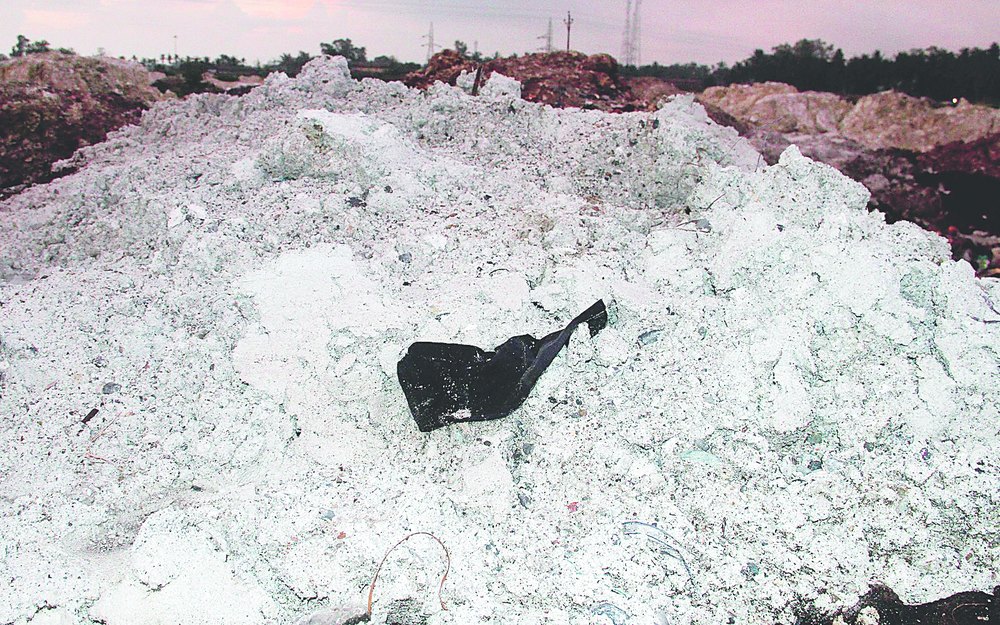
The Pollution Control Board Assam (PCBA) has taken up a novel initiative to utilise lime mud, a by-product generated from the Hindustan Paper Corporation Ltd (HPCL)-owned Nagaon Paper Mill, in manufacturing bricks.
The move will help protect waterbodies and farmlands adjacent to or near the mill at Jagiroad in Morigaon district from pollution caused by lime mud, especially during the monsoon. Besides, it will help HPCL in disposing the waste dumped on its campus.
The state pollution regulator had engaged scientists from Delhi Technological University (DTU), a premier government institution, to study the utilisation of lime mud as a construction material.
"Four experts from the DTU's civil engineering department had carried out the study. The final report was submitted before us last year. Subsequently, a patent for the invention (soil-based brick mixed with lime mud) was sought from the Controller General of Patents, Designs and Trademarks," PCBA chairman R.M. Dubey told The Telegraph.
Nagaon Paper Mill is around 50km east of Guwahati.
"The materials used to make brick in the study were lime mud collected from the HPCL campus, soil from the site of a brick kiln near Jagiroad and fly ash from National Thermal Power Station, New Delhi. They were characterised with respect to their chemical and geo-technical properties. Thereafter, experiments were conducted on hand-moulded burnt bricks to determine the compressive strength," DTU expert Raju Sarkar, who hails from Assam, said.
Sarkar and his associates, during the course of the study, had found that the lime increased the bonding properties of soil used for making bricks.
"This will not only solve the problem of stocking waste but will also reduce the use of natural soil for making bricks," a copy of the final report of the study read.
The pollution control board had provided Rs 3.5 lakh to the university to carry out the study.
Now, the board is expecting the patent for the invention by September.
"We hope to start utilisation of the waste in making bricks once the patent is granted. Units in and around the paper mill would also be encouraged to adopt the technique," said senior environmental engineer, PCBA, Gokul Bhuyan.
The waste has been affecting the waterbodies adjacent to the mill for decades now.
"The lime mud dumped on the mill's campus invariably makes its way to the Elenga Beel every monsoon and pollute the water," added Bhuyan. "If things go according to plan, we will carry out a similar exercise at Cachar Paper Mill (of HPCL) at Panchgram in Hailakandi district."