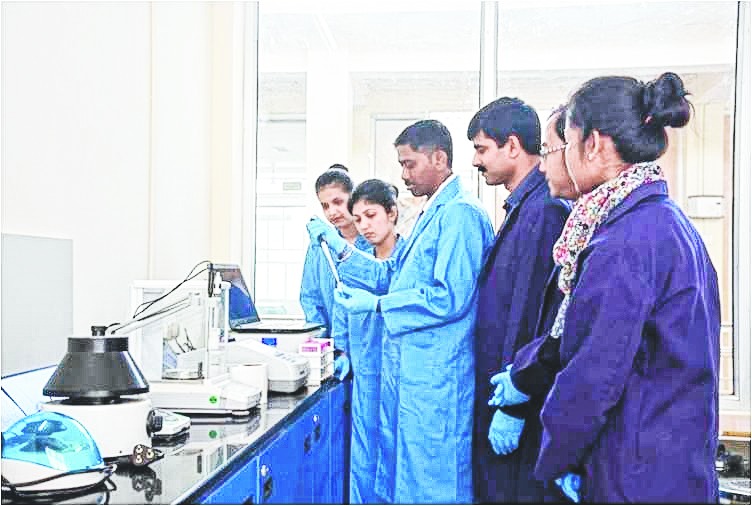

Jorhat, July 11: The bio-control agents produced in the nanotech lab of plant pathology department of Assam Agricultural University can bring succour to the tea industry battling with pests and diseases in this year's second flush.
Scientist and lab in-charge Pranab Dutta said they had produced seven liquid bio-formulations which found favour during trials in different tea gardens in the state.
Two bio-formulations are under trial at the national level for the management of nematode diseases of crops.
"Till date we have 124 isolates of bio-control agents collected from different tea gardens and vegetable ecosystem of Assam and Bengal. Groups of fungal bio-control agents like Trichoderma asperallum and Trichoderma harzianum were induced to produce silver nanoparticles and found effective against many soil-borne pathogens," he said.
Dutta said only 10 per cent of the amount of silver nanoparticle was required to be as effective as 100 per cent of other chemicals.
"In the coming days, this nanoparticle will be utilised for development of nanobioformulation with enhanced efficacy against the targeted pests and pathogens" Dutta said.
Bikash Joshi, general manager of Borsapori tea estate under the Jorehaut Tea Company said, they had been using Trichoderma harzianum on "about 50 hectares" of the plantation for the past nine months and found it very effective, compared to the section in which chemicals were being sprayed.
"The next time we are planning to increase the size of the area," he said.
Farid Ahmed, former adviser, Tocklai Tea Research Institute and tea consultant said Dutta was a pioneer in the biological management of tea pests and diseases.
"A number of gardens under Goodricke Tea Company like Amguri and Sessa had used our products and given positive feedback. Nonaipora, Salnoah and Orangajuli tea estates under Goodricke on the north bank have also placed a demand for our products like Org-Metajal, Org-Trichojal for the management of aphids, scale insects and termite," Dutta said.
Nonaipora tea estate manager Paran Das said they had acquired one of the products because of the positive feedback received from the other Goodricke gardens.
The tea industry is reeling under an attack of looper and helopeltis, two pests which have reduced yields in many gardens in Upper Assam by 30 per cent to 50 per cent.
A scientist of Tocklai Tea Research Institute said the looper was a kind of pest, which in the first, second and third instars completely finished off the new leaves of tea bushes after they were pruned in winter. He admitted that this time the problem was extremely bad.
"The managers did not realise the problem until 30 to 50 per cent of the bushes had been denuded of new leaves," he said
Former scientist of Tocklai Tea Research Institute B.K. Barthakur said the helopeltis sucked the stem cells of shoots and buds and the stalks withered as the pest let in a toxin.
"It takes months for the tea bushes to regenerate once these shoots and buds wither because of a helopeltis attack," he said.
Dutta said one of their products, Org-Beauverijal, was very "effective" against helopeltis but should be "applied in a scientific manner".