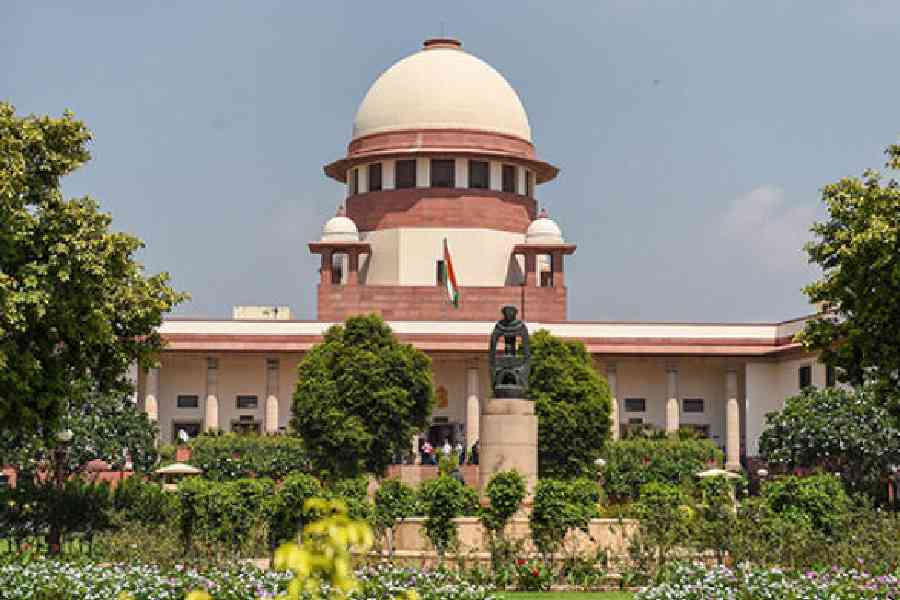
The Supreme Court has ruled that parental income cannot be the sole criterion for determining the “creamy layer” status of OBCs for exclusion from the benefits of reservation in jobs and education, dismissing a batch of appeals filed by the Centre.
“Mere determination of the status of a candidate as to whether he/she falls within the creamy layer or the non-creamy layer of the OBCs cannot be decided solely on the basis of income. Any attempt to read paragraph 9 of the 2004 letter in isolation so as to dilute or override the substantive scheme of the 1993 OM would be legally untenable,” the court said.
A bench of Justice P.S. Narasimha and Justice R. Mahadevan passed the judgment while dismissing the appeals filed by the Union government against judgments passed by the high courts of Delhi, Madras and Kerala quashing a letter issued by the government in 2004 seeking to exclude from OBC reservation benefits those children whose annual parental income exceeds ₹8 lakh.
The 2004 letter issued by the executive was in contrast to an office memorandum (OM) of the government in 1993 that said only those children whose parents are Group A or Group B officers in central or state government services, PSUs or the private sector could be kept out of the ambit of creamy layer benefits.
The 2004 letter sought to exclude OBC candidates merely on the basis of the income criterion, and not on the basis of the posts held by their parents.
The 2004 letter was successfully challenged before the high courts of Delhi, Madras and Kerala by several OBC candidates, aggrieved by which the Centre filed the appeals before the top court.
“A bare perusal of the 1993 OM makes it abundantly clear that certain categories of persons, namely, the sons or daughters of those holding Class I/Group A or Class II/Group B posts in the Civil Services of the Central and State Governments, have been excluded,” Justice Mahadevan, who authored the judgment, observed.
“The income/ wealth test has also been stipulated in the office memorandum, which prescribes an income/ wealth test as an additional criterion of exclusion. Significantly, the 1993 OM provides that these criteria shall apply mutatis mutandis (making necessary alterations while not affecting the main point at hand) for exclusion from reservation in respect of the children of those working in public sector undertakings, banks, insurance organisations, universities and other similar institutions, as well as those holding equivalent or comparable positions in private employment.”
“Income from salaries, agriculture or other sources cannot be clubbed for the purpose of applying the income/wealth test to determine the creamy layer status of a candidate.
“It is also evident from a comprehensive reading of the 1993 OM along with the clarificatory letter dated 14.10.2004 that income from salaries alone cannot be the sole criterion to decide whether a candidate falls within the creamy layer. The status as well as
the category of post to which
a candidate’s parent or parents belong is essential,” the court added.
The bench said the 1993 OM expressly laid down the criteria for exclusion from the benefit of reservation for OBCs by identifying the creamy layer, according to which it is “status-based rather than purely income-based, reflecting the policy understanding that advancement within the governmental service hierarchy denotes social progression independent of fluctuating salary levels”.
“Overemphasis on the 2004 letter to the extent of making income alone determinative without regard to parental status of service would defeat the structural framework of exclusion envisaged under the 1993 OM,” the court added.