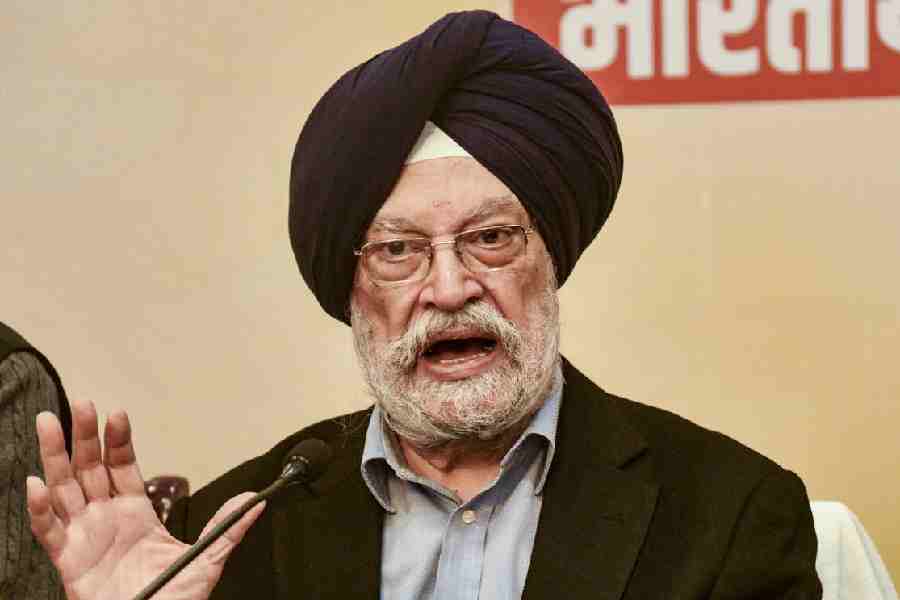
Petroleum minister Hardeep Singh Puri on Thursday told the Lok Sabha that the country faced no fuel shortage and took oblique potshots at Pakistan to underline India’s energy stability.
He lauded Prime Minister Narendra Modi for India’s management of the fuel situation, and attributed the panic over cooking gas supplies to “consumer anxiety rather than a supply shortage”.
Puri claimed the volumes of crude India had secured through alternative routes following the West Asia crisis had exceeded “what the Hormuz route would have delivered”. However, he described the rise in non-Hormuz supplies in percentages, not volumes.
Making a statement in the House, he said “the world has not faced a moment like this in modern energy history” but claimed that India had so far navigated the crisis with minimal impact.
Puri added: “The contrast with how other nations are managing this crisis places India’s response in its sharpest relief,” the minister said, highlighting the contrast with Pakistan without naming the country.
“A country in our neighbourhood has shut all schools for two weeks, moved government offices to a four-day work week, ordered 50 per cent of public employees to work from home, cut fuel allowances for official vehicles by half, and taken 60 per cent of government vehicles off the road,” Puri said.
“This (neighbouring) country has experienced the largest single fuel price increase in its history, with petrol up approximately 20 per cent in a week.”
He said another neighbouring country had closed its universities early and advanced the Eid al-Fitr holiday to conserve fuel, while several Southeast Asian nations had taken to energy rationing and conservation measures.
Amid sloganeering by Opposition members, Puri insisted that India’s petrol and diesel availability remained fully secure and that liquefied natural gas (LPG) cargoes were arriving almost daily through non-Hormuz routes.
‘Stocked’ outlets
“India’s crude supply position is secure, and volumes secured exceed what the Hormuz route would have delivered. Before this crisis, around 45 per cent of India’s crude imports transited the Hormuz route,” he said.
“Thanks to the Prime Minister’s diplomatic outreach and goodwill, India has secured crude volumes exceeding what the disrupted route would have delivered in the same period.”
Puri said the non-Hormuz sourcing of crude had risen to about 70 per cent of imports from 55 per cent before the conflict began.
“There is no shortage of petrol, diesel, kerosene, aviation turbine fuel or fuel oil. Retail outlets across the country are stocked and supply chains are functioning normally. Additional allocation of PDS kerosene has been issued to all states,” he said.
He said 40,000 kilolitres of additional kerosene had been allocated to states as an alternative fuel.
To address the surge in demand, LPG production had been increased by 28 per cent and additional procurement was under way, the minister said.
He, however, obliquely acknowledged a shortage in commercial LPG supplies, saying these had been “regulated to prevent black marketing” and “not to penalise the hospitality sector”.
Puri said the temporary regulations on the sale of commercial LPG had been introduced to manage public anxiety.
“In a supply-constrained environment where public anxiety is elevated, this deregulated structure creates a direct and uncontrolled pathway for hoarding, diversion and resale at inflated prices…,” he said.
“The government has therefore taken the responsible course to regulate this channel with clear priorities and a transparent allocation mechanism.”
Puri’s comments came after several Opposition MPs, including Rahul Gandhi, raised the LPG crisis in the House and staged protests on Parliament premises, accusing the government of bartering India’s energy security off to the US.
The minister urged the Opposition to refrain from “rumour-mongering or fake narratives”.
“Crude supply is flowing. Gas is prioritised for homes and farms. LPG production has been stepped up by 28 per cent,” he said.
“Consumer prices are held far below what markets and regional comparators would dictate. Schools are open. Petrol is on the forecourt.
“India must stand united behind its energy warriors, behind the institutions managing this crisis, and behind the national interest.”
At a separate media briefing, petroleum ministry officials said the oil marketing companies would, in coordination with state governments, allocate 20 per cent of the average monthly commercial LPG requirement from Thursday to prevent hoarding and black marketeering.
Asked how the allocation would be decided, Sujata Sharma, joint secretary (marketing and oil refinery) in the ministry of petroleum and natural gas, said the distribution would be determined by the state governments and Union Territories.
“State governments are the best judges to identify and prioritise consumers in their areas for the supply of commercial LPG,” Sharma said.
“We have prioritised the hospital and education sectors. Similarly, state governments can also prioritise other consumers to whom the supply should be made.”
Rural wait: 45 days
Sharma said the minimum gap between bookings had been increased from 21 to 25 days for urban areas. In rural areas, the period is now 45 days.