 |
 |
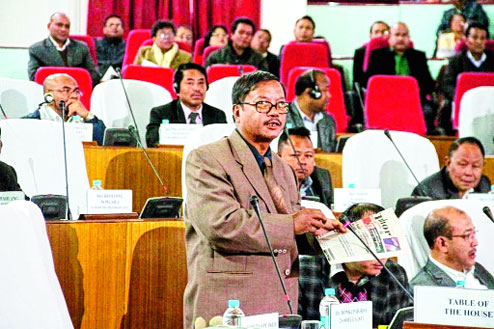
| Opposition leader Donkupar Roy and (right) deputy chief minister R.C. Laloo in the Assembly on Thursday. Pictures by UB Photos |
Shillong, Nov. 27: A section of legislators representing the Garo hills region today felt “discriminated” against as no school from Meghalaya’s western region has been included in the first phase of an ADB-funded programme.
The ADB will loan $100 million to improve secondary education and vocational training in Meghalaya so that students are better equipped to find high-quality jobs after graduation.
Apart from funds from the ADB, the state government also has to contribute another $25 million to the programme.
During question hour on the fifth day of the Assembly’s winter session, deputy chief minister R.C. Laloo told the House that 117 schools would be covered under the programme. He said these have been selected as per the ADB guidelines.
In the first phase, he said the programme would cover 30 schools from the Khasi-Jaintia hills region while the remaining 87 schools would come under the second phase.
Laloo also said that schools under the second phase, a majority of which are from the Garo hills, are in the last stage of finalisation.
This, however, outraged Opposition legislators belonging to the Garo hills who termed the move “discriminatory”.
“There are no schools from the Garo hills. Is the Garo hills second-class? This is unacceptable and we demand an apology,” NPP legislator James K. Sangma said.
However, another Opposition legislator belonging to the UDP, Jemino Mawthoh, said that earlier, he had been informed in the House that 10 model schools, which would be set up in the least-developed blocks of the state, would be only for the Garo hills region. “The process (for selection) has to be very clear,” he said.
Chief minister Mukul Sangma intervened by saying that it was inappropriate to create a perception of discrimination as this would be an opportunity for other forces.
“The scheme requires assessment of schools to be done as per the criteria. The initial assessment was done in East Khasi Hills, West Jaintia Hills and Ri Bhoi districts and the assessment could cover 30 schools. But there is no question of discrimination,” Sangma said.
The leader of the Opposition, Donkupar Roy, said in order to avoid the feeling of discrimination, schools should be identified constituencywise on equal share.
While giving the break-up, Laloo said the ADB funds would take care of civil work ($25 million), provide equipment ($18.34 million), engagement of consultant ($11.03 million), maintenance of school building ($1.1 million), skill and teachers’ training ($23.84 million) and contingency ($18.11 million).
Of the state’s share of $25 million, he said $2 million would be spent on counterpart staff salary, $2.9 million on operational cost, $4.2 million on incremental recurrent cost, $3.9 million on government contribution to skill challenge fund, $1 million on government contribution to school maintenance fund, $3.2 million on contingency and $7.8 million on financing charges during construction.
According to the ADB, enrolment in secondary schools in Meghalaya is only 29.9 per cent, compared with the national average of 45.5 per cent. It also said that there exists a wide disparity in the quality of facilities and teaching between schools.
Of the 961 secondary schools in Meghalaya, 591 are government-aided private schools where 71 per cent of the state’s students are enrolled, the ADB pointed out when it announced the programme in October 2013.
Further, it had pointed out that nearly 5,700 secondary schoolteachers do not have the required training. At the same time, it said that the state’s technical and vocational institutions struggle to teach the skills the private sector needs, thereby making it difficult for youths to compete for formal jobs, particularly outside the state.
The ADB had stated that the project would upgrade to national standards infrastructure of 117 government-aided private secondary schools and provide laboratories, libraries, clean drinking water, computers, separate toilets for girls and boys as well as access for the physically-challenged.
“This is expected to improve the learning environment for 18,000 to 20,000 students, around 40 per cent of whom will be girls. Students in remote locations will be able to work with tablet computers with built-in solar panels that are loaded with secondary school courses,” the statement said.
Moreover, the project will train around 3,500 under-qualified teachers and work with NGOs to raise awareness in poor communities about the importance of education and skills.
Altogether nearly 60,000 youths, 40 per cent of them girls, will receive skills training under the project, the ADB pointed out.
The project, Supporting Human Capital Development in Meghalaya, is ADB’s first loan in India focusing on boosting education and skills.
An additional $2 million grant from the Japan Fund for Poverty Reduction will be used to strengthen the capacity of related state government departments including education and labour, and non-governmental organisations to ensure the project reforms are sustained.