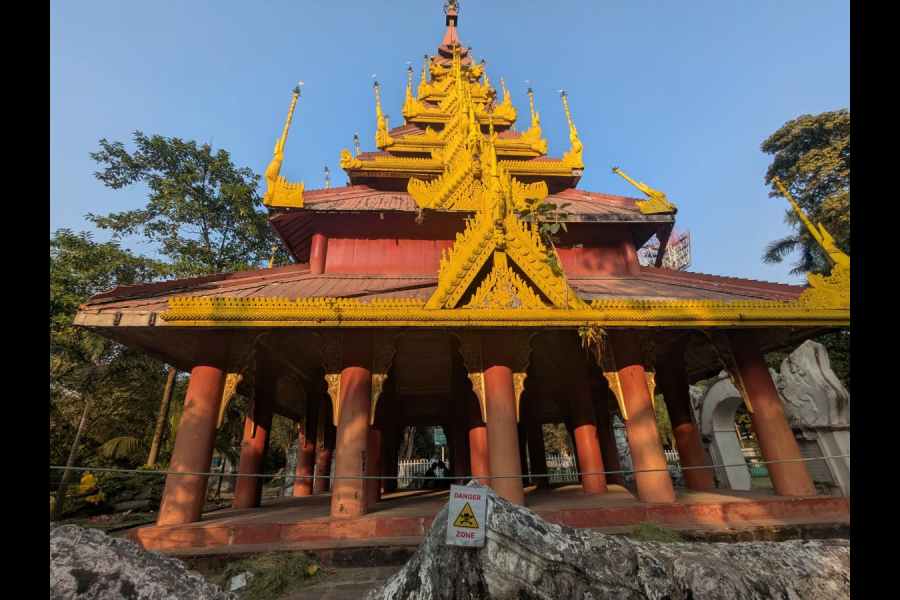
The brilliant red-and-gold structure looms over a languid lake in Calcutta’s Eden Gardens park. Indeed, the Burmese Pagoda, once the cynosure of this historic park, is now practically hidden from public view.
The masonry depicting mythical protectors, lions and the ornate gateway is in shambles. The weather-beaten plaster figures are stained with moss. Creepers embrace the tails of the monsters. The statues of the two guards with folded hands and smiling faces show wide cracks.
The entire structure is cordoned off and the signboard in front reads — “Danger Zone”. The gardener mowing the grass points to a gap in the tiered tower; some of the carved panels are missing.
You cannot just saunter into the precincts; you have to buy a ticket. The proceeds go towards the maintenance of the garden, which is the responsibility of the state forest department. But the custodian of the Eden Gardens grounds is the Indian Army. And the upkeep of the pagoda is the responsibility of the state Public Works Department (PWD).
It is the forest department that has put up the danger sign to protect visitors, says Barnali Paul, who is the range officer at Eden Gardens. According to Paul, it won’t be easy to begin the process of repair. “Neither the appropriate quality of wood, nor skilled craftsmanship is available. Above all, we’ll need a lot of funds.”
In 2012, which is the last time the PWD worked on the restoration of the pagoda, craftsmen were hired from Murshidabad. A poor wood substitute was used to replace the Burmese teak. But naturally, it didn’t last.
The pagoda has few visitors except for some furtive lovers. The marble plaque in front reads: “The above specimen of Burmese ornamental architecture was removed from the city of Prome in the months of August and September 1854 and reconstructed on this site in the months of October, November and December, 1856 (sic).”
Prome, today known as Pyay, lies to the northwest of Yangon in Myanmar. Ma Kin, who was the widow of the governor of Prome, Moung Honon, commissioned the construction of this pagoda to architect Moung Hune. Assisted by 10 carpenters, the pagoda was built in three months in 1852.
The shrine had a golden tazaung or multi-tiered pavilion and a statue of the Buddha studded with precious gemstones. Tazaungs in Myanmarese pagodas are carved with mythical birds and spirit figures.
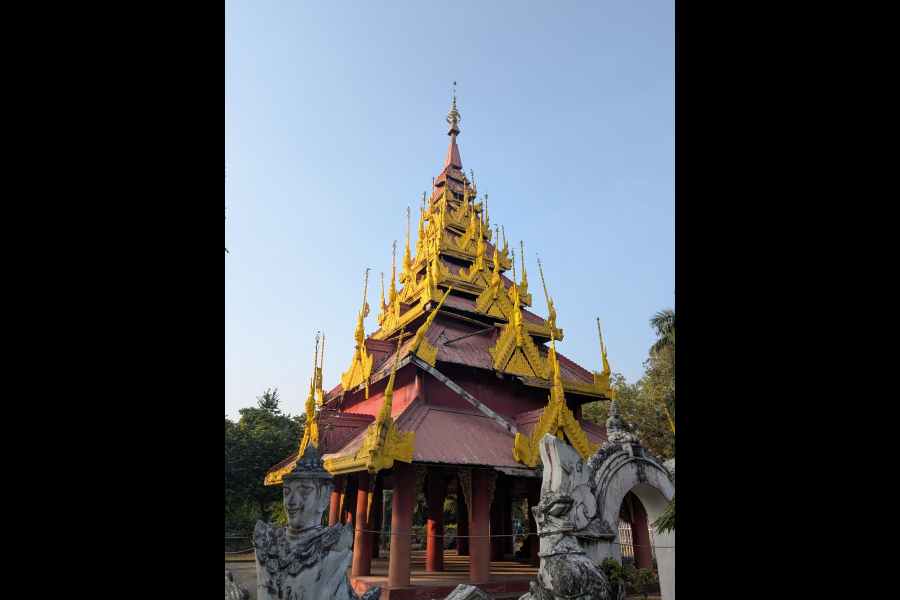
The Burmese Pagoda at Eden Gardens Park. Photo: Prasun Chaudhuri
Within a year of its foundation, the East India Company led by Governor-General Lord Dalhousie attacked Burma and annexed the fertile southern part of the country. When he visited Prome, he was impressed by the design of the pagoda and decided to dismantle it and bring it to Calcutta as a trophy of the war. The ship Shway Gong transported the pieces and they reached the banks of the Hooghly in 1854.
Initially, the cargo was kept in Fort William and only later assembled at Eden Gardens. No one knows what happened to the statue of the Buddha.
The oldest photograph of the pagoda is preserved at the Metropolitan Museum of Art in New York. Taken by Captain Richard Barton Hill, who was a soldier in the Bengal Army and an amateur photographer in colonial India, it shows a cylindrical spire on top and layers of wood carvings, most of which are now missing. The monochrome albumen silver print also shows the garden in full bloom all the way back in 1859.