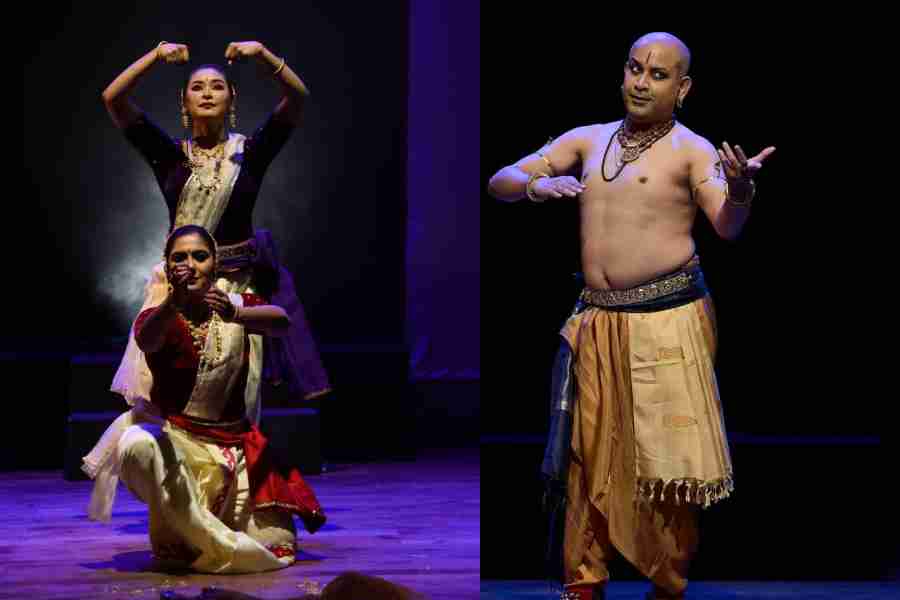
A metaphysical enquiry as esoteric as the Nasadiya Sukta of the Rig Veda, often described as the hymn of creation, does not lend itself easily to interpretation through an embodied practice such as dance. It runs the risk of becoming a laboured, ambiguous work of weighty allegory in which opacity could be mistaken for intellectual posturing. But it is to the credit of the dancers, Kankana Singh and Parna Chakraborty (picture, left), whose experiments with choreography led them to novel ways of iterating the emotions and the ideas contained in the hymn, that the work is saved from becoming banal. Nasadiya Sukta, presented by them as a part of the Kalavati Dance Festival 2026 organised by Manipuri Nartanalaya at Gyan Manch recently, was a fine articulation of a complex philosophical hypothesis.
The piece turns to that moment before creation when nothing existed and attempts to look at life, death and consciousness as an endless journey. It is a meditation on the mortal failure of human beings to reach their destination, caught as they are in the mundaneness of finite existence. Using the idiom of Manipuri dance, the choreographers borrow from the imagery of Pakhangba, the primordial, snake-like deity of the Meitei people, protector of their land, to embody the cycle of time. In the iconography of the serpent devouring its own tail, the choreographers find a metaphor for recurrence, with life curving inexorably towards death and death leading inevitably to life. The body’s twists and turns plot the trajectory of lived experience, adding to the visual coherence of the symbolism.
In Nasadiya Sukta, the story of life’s unbroken cycle unfolds through Sudipto Chakraborty’s haunting music and the evocative set conceived by Hemant Vishwakarma and Mira Singh. Light design by Gopal Ghosh, assisted by Monami Nandy, elevates the production significantly and ensures that it treads a fine line, intensifying mood and sculpting space without tipping the work towards empty spectacle. Singh’s and Chakraborty’s dancing is at once elegant and virtuosic and their foray into Thang-ta is neat and well-rehearsed, engaging the audience in a work that is ambitious while also being layered.
Another work presented at the same festival, Rajdeep Banerjee’s Sthapana (picture, right), unfolded as an intimate and psychologically-charged dialogue between mother and son. Bharat and Kaikeyi engage in a fraught exchange on love, loyalty, and righteousness, their conversation traversing the elusive lines between personal affection and moral duty. The piece trembles on the edges of uncertainty as Bharat wrestles with the anguish of ethical conflict. This tension lends the work an immediacy, preventing it from settling into easy moral binaries. An intense, abhinaya-driven iteration, Sthapana humanises the figures that are often flattened by epic grandeur. Here, they step out from the sweep of the narrative and emerge as vulnerable individuals voicing doubt, pain, and deeply-felt anguish with striking urgency.
Banerjee’s portrayals of Bharat, Kaikeyi, Manthara, and Ram are marked by nuance, restraint and finely observed detail. Each character is fleshed out in a way that reveals his or her motivations. In his assured storytelling, Banerjee is sensitively supported by Lisandra Konch and Moumita Gupta, who are both fine dancers.
The festival, dedicated to the doyenne of Manipuri dance in Calcutta, Kalavati Devi, also featured Subikash Mukherjee in an Odissi dance recital and Paramita Maitra and her ensemble in a Kathak performance.