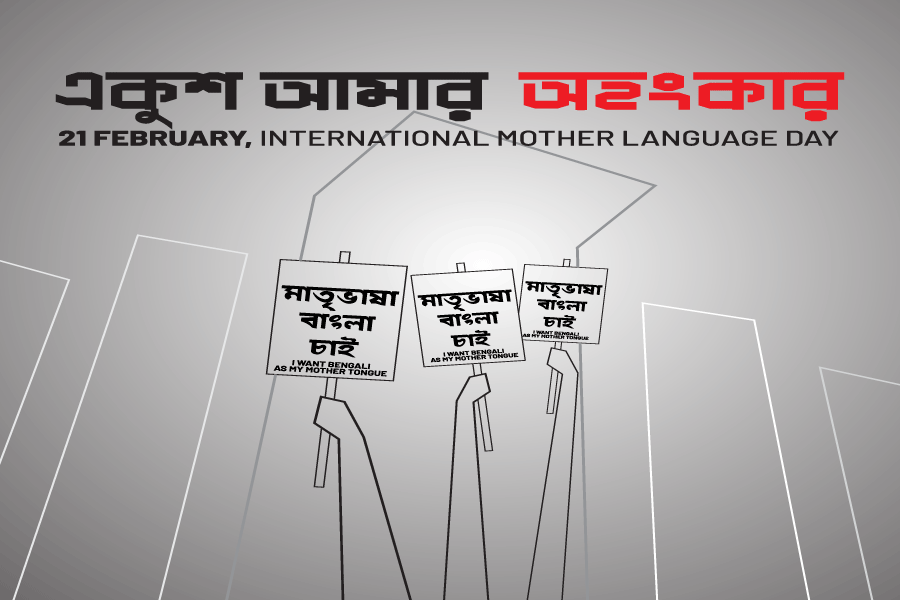
On a day meant to celebrate linguistic pride and cultural refinement, West Bengal’s political arena finds itself mired in acrimony, with personal attacks and sharp-edged rhetoric eclipsing substantive debate ahead of the 2026 assembly elections.
Once celebrated for its layered wit, ideological sparring and literary finesse, Bengal’s political discourse is increasingly dominated by rapid-fire exchanges designed for viral traction. Leaders across the TMC, BJP, CPI(M) and Congress accuse one another of lowering the bar, even as critics contend that all sides share responsibility for the decline.
The irony of International Mother Language Day is striking. The land that gave the world Rabindranath Tagore and Kazi Nazrul Islam now sees its political vocabulary shaped more by taunts that trend quickly than by arguments grounded in policy.
Veteran leaders recall an earlier era when political rivalry was sharp but seldom descended into crude personal attacks. From Marxist satire to Congress repartee and the TMC’s street-smart rhetoric, political speech was once considered an art form.
State Parliamentary Affairs Minister Sobhandeb Chattopadhyay conceded that standards have slipped, though he attributed the shift to broader societal change.
“Earlier, we criticised ideologies and political paths, but not in a disrespectful manner. There has been a serious decline in tolerance and patience among people. Politicians must remember that words spoken today can return as a boomerang tomorrow,” the 82-year-old TMC leader said.
He argued that political engagement has moved away from principles and towards expediency, observing that “now politics has largely become a scramble for power”.
State BJP president Samik Bhattacharya described the prevailing tone as “institutionalised aggression”, warning that insinuations about individuals are crowding out substantive critique.
Veteran Congress leader Pradip Bhattacharya termed the present phase “an all-time low”, attributing the deterioration to a thinning intellectual foundation within politics.
“One of the most significant reasons for this deterioration is the decline in intellectual depth among political leaders. Earlier, politicians read literature, philosophy and history. They had intellectual discipline and a broader worldview. Today, politics is confined to the immediate and the superficial,” he said.
The 81-year-old leader also pointed to changing public expectations.
“If a leader uses abusive language, sections of the crowd applaud. Political discourse has become coarser. Politics, in many ways, has turned into a closed pond. When it becomes insular and intellectually stagnant, degeneration is inevitable," he said.
The CPI(M), seeking to rebuild after years of electoral setbacks, has repeatedly flagged what it calls a “collapse of political culture”, contrasting current exchanges with an earlier phase marked by structured ideological contestation between Marxists, Congress stalwarts and regional forces.
TMC leader Kunal Ghosh countered that the erosion of civility did not begin recently, blaming the CPI(M)’s long rule for institutionalising confrontational political behaviour and arguing that the opposition now laments a culture it once nurtured.
Educationist Pabitra Sarkar widened the lens beyond Bengal.
“This is not limited to West Bengal; it is happening across the country. Politics reflects society. When social values decline, political discourse inevitably follows,” he said.
Historian Sugata Bose linked the shift to the absence of towering political figures who once defined Bengal’s public life.
“One of the major reasons for the decline is that we no longer have leaders of the stature we once had in pre- and post-Independence eras. Earlier, politics and debates were based on ideology and policy. Now politics is about capturing power and money,” the grandnephew of Netaji Subha Chandra Bose and former TMC MP told PTI.
Bengal’s political past featured formidable orators — B.C. Roy, Jyoti Basu, Pranab Mukherjee, Prafull Sen, Ajoy Mukherjee, Somnath Chatterjee, Siddhartha Shankar Ray, Indrajit Gupta and Bhupesh Gupta — who clashed fiercely on ideology but kept debate anchored in policy and constitutional norms.
Political analyst Moidul Islam situated the transformation within a broader trajectory of “depoliticisation” over the past 15 years.
“Bengal was historically known for deep political engagement. Today, that space has shrunk. When substantive ideological positions weaken, politics degenerates into personality-driven rivalries and verbal abuse,” he said.
Campaign strategists privately acknowledge that sharp barbs mobilise party workers and dominate news cycles. Rally speeches increasingly feature immediate rebuttals, generating a cycle of accusation and counter-accusation amplified by social media.
Short, provocative sound bites travel faster than nuanced arguments in an algorithm-driven ecosystem, rewarding aggression over analysis.
As the 2026 elections approach, some insiders anticipate a moderation in tone to appeal to undecided voters, while others predict further escalation as the contest tightens.
International Mother Language Day thus arrives steeped in contradiction. While leaders invoke Bengal’s literary legacy and celebrate linguistic heritage, the concern among observers is whether the state can restore civility and ideological depth before the 2026 assembly battle intensifies.