We live in a world that does not present itself uniformly. Some encounter it as a space of celebration; others experience it as a slow accumulation of unease — of darkness settling in, of violence quietly preparing itself. In such conditions, the human body adapts. Spines bend, postures adjust, and contours soften into shapes of capitulation and survival. Arindam Chatterjee’s figures emerge from this way of seeing. They are not heroic bodies; they are bodies that have learned how to endure.
This endurance is inscribed not only in posture but in surface. His figures often appear worn down, their skins rubbed thin, as though exposed to time rather than freshly painted. Pigment is worked into the paper through abrasion and withdrawal; edges remain unresolved, allowing bodies to blur into the ground. The result is a fragile sense of presence, where figures seem provisional, never fully secured within space.
This sensibility finds a pointed articulation in Avamanava, a body of work that reflects a condition of being neither fully human nor entirely other. Much of the exhibition (held at Emami Art recently) unfolds through drawings and works on paper, a medium that insists on proximity. Depth is compressed; backgrounds press forward, leaving little room for escape. Space behaves less like an environment and more like a pressure.
Conversation — or its absence — between humanoids lies at the core of the Jijnasa series. In The Flying Creature, it remains unclear whether the figure is trapped or in the process of tearing apart the remnants of a cage. Burning Pyres offers no sense of illumination or renewal. Flame appears as residue — ash, smoke, and charred tonalities that suggest finality rather than transformation.
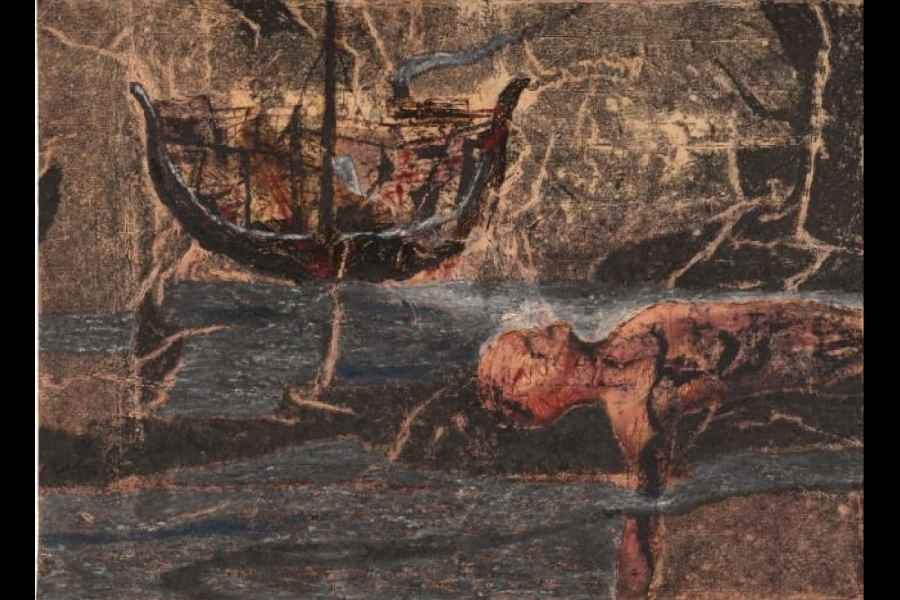
In Voyage, the ship is anchored to stillness, while the traveller, lifeless and adrift, hovers at the edge of drowning, echoed by the corpse-like presence in the foreground. Across these works, the landscape is strewn with images of hunting and devouring. A lone dog remains chained, unfed, and unaccompanied. The same unease extends into Shadows and the Empty House, where absence itself becomes a form of occupation.