What were you doing when World War I broke out… I hadn’t finished typing out my question for an Internet search, when the cheeky AI replied, out of turn, “As an AI, I did not exist when World War I broke out in 1914, etc.” Enthused by what I had stumbled upon, this time I typed, “What were you doing when the Iran War broke out?” The AI reply, “As an AI, I do not have a physical location or personal life, but I was processing real-time information as the conflict broke out, etc.”
Diss it all you like but the bot has an answer. How many of us do?
The first few days after the US-Israel attack on Iran on February 28, social media bobbed with images of a celebrity wedding, detailed reports on who all attended, who wore what, analysis of the groom’s non-expression… The OTTs dropped more than one new series and season. Then there were the cricket matches, their resolutions and the fireworks at night. Holi came and went, inboxes filled with offers of staycations, “Do us a favour. Stay as stubborn as the pakke rang on your face. Holi specials?” teased the food app…
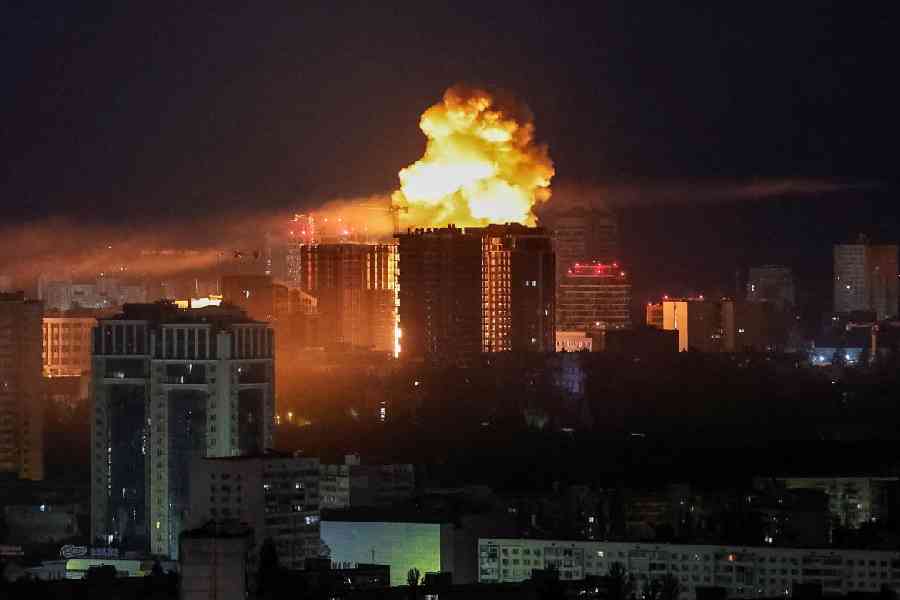
Day 8, 9, 10… Nabi Chit in Lebanon’s Bekaa Valley pounded by Israeli drones, 41 people killed; one Indian and one Bangladeshi immigrant worker reported dead when a military projectile from Iran struck Al-Kharj, a governorate in Saudi Arabia; a drone strike on the Bapco refinery in Bahrain and a massive fire. Unfamiliar names, distant places.
Of course, everyone knew that Dubai had been hit; after all, Dubai and its landmarks are to Indians — and the rest of the world — today what London with its Charing Crosses were for urban English-medium-educated Indians in the 19th and 20th centuries, a familiar unfamiliar.
This has happened courtesy the UAE’s army of influencers. The same influencers who started to stream the war until they mysteriously changed tack. One or two Indian travel vloggers also took to giving updates from conflict-ridden geographies — the parties at Israel’s bomb shelters, the friendly locals. An Insta story titled “ISRAELI City on Fire During War” turned out to be about fancy dress parties on the streets of Israel. Another reel titled “My Family & Friends are Concerned Coz Im Stuck in Israel During War” had This will be the day that I die playing in the background. Hashtag worldwar3. Sign off, “Be happy, spread love.”
The interrupted international flights had many aflutter with concern and then again all seemed to be well. Flights resumed, harried family and friends arrived and said nothing about war. Were they playing it safe? Had they been told to? One never knows. The political campaigns, bickerings and election moves continued, the dharnas too. And only when people and establishments started to feel the LPG pinch, when it started to look more like a punch, that is when Indians truly woke up to the war in West Asia.
***
Writer Kapil Krishna Thakur remembers the Sino-Indian and Indo-Pakistan wars from his growing up years in rural West Bengal. He talks about the fighter jets puncturing the skies, flying low, forcing people indoors; the “atonko” or terror all around; the mock drills for civilians. He says, “We lived close to the border and I remember the presence of military units, their trucks and tents, watching the emptying of schools and the creation of bunkers. War meant living through the shortage of kerosene and foodgrain.”
Scholar and writer Subhoranjan Dasgupta’s memories of his student days from 1968 to 1975 are entwined with the Vietnam War. He says, “No matter what our individual politics, there was an ideological consensus about war. And that is why we took to the streets to protest. Calcutta was awash with processions.”
The Vietnam War came close on the heels of the two world wars. “And the wars of 1962, 1965 and 1971 were actually so close home that they affected us,” says Thakur. He adds, “Those days there were people around us, elders who had lived through the hardships of World War II, they spoke of those times. Perhaps that too shaped our understanding of war.”
“We in India have never known high-intensity wars,” says Kaushik Roy, who is a military historian and professor of history at Jadavpur University, Calcutta. He continues, “Of the wars fought in the post-Independence period, the biggest in terms of casualties was the Third India-Pakistan War or the Bangladesh War of 1971. India suffered 5,000 casualties. More women die in childbirth. More people die in road accidents…”
Thakur spoke about the role of the radio in the courtyard at home back in the 1960s and early 70s, with its hourly bulletins reinforcing the gravitas of war. Sujan Dutta reported the Kargil War for The Telegraph in 1999. It was India’s first televised war. Looking back, Dutta says, “But for us on the field, reporting for print, we had no time to think of all that. There was the whole urgency of reporting from a conflict zone. One had to stay safe, and also had to figure out how to get the copy across to the desk in Calcutta.” He talks of the satellite phones and the missing links, and the all-too-budgeted talk time of one to one-and-a-half minutes. Dutta also reported for The Telegraph from Iraq during the 2003 invasion.
Thakur seemed to think that the moment war came to inhabit our screens like “cinema”, it lost its aura, its weightiness. According to Dasgupta, the war indifference we see around us is a byproduct of neoliberalism. “Jekhane ortho, ortho, ortho manusher dhyan, gyan… Where money, money and money is all that matters.” Dutta attributes the current oblivion to “an explosion of information, misinformation, disinformation”. It is he who points me to the book War in 140 Characters by David Patrikarakos. The second part of Patrikarakos’s title is — How Social Media is Reshaping Conflict in the Twenty-First Century. It was written in 2017.
***
Patrikarakos invokes the term “cyber utopianism”, which was coined by another writer called Evgeny Morozov. It defines the belief that the Internet favours the oppressed rather than the oppressor. But can any notion of utopianism fool a people who have been hammered by war?
Says Roy, “India’s demographic resources are huge; it is almost one-fifth of the population of the world. It is more than that of the US and even Europe. Compared to our population size, the size of our armed forces is small.” He elaborates on the
military participation ratio, how it is very low in India, how unlike Europe, the UK and Russia, we in India do not have any direct experience of war.
He says, “In the US during the Vietnam War, the casualty figures were staggering. We have never experienced anything like that. Look at Russia — since the Russia-Ukraine war broke out, Russia is facing a manpower shortage, conscription is a constant fear. During the world wars in Europe and during the Vietnam War, people in the US had to serve in the army. We don’t have this historical memory, which is why for the Indian urban middle class, war is something that happens far, far, far away.”
Nearly everyone I interviewed said that in a sense war, like war games, like trolling, is perceived from a distance as something that just plays out. All that frenzied participation on social media, all the egging on is possibly cathartic, releases personal anger. Dasgupta puts it all down to “a form of criminal solipsism where the social consciousness is totally at rest”.
And so, only when the otherwise shielded market suffers a jolt, only when the fire in the kitchen is imperilled, this utopia teeters. I can hear Pratul Mukhopadhyay’s impassioned voice singing from the skies those lines by Subhash Mukhopadhyay:
Priyo, phul khelbar din noy odyo,
Dhwangser mukhomukhi amra…
(My Dear, this is not the time to play with flowers
Not now, when we are faced with destruction.)
This is not the time to play with flowers or phones.