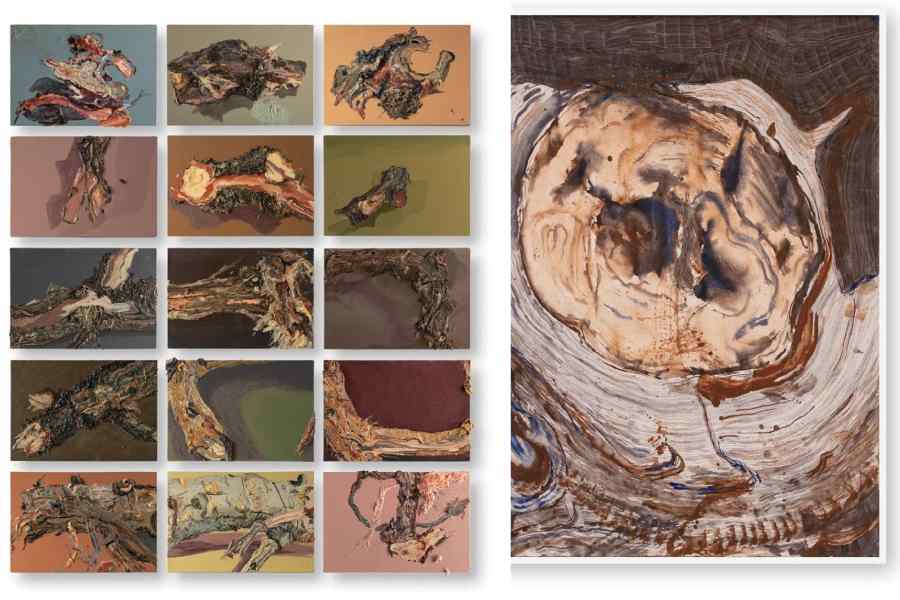
Rebecca Solnit once wrote about trees as witnesses that alter the scale through which time is understood. A similar sensibility underpins Vishal Kumar Gupta’s practice. The first thing that strikes the viewer in Field Notes (On the Afterlife of Trees) is restraint. Gupta’s debut solo exhibition at Emami Art gathers oil paintings, watercolours and graphite drawings that appear less concerned with spectacle than with sustained attention. The works linger on forms that most people step past without noticing: a broken twig, a weathered branch, the truncated body of a tree stump. In Gupta’s hands, these fragments acquire an unusual weight, as though the gallery has become a site where overlooked remnants of the natural world are granted a second life. These forms do not function as decorative motifs. They operate as physical records of time, their surfaces marked by the pressures of wind, decay and slow transformation.
Gupta’s method grows out of a practice shaped by observation and collection. During his years at Kala Bhavana in Santiniketan, and later during his Master’s studies in Baroda, drawing and photography became tools for studying the behaviour of natural forms. The works on display suggest that this habit of looking continues in the studio. Across the exhibition, images rarely arrive as complete or stable compositions. Instead, Gupta allows fragments, interruptions and repetitions to guide his work. A single curve of wood may appear in several pieces, shifting in scale or density. Some drawings are spare and searching, while the oil paintings build thick, impasto surfaces where pigment gathers and fractures under its own weight. These material shifts create a sense that each work is part of an ongoing inquiry rather than a finished statement.
What emerges from this accumulation is a quiet but immersive environment. Surfaces invite slow looking. Marks thicken, fade and reappear. In Field Notes, the act of painting becomes a form of attention extended over time, allowing fragments of the natural world to hold the viewer’s gaze long enough for their presence to be fully felt.