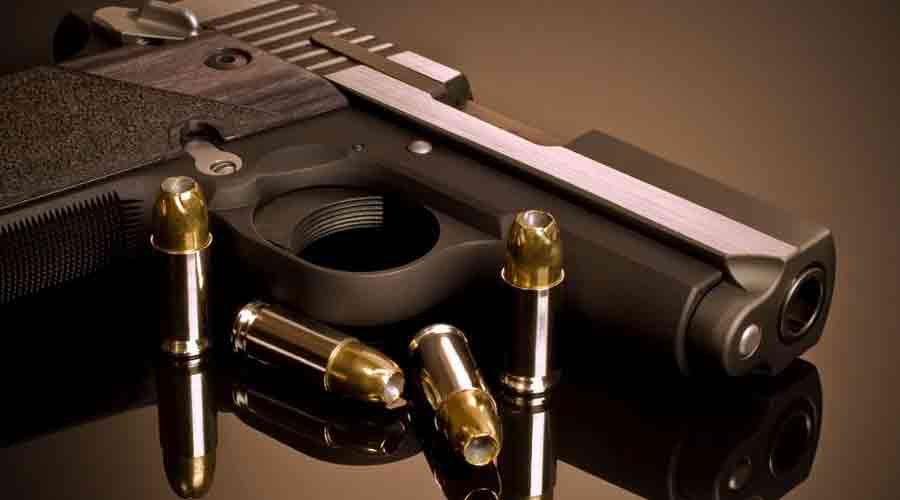
In a state where a gun that kills from up close is available for ₹4,000 and a “9mm pistol” that can kill from a distance costs no more than an entry-level smart phone, election authorities have reason to be wary.
Commission officials said they were expecting a bigger challenge maintaining peace in the second phase because of the predominance of urban constituencies.
Bengal police often face accusations of inability — or “lack of will” — to cut the arms supply lines.
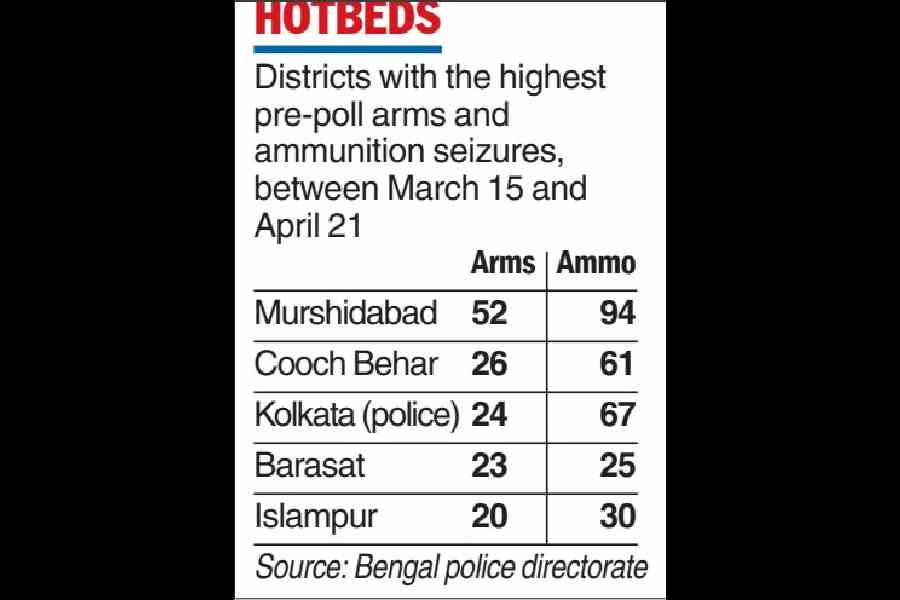
At least 332 illegal guns and 590 bullets have been seized in the state between March 15 — when the Assembly elections were announced — and April 21. The highest seizures came in Murshidabad, followed by Cooch Behar and Calcutta.
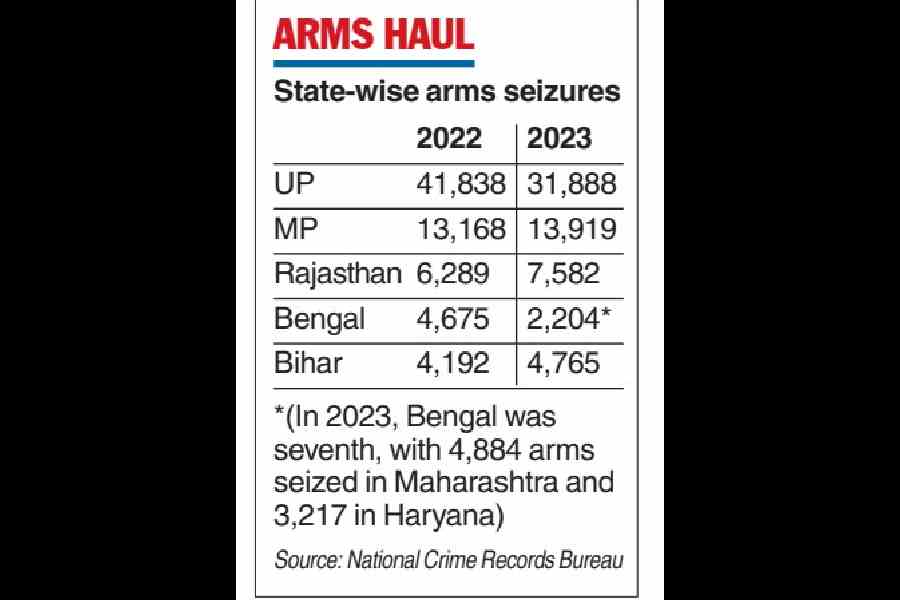
While gun crimes have risen consistently over the years, the gun seizures have decreased in the state.
A retired officer who has worked in city police’s Arms Act section said only a fraction of the arms that enter the state are seized.
Law-enforcement agencies say that most of the improvised guns with “made in USA” or “made in Serbia” tags that are available in Bengal have been made in neighbouring Jharkhand or Bihar.
One “Zatsava” gun loaded with eight bullets bearing the markings of a gun shell factory in Pune was used to attack Trinamool councillor Sushanta Ghosh in Kasba. The gun malfunctioned and Ghosh survived.
Original Zatsava arms are manufactured in Serbia. This one, the police said, was “made in Bihar”.
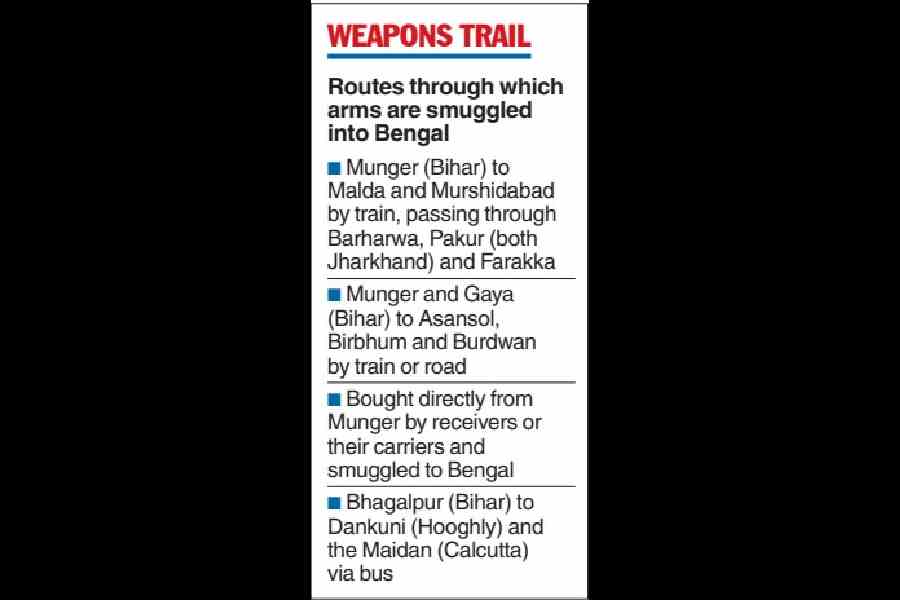
One of the commonest routes that arms smugglers use is the bus route from Bhagalpur in Bihar.
“They come by bus from Bhagalpur. Sometimes, to avert suspicion, they bring their wives along, who hide the guns in their saris if intercepted,” an officer with Bengal police’s special task force (STF) said.
“They either get off at Dankuni (on Calcutta’s northwestern outskirts across the Hooghly) or at the Maidan (in the heart of the city).”
STF teams have since 2023 unearthed at least 10 illegal arms factories in Bhagalpur, Munger, Chapra, Dhanbad, Giridih, Bodh Gaya and Cuttack.
In a recent pre-election raid, the Calcutta STF picked up a man hailing from Bihar and found carrying a cache of arms in the Rajabazar area.
Sources said the traditional way to smuggle guns into Bengal is by bus. But guns are now increasingly being assembled on Calcutta’s outskirts, mostly in makeshift lathe factories, to cut costs.
In 2020, illegal arms-making units were busted at Nimta in North 24-Parganas, and in West Burdwan.
In 2019, the STF unearthed an arms unit in Pilkhana, Howrah, a year after an illegal arms factory was busted in Domjur, also in Howrah.
“It’s not easy to detect such units, which run either in the garb of lathe factories or engineering goods manufacturing factories,” a senior police officer said.
Sources said lathe machines are easily available in central Calcutta, and the pipes used in making gun barrels are available near Thanthania Kalibari in north Calcutta.
“No one can stop you from legally purchasing a lathe machine or an iron pipe. It’s impossible to keep track of what the purchaser is doing with them,” a police officer said.
Prices
A crude, single-shot gun that has to be reloaded every time one fires costs around ₹4,000. It may be slightly costlier ahead of an election because of “demand”, an officer said.
But these single-shot guns do not come with a guarantee that they would fire straight, and are often hazardous for the shooter. The barrel has been known to explode in a user’s hands.
Improvised five or six-chambered revolvers cost more, but not more than a basic smart phone.
“The market value of a semi-finished, improvised 7.65mm revolver varies from ₹12,000 to ₹15,000,” a senior officer said.
“These semi-finished firearms are manufactured in various parts of Bihar and Jharkhand, and then sent to Munger in Bihar for further finishing to convert them into ready-to-use guns.”
The workmen use hand tools and gas burners or furnaces, the officer said.
“The raw materials used are springs and bicycle frames for magazines. Once the gun is completed with a steel body, the market value of each 7.65mm shoots up to anything between ₹32,000 and ₹40,000,” he said.
Bullets
The criminals’ guns may be improvised but the bullets are genuine, senior officers said.
“They are stolen from ordnance factories or bought from licensed vendors at a premium. Sometimes police arms are snatched in Maoist areas and change hands,” a Bengal police officer said.
N.C. Daw and Company, a century-old gun shop within 200 metres of the city police headquarters, Lalbazar, was searched and sealed last year after discrepancies between sales and procurement were detected in its stock registers.
The owners were arrested. They are accused of selling old weapons deposited with them to unauthorised people, and manipulating records to claim excess bullet use for testing or to show sales that never happened.
Police role
Are the police doing enough?
The short answer is, “No.”
Officers of various ranks that this newspaper spoke to said a shortage of dedicated officers and personnel made it difficult to pursue the arms chain.
“It takes months to develop a lead. We keep track of the suspects for months, and only after we follow them closely do some genuine leads develop,” a Bengal STF officer said.
“Unfortunately, not many in the force have the patience to pursue such leads.”
Arms seizures should be a routine activity, an officer said. But none of the specialised units has a separate wing for arms seizures.
Tracking illegal arms and ammunition can require inter-state intelligence.
Sometimes, it’s not possible to pursue all the leads because other tasks, such as maintaining law and order and investigating crime, take priority, police sources said.