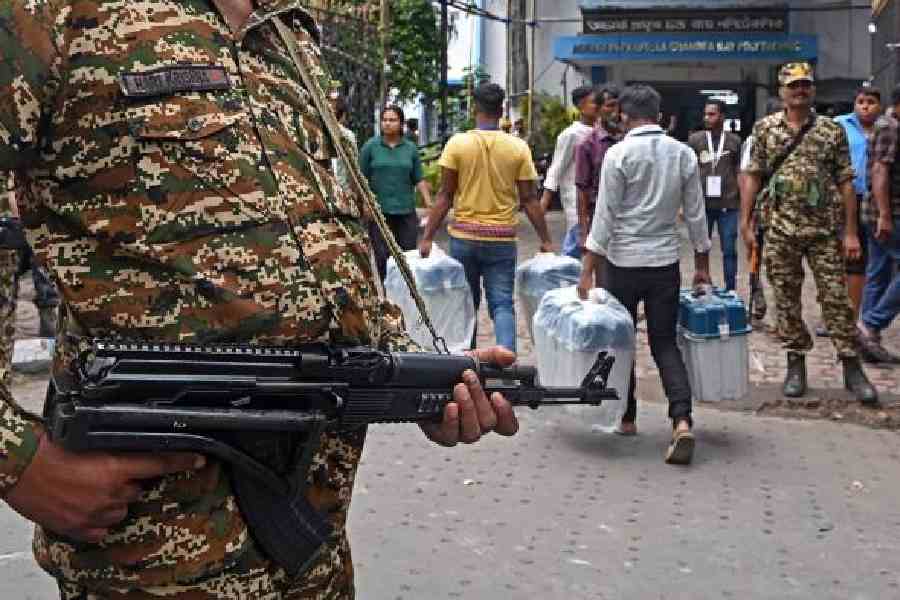
Many are hailing the 2026 Bengal elections as violence-free, with some even crediting the Election Commission as the player of the match.
But others are questioning that narrative altogether.
An election in which around 3 million residents were denied their right to vote can hardly be described as peaceful, said some of those who were deprived of their franchise. Those affected, along with several who voted in protest, said the absence of bloodshed does not translate into the absence of violence.
While acknowledging that no lives were lost, political commentators and social scientists said that violence is not limited to physical harm. They said violations of rights and harassment also amount to violence, both in philosophical and legal terms.
“The Supreme Court has not dubbed the right to vote a fundamental right. But my interpretation is different. Voting is a form of speech. Freedom of speech is a fundamental right. The violation of that right is a form of violence,” said political scientist Maidul Islam.
He pointed out that more than 30 lakh people were left out of the electoral process, while appellate tribunals restored voting rights for 99% of those who were heard. “What then is the justification of the Election Commission? This raises questions about the legitimacy of the election,” said Islam, who teaches at the Centre for Studies in Social Sciences, Calcutta.
On February 28, the poll panel published a “preliminary final” post-SIR list. More than 5 lakh names were deleted, while 60 lakh were placed under adjudication. Of these, 27 lakh were removed after scrutiny of logical discrepancies. Of the 27 lakh, the cases of only 1,621 voters were heard by tribunals — just over 0.06% — and 1,607 of them had their names restored, or 99%.
The SIR, presented as a reform exercise, resulted in large-scale exclusion. The process caused unprecedented suffering as well as social impact, affecting the sense of citizenship and belonging among multitudes, especially those on the margins.
“I don’t know what will happen to the deleted voters. I keep hearing about detention camps in Assam. If our appeals are rejected, will we be sent to such a camp?” asked Sk Maytab Hussain, 25, a tailor in Metiabruz who lost his vote.
Disenfranchised urban, affluent voters also have their own battles.
Imran Zaki, 58, a businessman and social worker who has travelled to over 50 countries with his Indian passport, has lost his voting rights along with his octogenarian father.
“My daughter voted for the first time on Wednesday. What should have been a memorable day turned into grief for my father and me. This is not just personal disappointment, but a serious concern for democratic rights and transparency,” said Zaki, a voter in Chowringhee.
Nandita Roy, a teacher at IIM Calcutta who has also lost her voting rights, said: “Violence has multiple forms. The State has disenfranchised millions. That is also a form of violence.”
Upal Chakrabarti, associate professor of sociology at Presidency University, said focusing only on polling day gives a distorted picture.
“The management of the polling day was very efficient. However, one should consider the electoral process in its entirety, not just the act of casting the vote. There was a unique structural violence in these polls. Voters were denied their fundamental right. The entire administrative machinery caused the violence,” he said.
The electoral process involved multiple alleged violations, including those affecting the right to vote, citizenship, belonging and security, Chakrabarti said. “The process also violated the peace of millions.”