Jammu and Kashmir’s two capitals, Srinagar and Jammu, were connected by a direct train on Thursday.
But the larger demand for the Valley to be linked seamlessly with the rest of the country appears unlikely to be met anytime soon, amid claims that such a development could diminish Jammu’s strategic and economic importance.
On June 6 last year, Prime Minister Narendra Modi had thrown open a train service that connected the Valley with the country’s rail grid, realising a 130-year-old dream.
But the train ran only up to Katra in Jammu, forcing passengers to switch trains for the onward journey, often after waiting hours.
Railway minister Ashwini Vaishnaw on Thursday flagged off the 20-coach Vande Bharat Express between the cities of Jammu and Srinagar, extending the train from Katra to Jammu City.
Vaishnaw said the next priority was track-doubling to enable more train operations along the Jammu-Srinagar rail corridor.
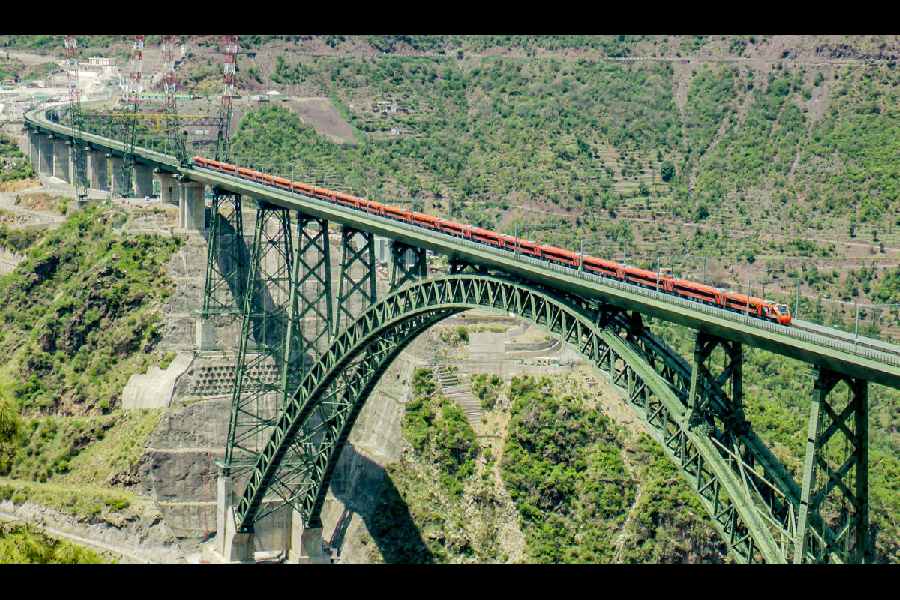
He said the Valley-Katra train, “passing over the world’s highest (railway bridge, the) Chenab bridge”, had become “a huge hit”.
“This train has 100 per cent occupancy. More than five-and-a-half lakh people have travelled so far. We are serving Dogri and Kashmiri food on this Vande Bharat,” Vaishnaw said.
“This train can be operated in minus-10-degree temperatures and the piping is such that water can’t freeze. In the last snow season we tried this train and, according to that, this new 20-bogie train was modified. Higher specification electronics are used, and 3,000 microchips are being installed in this Vande Bharat.”
Chief minister Omar Abdullah congratulated the railway ministry and said an eight-bogie train had been converted to one with 20 bogies, allowing 1,400 people to travel from Jammu to Srinagar daily.
“This train has given us a lot of benefits. Cement, and even cars, are being sent through the train to Srinagar; fruit is also being sent to other states from Kashmir,” Omar said.
“We need a dry port in J&K, and we want custom clearance to be done in J&K for goods to be exported. We were waiting for this day.”
Many in Kashmir, however, remain sceptical about the possibility of direct connectivity between the Valley and the country’s rail grid.
A businessman in Srinagar blamed political considerations for this not happening.
“Not many people from the Valley preferred trains because they needed to switch trains, which was extremely hectic. The problem persists, although we can at least travel directly to Jammu,” he said.
Pankaj Gangwar, principal chief security commissioner, the Railway Protection Force, said regular services between the two capitals would begin from May 2.
He said the railways would operate a pilot vehicle ahead of the train to ensure security. “It will move in advance in the morning and address any shortcomings along the route,” Gangwar said.
The railways have set up guard posts after every 2km. These will be manned by quick reaction teams made up of Government Railway Police and civil police personnel.
The 327km Jammu-Katra-Srinagar-Baramulla railway line, built for ₹43,780 crore, includes 36 tunnels, together spanning 119km, and 943 bridges.