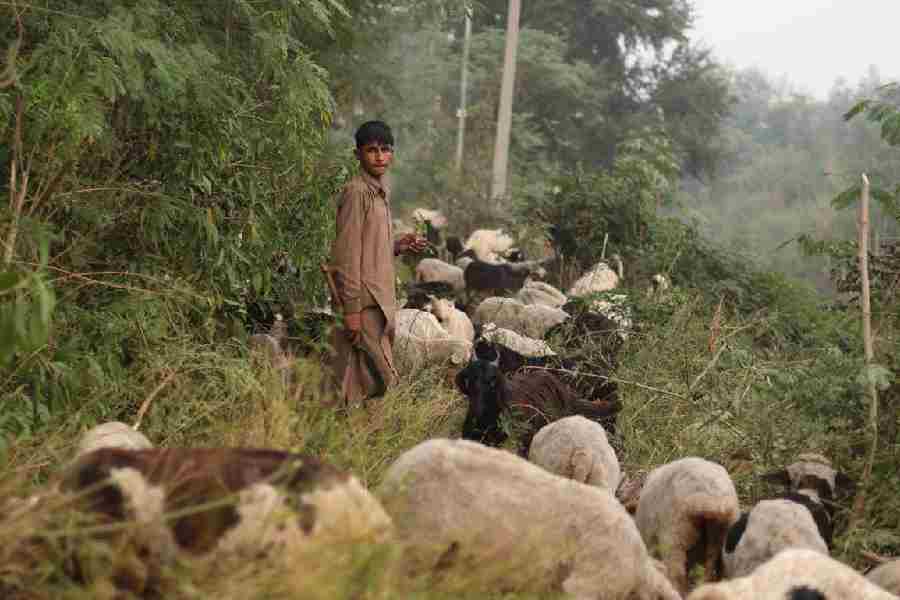
In Imtiaz Ali’s 2014 film Highway, Veera and Mahabir trek through Kashmir’s alpine landscapes, walking away from their traumatic pasts, deep into an unknown but idyllic terrain. They come across a group of Bakarwal pastoralists herding goats and mules, who take them in.
In many a Bollywood film, indigenous communities form part of the background when the story briefly moves away from urban settings to rural areas. In real life, they help conserve nature and support society.
Kashmir’s Gujjar, Bakarwal, Gaddi and Sippi communities who are khanabadosh or animal herders and move between fixed summer and winter pastures provide, according to a recent University of Oxford policy report, ₹6,000 crore worth of ecological services annually.
These services are varied and either help prevent natural disasters such as forest fires or supporting irrigation, hydropower and urban water supply in the Himalayan region.
“People think pastoralism is a dead profession and has no place in modern society or that at best it is a cultural relic worthy of preservation. The monetary valuation underscores the tangible benefits it brings to society,” says Shahid Sulaiman, founder of the Himalayan Pastoral Trust, a collective of pastoral youth from across the northwestern Himalayas.
Jammu and Kashmir has 6.4 lakh khanabadosh or transhumant pastoralists. Sometime end-March, 5 lakh of them set off from their villages to highland pastures, seeking climate and fodder best suited for their animals. Just as winter sets in and snow starts blanketing the grass, they trek back.
Their biannual movement between nature and human settlements makes the khana-
badosh emissaries between the two domains, and enables them to provide the crucial ecosystem services.
But this exposure to nature also makes them vulnerable to climate change.
In 2025, it snowed in June, when the khanabadosh were up on the alpine pastures. This year, snow in end-May has disrupted herd movements along several routes. “Our animals had nowhere to graze for days,” says Sulaiman.
Along some routes, herds are held up by unseasonal rains. This leads to bottlenecks in the upper pastures as herds travel in batches and have to queue up and wait for those before them to finish grazing before they can move in.
Even a day’s disruption is a financial hit. Unlike ranchers or farmers, their animals are not used to being held indoors and eating cut feed; they must graze outdoors in nature.
Add to that the problem of dry winters. This again means less water for animals around their homes in the lower reaches, as well as less winter snow on the upper pastures, which in turn leads to less water from snowmelt during summers.
And it is not just the animals that suffer. Pastoralists, after all, consist of families.
Pastoral systems are routinely held up as examples of sustainable production systems that adapt to nature’s rhythms, limit themselves to ecosystem boundaries and can cope with the unpredictable disruptions of climate change. What is much less clear is how to support them.
Jammu and Kashmir has set up seasonal education centres in the upper pastures so that khanabadosh children continue to learn during the summer months. However, it is a challenge finding qualified candidates willing to relocate to dhoks, which are alpine pastures and the seasonal homes built around them. The community, has the lowest literacy rate among any community in India.
“It remains a challenge to convince the khanabadosh that formal education is worth their time,” says Sulaiman. The Himalayan Pastoral Trust has tied up with government schools to develop context-relevant educational material in native languages and learning modules that are practical.
Nothing highlights the disconnect between government institutions and mobile communities more strongly than the history of India’s forest laws. British-era laws criminalise grazing, shifting cultivation and gathering of forest produce. Post-independent legislation was less extractive but focused on conservation, which in practice meant creating protected nature reserves, pushing forest communities out and into settled agriculture.
Finally, the Forest Rights Act of 2006 came along, which acknowledged past injustices. It was extended to Jammu and Kashmir in 2019. Not that it has drastically changed the lives of the khanabadosh. Says Sulaiman, “A large number of khanabadosh quite literally live outside society. They do not know about the Forest Rights Act; they live in a parallel world.”
Until their rights are formally recognised, the khanabadosh remain encroachers on their lands, and under constant threat of eviction and demolition of their homes.
In 2025, the responsibility of implementing the Forest Rights Act was transferred from the forest department to the department of tribal affairs. Khanabadosh leaders and organisations like the Himalayan Pastoral Trust live in hope that this will lead to a more just implementation of the Act. In a parallel universe, 2026 is being observed as the UN International Year of Rangeland and Pastoralists.
Abraham Abhishek is project manager at the University of Amsterdam and a part-time journalist