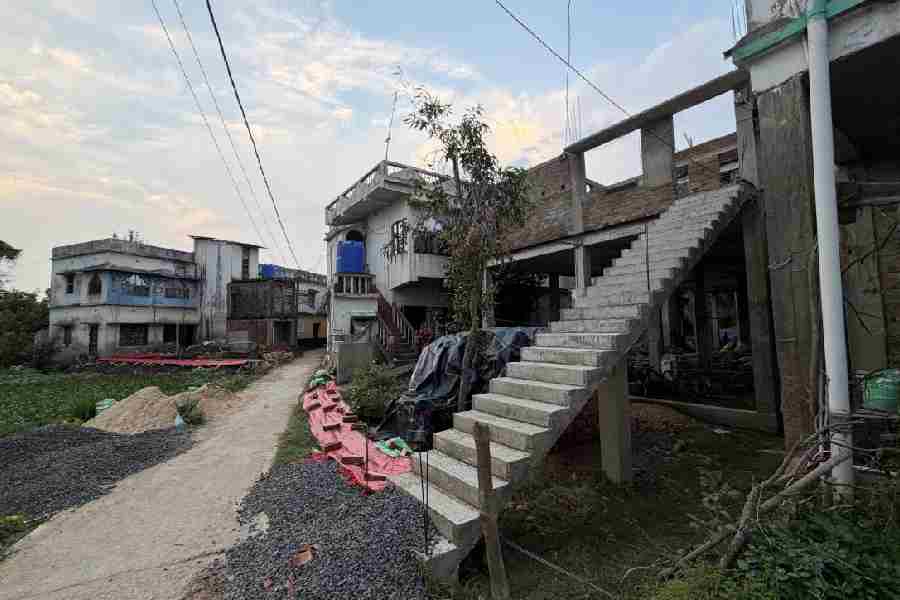
Come monsoon, and a flight of stairs in the Samanta family’s two-storey home in Ghatal’s Shyampur village turns into their lifeline.
For the Samanta household — and those privileged to have a two-storey house in deluge-prone Ghatal in West Midnapore — stairs spell survival.
Like most of the region, Shyampur has been surviving floods for decades and things haven’t changed since CPI MP Nikunja Behari Chowdhury raised the issue in Parliament in 1956 when Jawaharlal Nehru was the Prime Minister.
And although the Ghatal Master Plan or GMP — a massive flood management programme — had its foundation stone laid in 1982, execution remains infamously delayed. The reason — protracted political dead-locks over funding, bureaucratic delays and knotty land acquisition issues.
And so, while the Indian Meteorological Department routinely forecasts the monsoon-entry date in mid-May, for the Samantas it is time to press their survival instincts into action. In slow and steady measure, they begin to realign their lives on the first floor of their home.
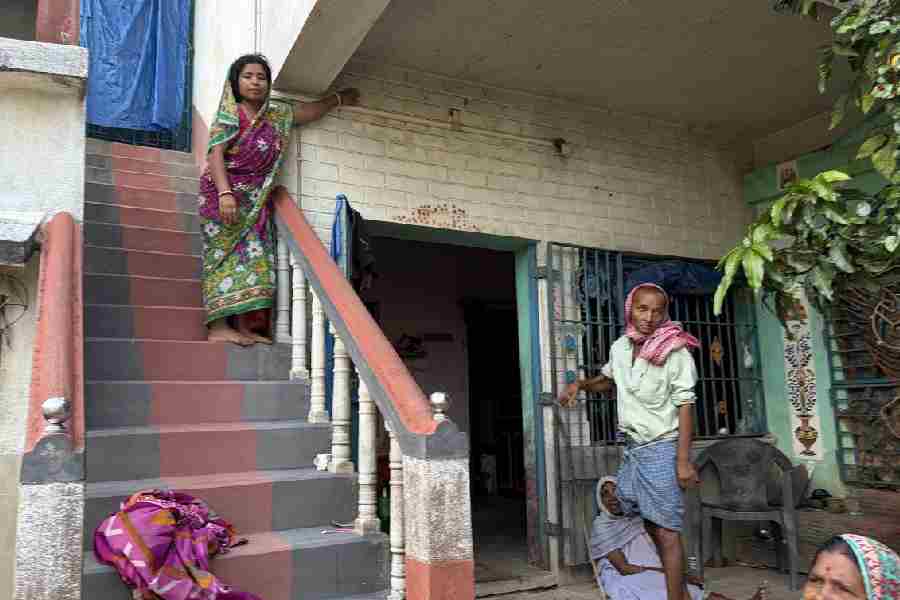
Mitali (standing) points to the level breached by the floods last year
“The shift is not just us moving a level up, it requires carrying everything from the ground floor — fridge, furniture, TV, fans, lights, utensils,” says the short but doughty Mitali Samanta. “And mind you, unlike you city guys who would hire labourers for such jobs, we do it all by ourselves,” the homemaker adds.
It is still summer but suddenly there is a heavy downpour. The spell does not last long and the sun reclaims its position, although dark clouds threaten to rob its shine any moment.
But for now, the humidity is much less and a cool breeze is blowing. The early evening is surprisingly pleasant, comfortable enough for people to be outdoors.
Wearing a green and purple sari with floral prints, Mitali is combing her hair in the company of a few neighbours. At a distance, her mother-in-law sits in the verandah, reclining against the ground-floor wall that gets inundated when floodwaters gush in from the overflowing Silabati and its canals.
The verandah, which is about 3 feet high, is the first elevation from the road level. From that concrete platform, a flight of at least 17 steps leads to the first floor, which is built at a height of no less than 13 feet. The usual ceiling height in modern-
day houses, it may be noted, is 9-10 feet.
Ask Mitali about the unusual architecture and she drops her comb, covers her head with the end of her sari, sprints nine steps up and stretches out her left hand to a point above the white casing for electric cables to the first floor. The spot is about 12 feet from the floor.
“Bonya-r samay jol ekhan obdi uthe aashe... During floods, the water rises till here,” she says. “Khub koshto eibhabe bneche thaka. Barshar maashgulote chhele-meyeder lekhapora kora prai oshombhob... It is difficult to survive this way. In the monsoon, it becomes almost impossible for our children to continue with their studies.”
Mitali’s husband Ratan Samanta, wearing a blue striped lungi with a gamchha covering his head, is pacing up and down the verandah. He reiterates, “Everything needs to be taken down before the monsoon. Year after year.”
There seems to be no sign of reprieve, although a couple of kilometres away, workers are desilting a canal as part of the GMP.
Ratan’s house in Shyampur is down a muddy slope — a “road”, according to panchayat officials — off the state highway not far from bridges over the Silabati and an adjoining canal.
As one climbs down the path, it takes less than a hundred steps to reach Shyampur. On the way is a culvert on a canal linked to the Silabati. The canal, barely 30 feet wide, is the reason Shyampur’s sorrow flows this way.
Governments have come and gone at both the Centre and
the state but Shyampur remains where it is.
No one knows it better than Ratan’s 78-year-old neighbour Ramapada Samanta. A man of frail health, Ramapada stands with difficulty on the staircase of his two-storey house that faces the canal. The wall above the grille-door entrance is fixed with ceramic tiles imprinted with pictures of Hindu gods and goddesses. A prayer for divine intervention, perhaps.
“Even the presence of gods and goddesses has not been able to save our house. Why blame the divine? They also get marooned when the waters rise,” says Ramapada, his voice almost choking.
The vulnerability of Shyampur’s residents — according to Census 2011, there are at least 166 families there — is stark, staring at anyone who would care to see. The most they can do is brace themselves for the calamity by restructuring their lives every monsoon.
“What else can we do? My grandfather has seen this. We heard him talk about six-month-long inundation. The silver lining, if any, is that the duration of flooding has reduced significantly these days,” says Ramapada, stoically.
Ramapada’s grandson Santanu Samanta refuses to believe the master plan will materialise anytime soon.
“That has been the lesson for all of us. Do it yourself is the lived experience of everyone in Ghatal and neighbouring Daspur,” he says, pointing to their boat lying face down on the canal bank.
And that is another lifeline for a people submerged by government failure. “It is our only mode of transport during the floods. Also crucial are the bridges on the Silabati and its adjoining canal. When our homes are flooded, the bridges on the state highway are where we take our cows and goats for safekeeping. After all, they are our livelihood,” the farmer in Santanu speaks out.
So what’s next in their survival plan?
“We cannot sit and wait for the GMP to be completed, or dream of the day when all the floodwaters will flow into the Rupnarayan,” says Mitali, and points to the new structure coming up on the adjacent land.
“That’s going to be our new home. Count the number of stairs. It is more than the number of stairs in our current house. It lifts the height of the first floor to combat the rising water level. There will be no ground-floor rooms as our lives will be permanently realigned on the first floor. It will be difficult but we need to choose our battles,” Mitali says, fighting to control her tears.
People like Mitali are aware that it is not the time to break down. The water level in the rivers and canals in and around Ghatal is rising and the only way to survive is to plan strategies and implement them on one’s own. Which, in Mitali’s case, is climbing the stairs of their new home to an even safer height.