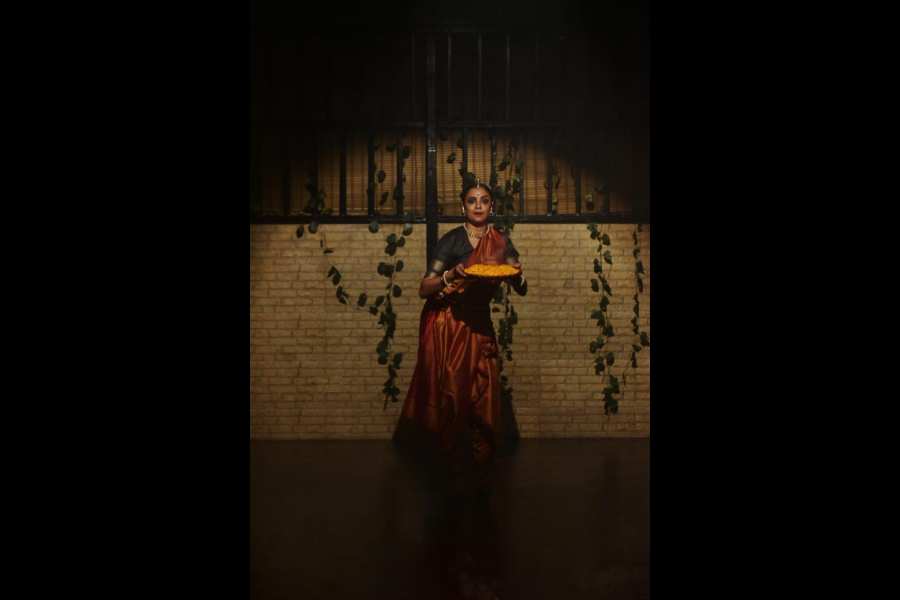
A sparsely done-up space with natural elements and textures, flickering candles, and subdued electrical lighting was the exquisite venue where Shashwati Garai Ghosh recently presented a measured and composed iteration as the first performance of a series called Uttsarg. Avani, Angashhuddhi’s thoughtfully-designed stage, functioned as a calm, uncluttered platform that supported and, indeed, shaped the three exquisite dance pieces she had carefully curated for that evening.
Ghosh began with the deeply atmospheric Devi Bharani, a meditative evocation of the goddess, Sambhaleshwari, based on a ritualistic tradition of Western Odisha created by her guru, Sharmila Biswas. The folk paradigm of the work, its soundscape blending evocative chanting with temple drums, flute and ambient resonances, its choreography a powerful dialogue between movement and sound, merged so completely with the surroundings that the boundary between performance and space quietly dissolved, creating the sense that the work would inhabit the environment even in the dancer’s absence.
With the weight of her tradition behind her, Ghosh’s pallavi was, however, a compellingly individual creation that was as meditative as it was energetic in its exploration of pure dance. The contemplative mood of dhwani, exploring the relationship between sound and silence, lent a serene inwardness to the dance piece that was virtuosic and elegant.
Poorna, Ghosh’s final piece, was a reckoning with the idea of completeness. It plunged into love’s varied registers with Radha’s restless adoration and Sakhi’s silent, self-effacing devotion to Krishna at its core. In Ghosh’s choreography, these seemingly divergent impulses are drawn into a single, unbroken current where longing accumulates a searing spiritual force. This fusion propels the work towards moments of near weightlessness, a state that Ghosh inhabits with urgency. Her movement language holds together Poorna’s central paradox, pulling the audience into the emotional and the sensorial gravity of the experience in the subtly darkened space of Avani. The voices of Dipannita Acharya and Sucheta Ganguly heighten this pull, their impassioned singing allowing the performance to turn inwards, where love steadies into trance and finally transforms into a charged pursuit of the unknown.
Presented at Gyan Manch as part of Nandanik Movement Arts’ 30th anniversary celebrations, the Khonthang Festival featured Krishna Kubuja Samvad as one of its central offerings. Conceived, scripted and choreographed by Poushali Chatterjee, the work revisited a Mahabharata episode in which Krishna heals the body of Kubuja, a hunchbacked woman. Following her transformation, Kubuja, swept by joy, erupts into praise for Krishna. The narrative reveals that Kubuja was Surpanakha in another birth and Krishna was Ram. By imagining that she dances with Krishna, in the closing moments, Kubuja becomes the site through which Surpanakha’s thwarted desire for Ram is symbolically redeemed. The resolution rests on the logic that female longing is deferred across lifetimes and reconciled only through bodily transformation and divine sanction.
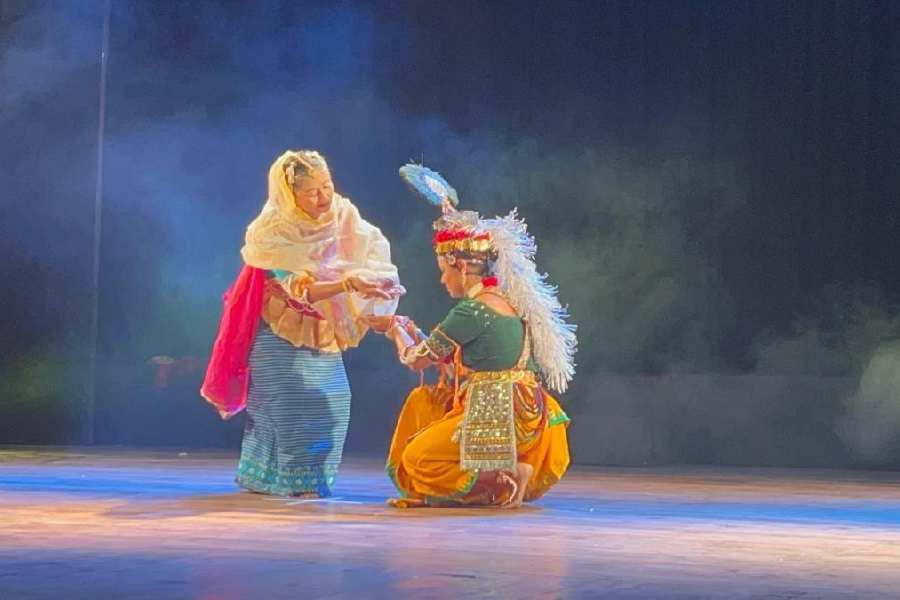
Poushali Chatterjee Source: Kathakali Jana
Earlier in the evening, Chatterjee presented her students in Ta Ri Ta Na, a pure dance composition drawing on elements of Manipuri Nat Sankirtana. Sakshat Darshan, Guru Bipin Singh’s composition, was maturely performed by Chatterjee, tracing Radha’s rapture at Krishna’s ineffable beauty even as it registers her acute anxiety over scrutiny by her peers and in-laws. As part of the evening’s pedagogic emphasis, the charis and hastas fundamental to Manipuri training as conceived by Bipin Singh were assembled into a presentation offered disarmingly by children. Another segment, Pung Yeiba, showcased Manipur’s iconic drum dance.