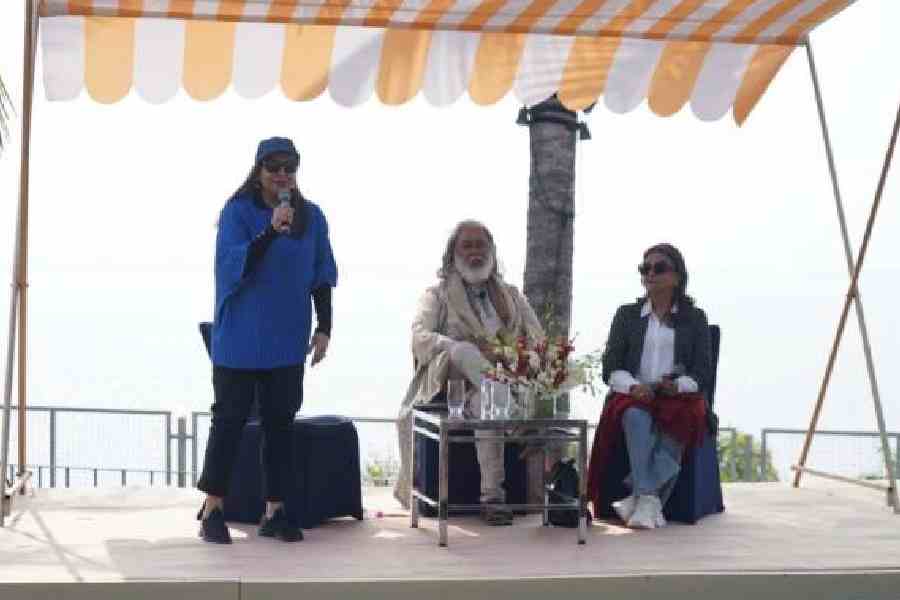
As the Hooghly stretches languidly past Raichak, carrying centuries of memory in its current, Taj Ganga Kutir Resort & Spa feels less like a venue and more like a pause, a reflective space where art, conversation and introspection are allowed to breathe. It is here, amid whispering trees and the quiet authority of the river, that two of India’s most formidable cultural voices — Shabana Azmi and Aparna Sen — came together for an unfiltered, deeply humane conversation on acting, creativity, responsibility and the changing moral landscape of art.
Moderated by cultural thinker Kalyan Ray, the session was not a masterclass in technique alone. It became, instead, a rare philosophical excavation of what it means to perform, to observe, to endure, and ultimately, to remain porous to life itself. With warmth, humour, dissent and mutual admiration, Azmi and Sen, friends and colleagues of many years, peeled back decades of experience across theatre, cinema and activism, offering a dialogue that moved seamlessly between craft and conscience. Excerpts from the afternoon at the cultural retreat at Taj Ganga Kutir Resort & Spa, Raichak.
Is an actor born or made?
Kalyan Ray opened the discussion with a deceptively simple question: is acting an innate gift, like music often is in hereditary lineages, or is it a craft that can be learnt, like sculpture or painting?
Shabana Azmi was quick to dismantle the assumption even before answering it. “Sculpture is not a good example,” she said firmly. “There are great sculptors, just as there are great actors. Talent may be god given, but talent alone is never enough.”
For Azmi, acting exists at the intersection of instinct and discipline. Emotion is vital, but it must be tempered by craft. On stage, where a performance is repeated night after night, one cannot depend solely on emotional spontaneity. In cinema, where a camera lens magnifies the smallest tremor, unchecked emotion can quickly tip into excess, she said.
“What fascinates me most about acting,” she added, “is that two people are always working simultaneously. One is feeling the emotion completely, truthfully. The other is observing — aware of the camera, the lens, the movement, the technical demands.” This duality, she suggested, is what defines craft. The actor is both inside the moment and outside it, calibrating performance without diluting truth. Acting, then, is a raw diamond... luminous but unfinished, that must be polished through training, awareness and time.
Observation as education
Aparna Sen agreed, though her route to the craft was notably unstructured. “I never had formal training,” she admitted candidly, “and I don’t see myself as a great actress.” Yet observation, she suggested, is its own education. Speaking of her daughter, actor-director Konkona Sensharma, Sen noted that while Konkona lacked formal training, she learned by watching, absorbing, intuiting, refining. Still, Sen believed that structured training could only have strengthened that natural ability.
What concerned her more, however, was when effort becomes visible on screen. “There are actors who haven’t had training,” she said, “and you can see the effort. The effort must never show.” Echoing Azmi’s earlier point, Sen described acting as a divided act, one part of the self emoting freely, the other monitoring posture, light, framing. Legendary actor Soumitra Chatterjee, she recalled, once advised her to think of cameras and microphones not as obstacles, but as collaborators.
“They are your friends,” he had said. “You take the light, you take your position and half of you watches, while the other half forgets.” Some actors, Sen noted with wry self-awareness, are blessed with faces and muscles that “listen” to them. Others, herself included, struggle to translate inner emotion into visible expression. Uttam Kumar, she recalled, overcame this through relentless self-study, practising in front of mirrors as one would practise an instrument. “The body and face are the instrument,” Sen said simply.
Method, myth and the Hoffman–Olivier anecdote
The discussion soon veered into one of acting’s most beloved myths — the legendary clash between method acting and classical technique.
Azmi recounted the oft-told story from Marathon Man, where Dustin Hoffman reportedly exhausted himself physically to inhabit a tortured prisoner, only for Laurence Olivier to quip: “My dear boy, why don’t you just try acting?”
While the anecdote is frequently used to critique method acting, Azmi was careful to nuance the argument. As a student of Konstantin Stanislavski herself, she believed deeply in emotional truth but warned against fetishising suffering.
“Unless you are in the moment,” she said, “you never get it right. You cannot force it. The feeling has to be there.” At times, actors may use triggers, memories, sensations, but these are not substitutes for emotion. They merely enhance it. Ultimately, much of an actor’s labour is guided by the director, and when an actor surprises a director with an unexpected truth, it becomes a gift to the film itself.
Director’s eye: accidents, instinct and control
Kalyan Ray brought up an anecdote from Satyajit Ray’s Teen Kanya (Samapti), where an accidental slip by Aparna was retained in the final cut because of its unrepeatable authenticity. This opened a wider discussion on how much control a director should exert. Sen responded with a story of her own — one involving spiders, fear and a fall from a tree during Samapti. The fall, she revealed, was entirely real, triggered by acute arachnophobia.
Ray, instead of stopping the take, laughed and kept the shot. “That moment,” Sen reflected, “could never have been acted.” She went on to describe Ray’s casting philosophy: faces mattered as much as skill. Often, Ray cast non-actors whose physiognomy carried an emotional truth, using framing, close-ups and minimal direction to extract meaning. But for emotionally dense scenes, Sen was unequivocal, trained actors matter. “With good actors,” she said, “you must leave them alone.” She cited her work with both Shabana Azmi (Sati) and Konkona Sensharma (15 Park Avenue), noting that over-directing such actors could disrupt their inner rhythm. Other actors, however, required precise instructions — movement, gesture, timing. “Direction,” she concluded, “depends entirely on who you are directing.”
Waiting, patience and the discipline of stillness
From craft, the conversation drifted toward endurance... the long, unglamorous hours of waiting that define an actor’s life. Azmi recalled advice from theatre director Ebrahim Alkazi, who once told her that talent was not her challenge, patience was. She described early years spent waiting endlessly on set, often juggling two shifts a day, with co-stars arriving hours late. Yet she never allowed waiting to turn into resentment.
“My mother (Shaukat Azmi) told me,” Azmi said, “‘Your commitment is to the producer, not the star.’ And that stayed with me.” Without vanity vans or comforts, actors waited under trees, reading books, conserving energy. Patience, she learnt, was not passive, it was a cultivated skill.
Sen added dryly that she reminded Konkona that she was paid as much for waiting as for acting. Waiting, she said, is part of the job, much like life itself.
Stage, screen and the truth of the moment
Was there a fundamental difference between acting on stage and acting for cinema? Azmi disagreed. The process of building a character, she argued, remains the same. What changes is time — theatre allows rehearsal, cinema offers little preparation, television offers none. What differs most profoundly, however, is adrenaline. Theatre offers an immediacy that cinema cannot replicate, a live feedback loop with the audience. Yet even here, she warned against pandering.
“My mother told me,” Azmi recalled, “‘When you feel the audience slipping away, don’t chase them. Go back to the truth of the moment. They will return.’” It was advice she carried throughout her career.
Melodrama, Western gaze and cultural decibels
Having worked extensively with Western filmmakers, Azmi was asked whether different cinematic cultures demanded different acting grammars. “There is a lower decibel level,” she acknowledged. Recounting her experience on City of Joy with Roland Joffe, she described resisting an instinctive gesture, cradling a dying man, because the director found it melodramatic.
“I felt melodrama, in the right proportion, is not a weakness,” she argued. “Earlier Hindi cinema used it beautifully.” To reject melodrama entirely, she suggested, is to reject emotional access, something Indian audiences historically understood well.
Neurosis, vulnerability and the fine madness of acting
One of the most arresting moments of the afternoon came when Azmi stated, without irony, that actors must be neurotic. Civilised society demands emotional restraint, she argued. Acting demands the opposite, emotional readiness, summoned on command. “Take number 17,” she said, half-smiling. “Emotion number 23. Come on.” If one can cry at will, she suggested, one must be a little mad, a fine madness, perhaps, but madness nonetheless. And this, she added, is why actors need partners who understand the volatility of the profession.
Acting as reaction and the weight of inheritance
Great acting, both Azmi and Sen agreed, thrives on reciprocity. Two strong actors elevate each other because acting is fundamentally reactive. “You don’t have to do anything,” Azmi said. “If the person in front of you is telling the truth, you just have to look.” Sen lamented older cinematic practices where actors were instructed to look away from each other during emotional scenes, a symptom, she believed, of discomfort with naked emotion.
As the afternoon drew toward its close, Ray shifted the focus to lineage — to poetry, inheritance and voice. Azmi, daughter of Kaifi Azmi and wife of Javed Akhtar, deflected the familiar question with humour. “I don’t write poetry,” she said. “I provide the inspiration.”
Sen then introduced a reading of Jibanananda Das’s Banalata Sen, translated by her father. Hearing Azmi read the English translation — lyrical, restrained, resonant felt like a culmination of the day’s themes: translation, embodiment, fidelity to essence.
Gender and the politics of naming
A question from the audience about the use of “actor” versus “actress” prompted a revealing exchange. Azmi explained her early insistence on the gender-neutral “actor” as a political choice professions, she argued, should not be defined by gender.
Sen admitted she once resisted labels like “women’s film festival,” but later came to embrace the idea of celebrating the female gaze, not as limitation, but as perspective. “I want my cinema to be informed by being Asian, Indian, Bengali, and a woman,” Sen said. “Why should that be a problem?”
Asked what they admired and could not fathom about each other, the tone softened into affection. Sen praised Azmi’s humour and her empathy toward directors. “She understands the director as a human being,” Sen said. “That makes all the difference.”
Azmi, in turn, spoke of Sen’s intelligence and lamented the financial constraints that still burden a director of her calibre. Her anecdote about Sen’s “Bombay English” and a near-disastrous storm shoot during Sati drew laughter and warmth, underscoring the camaraderie between two women who have shared decades of creative risk.
Intellectual property, AI and the uncertain future
The conversation veered into the territory of intellectual property and artificial intelligence. Sen spoke bluntly about exploitative contracts that strip creators of future rights. Azmi warned that actors have been dangerously complacent, often signing away likeness and voice without foresight. Referencing a Black Mirror episode, she cautioned that AI replication is no longer speculative, it is imminent. “We will have to treat AI like a friend,” she said, “not an enemy. But we must take it seriously.”
Art, activism and the moral residue of acting
Perhaps the most moving segment came when Azmi spoke about social engagement not as choice, but inevitability.
Acting, she said, forces one to inhabit marginalised lives. Over time, those lives leave residue. After Arth and later Paar, she found herself unable to walk away from the realities she had portrayed. A friendship with a young woman living in abject poverty became a turning point. “If I had done nothing,” Azmi said quietly, “I would have used her.” That realisation propelled her into sustained activism, not from saviourhood, but from accountability.
At Taj Ganga Kutir, between river and silence, Shabana Azmi and Aparna Sen reminded us that acting, like living, is less about performance than presence. And presence, as both women showed, is the hardest craft of all.