At Convergences: A Shared Ground — Lineages, Practices, Futures (on view at Emami Art until today), what connects the works is not a common aesthetic but a shared way of working. Surfaces show signs of careful mending, materials move through more than one life, and skills are passed on through practice rather than formal instruction. The exhibition draws attention to the idea that materials and makers shape each other over time, and that objects carry the stories of labour and environments that produced them. Instead of treating artworks as finished, self-contained pieces, the show focuses on the processes that led to their creation. Bringing together artistic, craft, and architectural traditions from eastern and northeastern India, Convergences highlights methods rooted in close engagement with local materials, seasonal rhythms, and collective knowledge. In doing so, it quietly challenges the long-standing divide between art and craft, presenting making as a continuous activity shaped by experience, necessity, and place.
The thebvora shawl, for instance, reflects remarkable artistry, combining hand-foraged stinging nettle fibre with painstaking spinning, natural dyeing, and intricate backstrap loom weaving to produce surfaces rich in texture and with subtle tonal variation. The tradition has evolved into contemporary design such as tailored jackets that retain the fine craftsmanship, textured surfaces, and restrained graphic elements of the original form.
Tribal artforms like Kurmi Khovar and Sohrai paintings — represented here by Putli Ganju, Rudhan Devi and Sajhwa Devi, among others — are conceived as cyclical acts of creation, renewed with each season and life event. Created by using locally-sourced earth pigments, plant materials, and simple tools, they embody the same close relationship among maker, material, and environment that the exhibition foregrounds. The paintings are learnt through observation and repetition within households, passing from one generation to the next without formal training.
Ujjal Dey situates domestic work within the exhibition’s exploration of embodied knowledge, presenting everyday labour not as background activity but as a sustained, creative practice that quietly structures both material culture and artistic form. The soft fabric scrolls, layered with tightly repeated patterns, use natural dyes and inks that are prepared through processes that mirror the very domestic labour they invoke: grinding, boiling, washing, and straining. Ujjal Sinha’s sculptural practice introduces a strikingly kinetic dimension. His works recall, in spirit, the wind-driven constructions of Theo Jansen. Built from modest materials and assembled through precise, labour-intensive processes, Sinha’s sculptures appear less as static objects than as systems designed to respond to the forces around them. His practice remains rooted in the ethos of resourcefulness that runs through the exhibition. The use of accessible, often everyday, materials situates his work within a lineage of making shaped by necessity and adaptation.
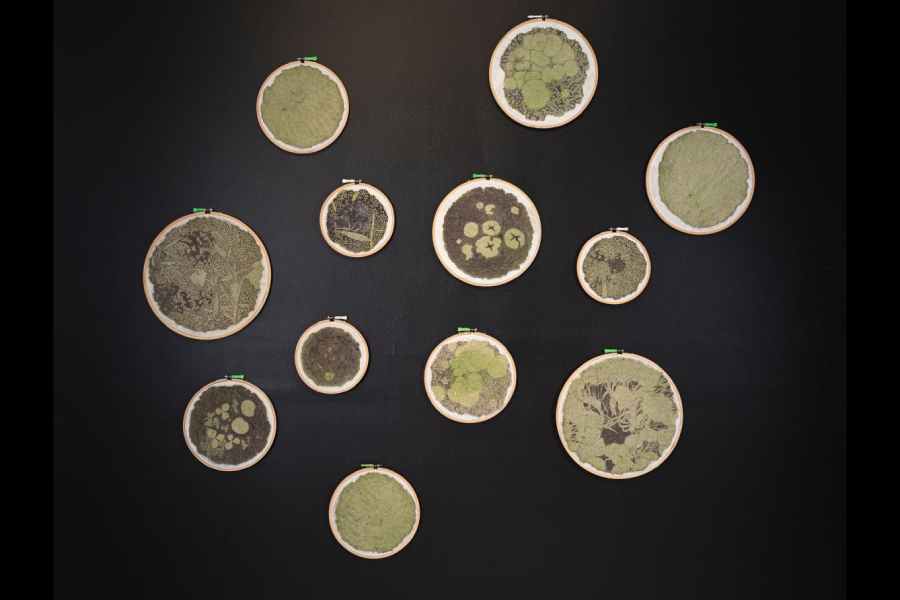
Ruma Choudhury treats nature as both source and archive, collecting discarded organic materials such as banana fibre. She transforms these fragile remnants into abstract compositions shaped by organic paper that she makes herself. In doing so, she uses the processes of gathering and preservation to reflect ecological depletion and the quiet disappearance of natural identities. Simi Deka’s works unfold like quiet surfaces of ponds held in stillness (picture). Her ink drawings on handmade paper take the form of lowland wetlands, echoing the floating geometry of hyacinth leaves, the soft spread of algae, the delicate persistence of moss. Her pieces deepen the exhibition’s engagement with ecology by treating waterbodies not as scenery but as living memory. The restrained marks and muted tonal fields evoke both calm and loss, suggesting environments that endure through fragility rather than permanence. In their quiet repetition, these works become acts of attentive looking, preserving the textures of places that risk slipping out of everyday awareness.
Anshu Kumari’s patchwork maps unfold between terrain and textile. Stitched from discarded fabrics, they resemble aerial views of fields and rivers even as they recall worn quilts that have passed through many hands. Their intricate seams hold fragments of memory, binding land, labour, and identity into surfaces that appear both fragile and enduring. Silpinwita Das turns the act of dyeing into a form of revelation. Using natural pigments, she creates works that seem to summon the very plants from which colours are drawn, allowing leaves, stems, and organic textures to appear as both source and image.