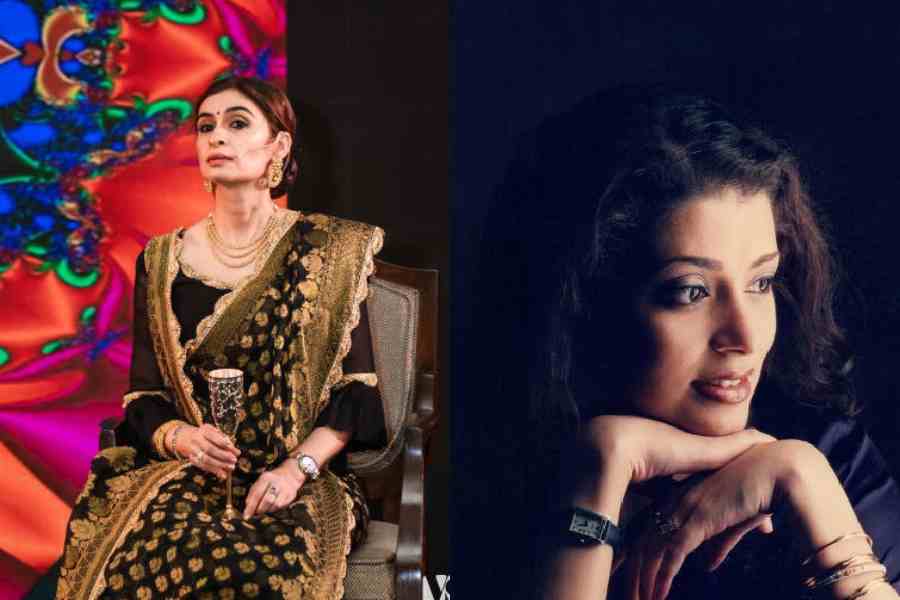
Multihyphenate talent Isheeta Ganguly is all set to not only bring her play Three Women to the big screen, but also in the form of a graphic novel. A t2 chat with Isheeta.
What can you tell us about your successful stage production Three Women being adapted into a graphic novel?
This is the first time any kind of story of Tagore writing on women is being adapted into a graphic novel by a major publisher. As I work on the graphic novel edits, it highlights a lot of the key themes of what makes Three Women a unique story, both from a graphic novel perspective and from the perspective of a film.
An Audible recording of Three Women is happening as well. I may have Nandita Das as the voice of Kadambari. We are aiming at a full-blown auditory experience which will roughly come out at the same time as the graphic novel, which is around May.
The key aspect which has kept me rooted to the story of Three Women, as I now go on to make a film on it as well, is that fundamentally it is a story of how women’s desire is an engine for growth and transformation. It is also about these women not being clear of their purpose, of what it is they want out of their own lives. Their desire becomes a channel for these women to come into their own. Kadambari really wanted to become a writer. She was a frustrated artist on so many levels, trapped in a home with her sisters-in-law trolling her, her mother-in-law trolling her, and her own self-expression, creativity and personal freedom completely being suppressed. But I gave Kadambari a different ending, with the ghost realising her creative potential and becoming a professor in the modern day. Charu becomes a writer, saying that she may not have Amol but she has her writing.
Tagore’s sensitivity in creating these characters, which were autobiographical, and in terms of his own relationship with Kadambari, was quite progressive. To be able to enter a woman’s mind of loneliness and longing and create that reality through a convincing narrative was his strength as a feministic author.
The journey of desire is an arc that is also applicable to women’s lives today in terms of how we navigate our career, personal life and aspiration. In a nutshell, working on the graphic novel and bringing forward this theme has been very exciting.
Visiting them through a new format, did you discover any new aspects to these characters?
Yes. The story of these three women is also the story of what it is like for modern-day women who lead lives of quiet desperation. When you can’t fully express yourself, then you can’t fully assert yourself. The time-travelling ghost in Kadambari gives us the chance to ask if we could see things differently, what if we could have more, what if we could take charge of certain aspects of our lives.... The story is ultimately about how they harness their intellectual power to become their own person on their own path. I find that very relatable to what women’s stories are cross-generationally in 2026.
And you are set to bring Three Women to the big screen as well...
I have signed an NDA (non-disclosure agreement) with the production house and can’t talk too much about it right now. In terms of casting, I have interest from Rani Mukerji and John Abraham. I hope to engage talent from Tollywood as well. Paoli Dam has been passionate about Three Women.
The story is about a dysfunctional mother-daughter relationship. The vibe is like Piku and Zindagi Na Milegi Dobara. There is, of course, the element of Kadambari’s ghost that haunts the women of the family and the mother and daughter have to face the dysfunction of their relationship, address it and heal themselves through it. In the end, there is an element of catharsis. It is quite a mad ride, what with this crazy family going through a hilarious search from one Calcutta spot to another trying to find Kadambari’s heirloom by midnight on Kali Puja.
Between the US and India, what else is keeping you busy?
I am excited about my stage production Shakuntala Awaits. It is coming to NMACC (Nita Mukesh Ambani Cultural Centre) in Mumbai in May. NMACC is bringing its New York cast to India. I am thrilled about that because it is, after all, an Indian-American story, about the diaspora, about a couple in New York that falls in love in a precarious way through a one-night stand, and then she becomes pregnant, but he loses his memory, much like the Shakuntala-Dushyant story. We plan to take it to other locations in South-east Asia. The Three Women graphic novel will be launched in New York with a live reading by three actresses, one of which is Calcutta girl Mahira Kakkar. Through the story of Three Women, we will be stressing on women in leadership and the importance of women to take charge. That is a powerful message that we are carrying forward in partnership with McKinsey.
There is also my work in the social sector. Last year, I attended UNGA (United Nations General Assembly) in New York. Since then, I have been asked to join the Mumbai advisory consortium by (American economist) Jeffrey Sachs. My work as a playwright and filmmaker and what I am doing in the social sector run parallel to each other. That is because the story is the same. It is about women trying to aspire beyond their survival, to find agency with purpose. Survival is also the focus of the social sector, like in cases of high-risk maternal mortality and high-risk adolescent health issues. Ultimately, what we are trying to do is empower women to fulfill their dreams. That is becoming more and more of a reality as we see women across socio-economic groups taking charge of their lives beyond survival.