The world’s highest mountain, Mt Everest, has inspired explorers, mountaineers and dreamers for generations. While most Indian travellers who dream of visiting Everest Base Camp think of Nepal, just a handful think of the other route — the one that approaches the mountain from its majestic north face through Tibet. It was this less-travelled path that drew us.
Our journey began in Calcutta with a direct flight to Kunming. From there, we travelled through Beijing and Xi’an before finally arriving in Lhasa, the ancient capital of Tibet. Unlike a conventional holiday, this journey demanded more involved planning. In addition to a Chinese visa, visitors require a Tibet travel permit, issued only through an authorised travel agency. Independent travel is not permitted within Tibet.
The extra planning, however, is part of what makes the journey special. Few travellers from Calcutta choose this route, and that sense of venturing somewhere largely unfamiliar made the experience even more fascinating.
As our aircraft descended into Lhasa, the landscape below transformed dramatically. The lush greenery of lower altitudes gave way to rugged mountains, broad valleys and an endless plateau stretching towards the horizon. We had arrived on what is often called the ‘Roof of the World’. What we did not anticipate was how quickly the altitude would remind us where we were.
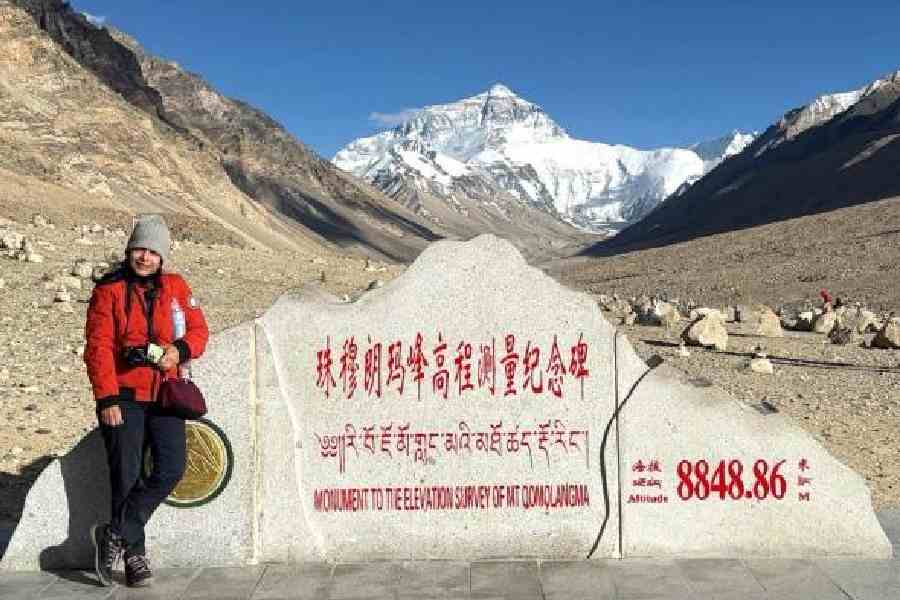
The writer with marker for Mount Everest with the peak in the background
Lhasa: Learning to Slow Down
Lhasa sits at approximately 3,650m above sea level. The moment you arrive, the city quietly teaches you an important lesson: slow down.
We had made one mistake before reaching Tibet. Ideally, medication to help prevent altitude sickness should be started well before arriving in Lhasa. In the excitement of planning the trip, we had forgotten about it. And within hours of landing, our bodies reminded us.
The first two days were difficult. A persistent headache refused to leave. Nausea, weakness and overwhelming fatigue accompanied even the simplest activities. Walking slowly became essential. Climbing a single flight of stairs felt surprisingly demanding. At one point, I needed supplemental oxygen for nearly half an hour.
Travel brochures rarely speak about these moments, yet they are very much part of the experience of travelling at high altitudes. Looking back, I would advise anyone planning this journey to spend at least two or three days acclimatising in Lhasa before travelling any higher. The mountains are not going anywhere. There is no prize for rushing.
Thankfully, by the third day, my body had adjusted. Only then did Lhasa begin to reveal itself. The city has an unmistakable spiritual rhythm. Pilgrims carrying prayer wheels quietly circle temples from dawn until dusk. Elderly Tibetans perform full-body prostrations with astonishing devotion. Colourful prayer flags flutter against deep blue skies while the magnificent Potala Palace watches over the city as it has done for centuries.
But as memorable as these sights were, they were not what stayed with me the most. It was the people. Children smiled at us as we walked past. Shopkeepers greeted us warmly. Even without a common language, there was a kindness in their expressions that made us feel unexpectedly welcome. Little did we know that the warmth of Tibetan hospitality would soon leave one of the deepest impressions of our entire journey.
Kindness Beyond Language
One of the strongest memories I brought home from Tibet was not of mountains, monasteries or breathtaking landscapes.
It was of its people.
One evening, after a long day of exploring Lhasa, we found ourselves hopelessly lost while trying to locate our hotel. We had what we thought was the correct address, but every turn led us to another dead end. Unlike back home, the navigation apps we instinctively relied upon were of little help, and with every passing minute we became more confused.
Eventually, we walked into a small neighbourhood restaurant hoping someone could point us in the right direction. Two young women looked up from their work, smiled, and immediately tried to help. Neither of them spoke English. Yet for almost half an hour, they patiently communicated with us through translation apps on their phones.
They searched maps, compared addresses, made phone calls and refused to give up until they found our hotel. They did not have to do all this. We were complete strangers who would probably never cross their paths again. Moments later, our hotel receptionist arrived on his scooter and personally guided us back through the maze of narrow streets.
As we followed him through the evening traffic, I found myself thinking how extraordinary kindness can be. Sometimes it needs no common language. Looking back, that evening captures Tibet for me far better than any monument or photograph ever could.
The Road to Everest
After spending a few days acclimatising in Lhasa, we travelled west along the scenic G318 Highway to Shigatse (3,845 metres), Tibet’s second-largest city and the traditional seat of the Panchen Lama, the second-highest spiritual leader in Tibetan Buddhism. Winding past
Tibetan villages, the shimmering waters of Yamdrok Lake, the magnificent Karola Glacier, overlooked by the sacred peak of Mount Noijin Kangsang (7,191m), and the historic town of Gyantse, it was one of those journeys where every bend in the road revealed another breathtaking landscape.
Everest Base Camp
The drive from Shigatse to Everest Base Camp takes seven to eight hours, but calling it simply a drive hardly does it justice. It is an expedition across the Tibetan Plateau, the world’s highest and largest plateau.
Beyond Lhatse, as we entered Tingri County, the Tibetan Plateau revealed its true scale. Civilisation slowly gave way to vast open landscapes beneath an impossibly large sky. Tiny Tibetan settlements became fewer and farther between, while prayer flags fluttered from rooftops and yaks grazed peacefully across the vast grasslands.
Then came Gyatsola Pass. At 5,280m above sea level, our guide suddenly pointed towards the mountains.
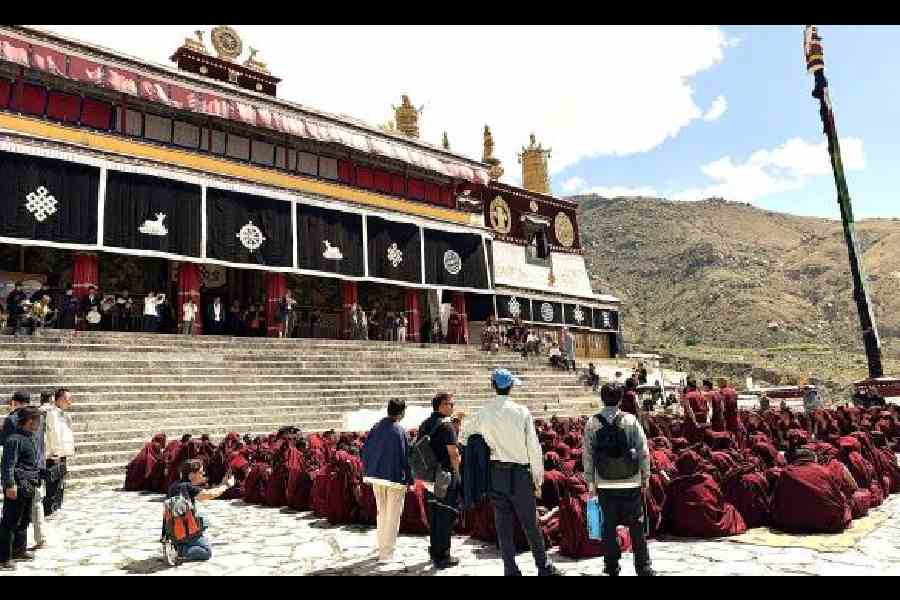
A monastic debate under way at Drepung Monastery
“There,” he said.
At first, I couldn’t see it. Hidden behind neighbouring peaks, Everest appeared almost shy, its summit rising delicately above the mountain range like the petals of a lotus just beginning to bloom. It was my first glimpse of the highest mountain on Earth. Soon afterwards, we entered the Mount Everest National Nature Reserve and climbed towards Gawula Pass at 5,198m.
If there is one viewpoint along the journey that deserves to be remembered, it is this one. Spread before us was an astonishing panorama of the Himalayas, where several of the world’s highest peaks stretched across the horizon, with Everest commanding the skyline. The road wound through countless hairpin bends below us, reminding us just how far we had climbed.
Beyond this point, private vehicles are no longer permitted. Everyone transfers to a government-operated electric bus for the final 40-minute journey to Everest Base Camp. I found that rather fitting. The quieter approach somehow felt respectful. Almost as though the mountain deserved to be approached with a little less noise and a little more reverence.
None of us spoke very much during that final stretch. Perhaps we were tired. Perhaps the altitude had slowed our conversations. Or perhaps each of us was quietly preparing to meet a mountain we had known only through photographs, books and documentaries.
When Everest Finally Appeared
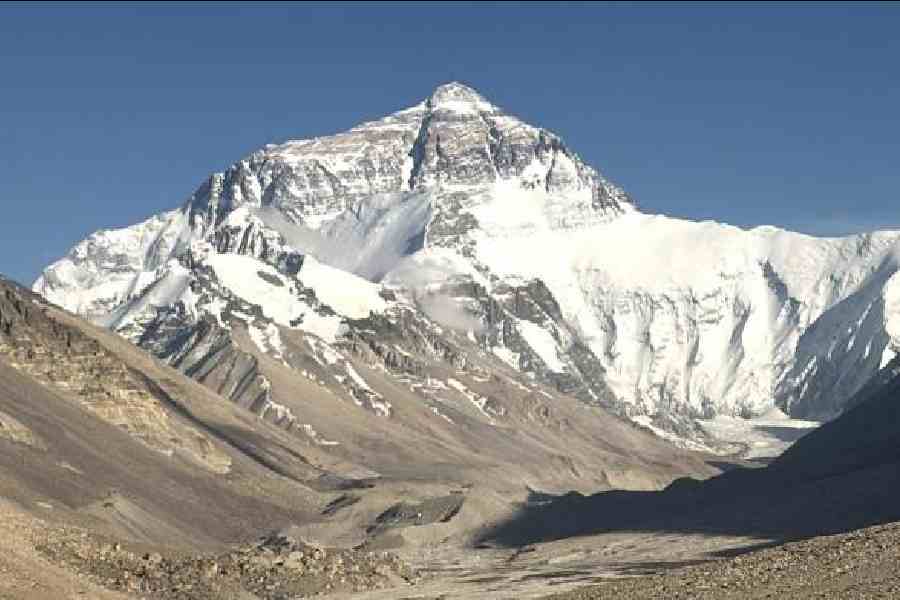
Then, almost without warning, Everest appeared. No photograph had prepared me for that moment. It felt surreal to realise that I was no longer looking at an image in a magazine or watching a documentary on television. I was standing there, at more than 5,200m above sea level, looking directly at Mount Everest itself.
From the Tibetan side, Everest doesn’t immediately overwhelm you with its height. Standing on the vast Tibetan Plateau, almost level with the Himalayan giants, the mountain appeared more understated than dramatic. But the longer I looked, the more its immense presence revealed itself. For a few moments, I simply stood in silence.
Months of planning, countless hours of travel, the altitude and the long road across Tibet — everything else seemed to disappear. There was only Everest. We had arrived at Everest Base Camp in the late afternoon. With sunset still a few hours away, I assumed I would have plenty of time to return to camp for warmer clothes before the light began to change.
It was a mistake. Dressed in little more than a T-shirt and a jacket, I had completely underestimated the Himalayan cold. The wind grew stronger with every passing minute, cutting through my clothes with an intensity I had never experienced before. Yet I could not leave. What was meant to be a brief stop became more than three hours. I eventually found a quiet spot, sat down, and simply watched. Time lost all meaning.
Around me, visitors came and went. Cameras clicked. Conversations rose and faded into the wind. Yet my eyes never wandered far from the mountain. It held me completely. As the cold slowly crept through every layer I was wearing, a familiar song began playing in my mind. Pink Floyd’s Comfortably Numb. I smiled to myself. It felt strangely appropriate.
My body was becoming increasingly aware of the freezing wind, yet my mind had drifted somewhere entirely different. I wasn’t thinking about the altitude anymore. Or the cold. Or even the long journey that had brought me here. I was simply...present.
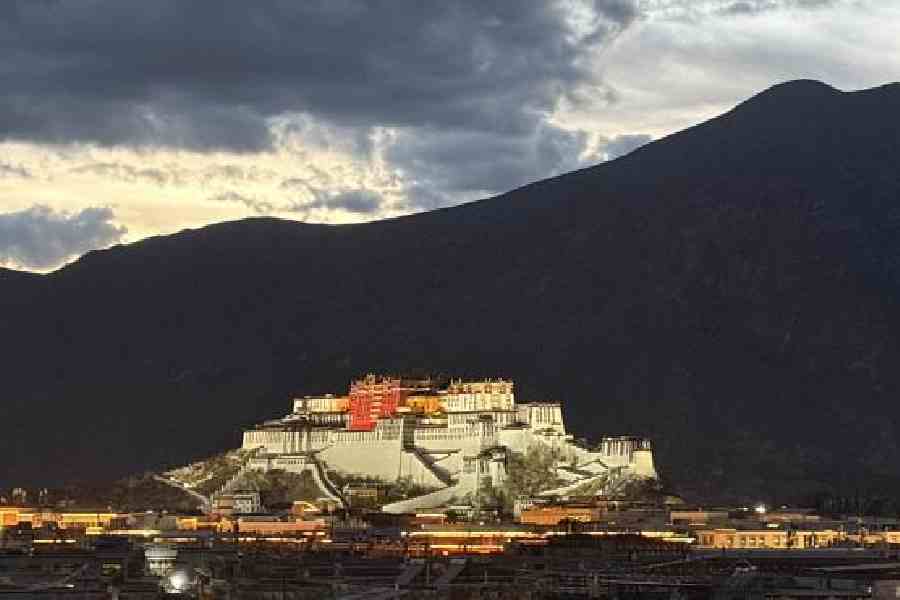
The magnificient Potala Palace in Lhasa at dusk
Slowly, the evening light began to soften. The brilliant whites of Everest gradually transformed into shades of gold, then amber, before finally taking on delicate hues of pink as the sun prepared to disappear behind the Himalayas. Every few minutes the mountain seemed to transform into something entirely different. No camera could truly capture what unfolded before my eyes.
Perhaps that is why so many people dream of coming here. Not simply to see Everest. But to experience it. Standing before the highest mountain on Earth, I felt both incredibly small and deeply privileged. Nature has a remarkable way of reminding us how insignificant our worries really are. For a brief moment, everything else in life seemed wonderfully unimportant. We had been fortunate.
Travellers often wait days for clouds to clear, only to catch a fleeting glimpse of the summit. That evening, the skies remained perfectly clear. Everest stood before us in all its magnificence, allowing us to witness one of the most beautiful sunsets I have ever seen.
As the final rays of sunlight disappeared from its snow-covered slopes, I realised something. This was no longer simply another destination on a travel itinerary. It had become a pilgrimage. Not in a religious sense. But in a deeply personal one.
People often ask why we travel. Standing there, in the silence of the Tibetan Plateau, I felt I had found my own answer. Sometimes we travel not to discover new places. We travel to discover a quieter part of ourselves. Only after the last light had faded from Everest’s summit did I finally stand up. Reluctantly.
I took one last look. Turned around. And slowly walked back towards camp, knowing I was leaving with far more than I had come for.
The road to Everest Base Camp is not difficult. But it deserves patience. And perhaps that is exactly how it should be.
If You Go
Getting There: For those inspired to experience Mount Everest from its northern face, Tibet offers a remarkable alternative to the more familiar Nepal route. The journey begins with a direct flight from Calcutta to Kunming, making this extraordinary adventure more accessible than many travellers realise. From there, you can continue by air or combine your journey with China’s impressive rail network before arriving in Lhasa.
Entry into Tibet requires both a Chinese visa and a Tibet Travel Permit, which must be arranged through an authorised local tour operator. Independent travel is not permitted, so advance planning is essential.
Staying There: Accommodation ranges from comfortable three-star hotels to luxury properties, allowing travellers to choose an itinerary that suits both their comfort and budget. Our journey, including permits, accommodation and transport within Tibet, cost a little over $6,000 for two people, excluding international flights, meals, shopping and personal expenses.
Tips: If I could offer just one piece of advice, it would be this: Respect the altitude. Spend at least two or three days acclimatising in Lhasa before travelling towards Everest. Carry more warm clothing than you think you will need because the weather in the mountains can change far more quickly than you expect.
Ranjana Jha is a Fractional CHRO. She helps growing organisations build people strategies that enable sustainable growth. She is a passionate traveller and blogger who believes every journey is an opportunity to connect with people, cultures, and history.