 |
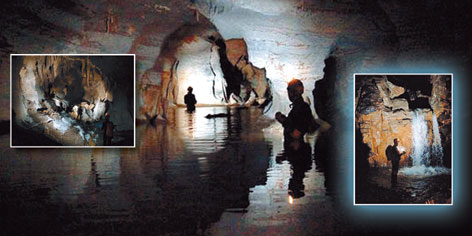
| Group activity: Cavers have to take some precautions in the form of clothing and assured company (Photos: Reuters) |
If heights hold horrors for you, don?t despair. If you still want a brush with adventure, consider caving. What?s that, you?d ask. To put it simply, it?s just the reverse of mountaineering. But travelling deep into the caves isn?t as simple as it sounds. It?s technically diverse ? you have pitches to climb, tunnels to cross and even pools of water to clear. The going can get rough. So don?t expect to climb down safe ladders with handrails. Decked out in an overall, helmet and headlight, looking somewhat like a miner, you will have to begin all caving adventures with a safety and equipment briefing. Once you are in the pits, literally, it?s nothing short of a journey into earth?s deepest hidden recesses.
Caving is yet to take off in India. But that doesn?t mean that there is a shortage of places to explore. Also known as ?potholing? and ?spelunking? in some parts of the world, caving is mostly done in groups of four or more. As of now, there are no package deals on caving available in India. The good news, however, is that Meghalaya Adventurers Association (MAA), a Shillong-based organisation formed in 1990, is soon going to start four to five-day caving tours.
Places to go
In the south Garo Hill district, your opportunities include Sijudobkhakol, the most researched cave in India. At 4,772 m, it is the third longest cave in the Indian subcontinent containing some of the finest river passages. There is also Tetengkol Balwakol or ?the cave of the dwarfs with inverted feet?, Dhobhakol Chibe Nala and Bok Bok Dobhakol.
Meghalaya is home to more than 500 caves. According to B.D. Kharpan Daly, general secretary of MAA, heavy rains could be the reason for the abundance of caves in the region. He is confident that the count could go up to even a thousand.
plunge in
• Never go caving alone. There should be a minimum of four people on each trip. Contact a local group , or someone who has caving experience.
• Always leave word as to which cave you will be visiting and your expected time of return, allowing a few hours for any accidents.
• The slowest caver sets the pace. Do not break up the party. Experienced cavers have lost their way in even seemingly easy, straight passages.
• Caving is extremely tiring. Know your limitations, rest frequently and watch for fatigue in others.
• Avoid hypothermia. Dress well and monitor each other for the first signs of hypothermia: shivering. To combat hypothermia stay active, well-fed, well-hydrated. Do not push yourself till you are exhausted.
• Do not take risks. Even an injury that is minor at home, could put your life at risk in a cave. Rescuing a person from a cave is a very technical and difficult operation.
• Leave bats undisturbed. Although mostly harmless, bats are wild animals, so you should never try to touch one or pick one up.
• Carry out trash. Take any thing you bring into a cave out with you or it only leaves an unsightly mess for the next person. If you are the next person and find some trash, pack it out with you. All responsible cavers do.
• Bring freezer bags to remove human waste. Such waste pollutes the cave environment and water. You can pack in a few empty bottles to pack out liquid waste as well.
• Carry at least a couple of light sources. It could be a flashlight with a set of extra batteries and bulbs and candles with loads of matchboxes.
• Take a small sidepack with water, some high-energy foods (say, chocolate bars) and a first-aid kit.