 |
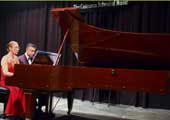
| Piano duet by Chantal de Salberry and Fared Curmally at the Calcutta School of Music |
They say roots make a man. Stephen Masi, an Italian residing in the US, remains, thankfully, an Italian. He teaches piano. But, one reckons, he plays it better. This was incontrovertibly evident during his performance at the Calcutta School of Music on September 17. Masi is not a performer; he is too much in love with his craft for that. He just sinks into the ivory. Schumann’s abject romanticism, therefore, could not have deserved a better acolyte than Masi, as he approached Two Fantasie Pieces, op. 12 together with its two movements, Des Abends and In der Nacht, with a bouquet of notes that radiated a sense of convivial chaos, comprising a litany of small melodic phrasings, mildly peremptory and sometimes coquettish, all in an ode to the sense of beckoning melancholy that weaves through most of Schumann’s oeuvre.
Masi didn’t fall short of ingesting Chopin’s forte either — harmonic intensity. Choosing the latter’s Sonata No.3 in B Minor. Op.58, Masi had a field day, as he created an engaging scuffle between rhythmic impatience and melodic sobriety. The third movement, Largo, gained salience, thanks to his masterly interplay of the elegiac and the frolicsome.
Masi’s next subject showcased not so much his virtuoso, but his exploratory streak, necessitated perhaps by his profession. He bunny hugged Debussy’s From Etudes, Book 1 with the requisite harmonic economy, notably during Pour les octaves, when Masi dined out on a piece that offered the latitude of being joyfully militaristic and much resonance in the deeper registers.
That done, Masi moved on to the relatively modern, and a tad egoistic — Liszt. Again, a wise choice, given the composer’s penchant to make the piano the pivot in the orchestral scheme of things, an enterprise that was hugely evident during Sonetto 104 Del Petrarca, as a hive of flamboyant chords, overwhelming strident, was punctuated by an euphonic gravity that was both elastic and introspective.
While Masi’s reverence for Liszt greatly adrenalised the piece, the former’s métier when it came to tonal unorthodoxy was equally gratifying during La Campanella, though a concerto penned by Paganini, violinist extraordinaire, but adapted by Liszt for piano in an attempt to garner more cultural primacy. No lazy lingering notes, rather a hectic collage of short, often pert, but always sonorous strains, testified to Liszt’s genius — and, of course, Masi’s versatility.
Four days later, on September 21, at the same venue, the experience was altogether different, but not the thrill. Piano Duets by Chantal de Salberry and Fared Curmally, represented a pianism marked by a coordinative finesse and sameness of spotlight that bespoke not merely their seasoned schooling but perhaps even the richness of their repertoire. Aptly, Mozart’s Sonata in F Major K.471 flagged off the evening, and the duo optimally leveraged on the myriad moods the clutch of movements offered, notably during Andante, which courted the lachrymose, the playfully rebellious with de Salberry deftly switching from the accommodative to the assertive. Their delicate partnership was equally adept at engineering a palette of variegated tones while serenading master melodist Schubert’s Divertissements a ’Hongroise — the flirty met the solemn, the pesky gamboled with the feisty, while Curmally took a bow with de Salaberry to share the applause.photographySujoy Das