|
 |
 |
 |
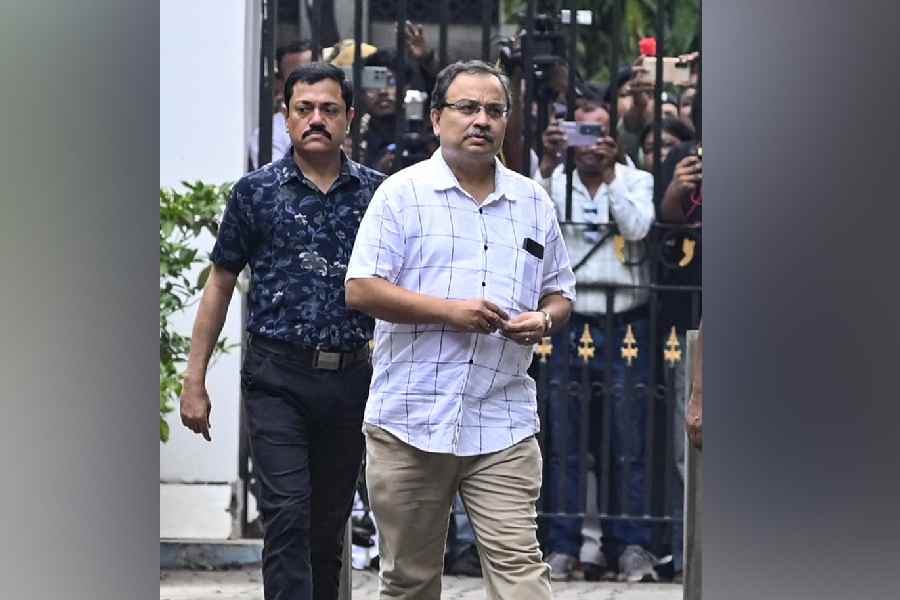
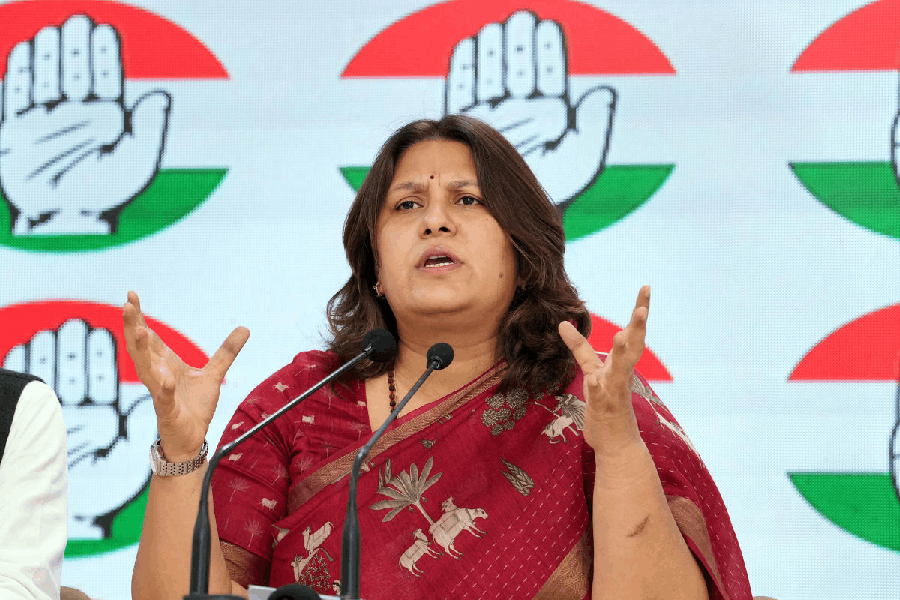
| (From top:) Bharti Yadav; Parthapratim Roy Burman; Shayan Munshi and Zahira Sheikh |
Until Wednesday morning, before she entered a Delhi court to sit through the deposition of Bharti Yadav in the murder case of her son Nitish, Neelam Katara was living on the hope that love would win over fear. “There may be so many things Bharti never had the time to tell the court,” she had earlier optimistically remarked, referring to Bharti’s fleeing to England soon after Nitish was murdered on the night of February 16, 2002, allegedly by Bharti’s brother Vikas and cousin Vishal Yadav. “I hope the deposition will now give her the chance to finally speak out and profess her true feelings for Nitish, and set the case on course for justice.”
Bharti eventually did not do that. While she admitted and corroborated in the Patiala House Court earlier this week some of what had happened in the past, she avoided implicating her brother and cousin directly. Bharti — a key witness whom the prosecution relied on heavily — denied that she and Nitish were either in love or wanted to marry. And while not exactly hostile, she wasn’t quite a friendly witness either.
But nobody is really surprised by that, for Bharti is just one among the many witnesses in Indian legal history to have retracted statements, supposedly forgotten crucial facts or done a volte-face in court. The sudden bouts of amnesia are directly linked to the clout — political or economic — of the accused.
The government is alarmed at the way justice is taking a back seat in several high-profile cases. In November, Kapil Sibal, former senior lawyer and at present minister of science and technology — out of his keenness for law and his position in office — announced the development of a new digital evidence system in association with Microsoft that could help with the problem in future, by making recorded evidence tamper proof, thus preserving its authenticity. That apart, the 2003 Criminal Law Amendment Bill, approved by Parliament in its 2005 winter session, also speaks of laying down measures for taking stern action against perjury.
Clearly, the task of getting witnesses to testify truthfully in court is something the criminal justice system seems to be grappling with. Just how bad things currently are is demonstrated by figures provided by lawyer and activist Teesta Setalvad. “In over 70 per cent of cases in India, witnesses tend to turn hostile,” she says. But the problem, she feels, is not just with witnesses prone to lying, but with loopholes in the system that allow them to take advantage of the situation. “In 95 per cent of the cases where the criminal cases fall flat because of hostile witnesses, the state does not play a positive role,” she says.
Setalvad was herself dragged into the issue when Zahira Sheikh, a witness in a case relating to the Gujarat 2002 anti-Muslim violence, changed her testimony several times over in court. In one of the few recent instances where people lying in court were penalised, she was finally convicted of perjury and sentenced to a year’s imprisonment, with a special court directing an investigation into her assets supposedly acquired during the trial.
Sheikh’s punishment was widely hailed as a much-needed move. After all, the sheer number of high-profile cases in the recent past where witnesses have made proceedings go awry is staggering. Consider the Jessica Lal case. Shayan Munshi, a model-turned-actor who was present at a party in Tamarind Court, a Delhi restaurant, when Lal was shot dead at point blank range, gave a wildly conflicting account of the events. He first stated to the police that both gunshots, including the one that killed the model, were shot from a single gun. He later changed his statement, pointing to a two-gun theory, saying the first statement was incorrect and recorded in Hindi, a tongue that he claimed he didn’t know well. Then, Khadim’s boss Parthapratim Roy Burman told a Calcutta court last week that he couldn’t recall details of his abduction in 2001 since he had lost consciousness while being nabbed, and was feeling unwell while even recounting it before the court.
Or take the case of a man called Manoj Malik. He survived an accident in which six people were run over by a speeding car in Delhi in what was later referred to as the BMW case. He subsequently testified that it might have been a truck that hit them and not a car, which triggered a debate that he had been paid off to lie in court.
And to bring it full circle, if Bharti indeed refuses to help the prosecution adequately, it wouldn’t be the first jolt the Katara case would receive. Another key witness, Rohit Gaur, brother of Shivani, whose marriage Nitish had gone to attend before he was killed, already resiled in September, denying that Nitish and Neelam were in love, or that he had seen Nitish being whisked away from the party by his alleged murderers.
But why, in the first place, do witnesses turn hostile? Money is perhaps the most obvious answer — experts say the trend of buying off witnesses is more than prevalent in India. But that, however, is just the tip of the iceberg, they assert. Down below, there are several other factors which build up to dilute criminal cases, in different stages of proceedings through the criminal justice system.
Fear is an immense deterrent for witnesses who don’t see a stake in testifying correctly. “On many accounts, the investigating authorities themselves embroider cases to such an extent that it leads to a complete loss of faith in the system,” says Supreme Court lawyer Nitya Ramakrishnan. “When the prosecution, along with the investigating authority, is found to falter in approach to a case, how much courage does it give an ordinary citizen to stand up and tell the truth? This lack of faith can provoke a witness to lie out of his own volition, the more so if he is paid off or terrorised.”
The situation only worsens if citizens are urged to testify against people who come from the high and mighty rungs of society. “The modus operandi of any influential accused is to buy off the witnesses either through money or force,” says Sabrina Lal, sister of Jessica who is still hoping for justice to be dispensed. “In the beginning of a case there are 10 witnesses, and as it progresses you are left with no one ready to tell the truth. And if you see it from the point of view of the witnesses, most don’t really want to get involved in other’s matters and are happy to accept money to retract their previous statements.”
Power, undoubtedly, plays a role in the course of court proceedings. Manu Sharma, prime accused in the Jessica Lal case, is the son of a prominent Haryana Congressman. Sanjeev Nanda, who was in the BMW, comes from a top-notch Delhi business family and is the son of a former arms dealer. And the reason the Kataras are running from pillar to post to seek justice could be related to the fact that Bharti, and her brother Vikas, have former Rajya Sabha MP and Uttar Pradesh strongman D.P. Yadav for a father.
But what’s questionable here is the space that the law makes for people to retract. As police proceedings go, witnesses are asked to give a statement to the police after an FIR is registered with them, under Section 161 of the Code of Criminal Procedure (CrPC). This statement is recorded in the police station, and is not required to be signed by the witness. In the absence of a signature, and given the fact that it is not required in the presence of a magistrate, the statement cannot be produced as evidence in a court.
It is this initial statement that most hostile witnesses tend to backtrack on. Even the prosecution in the Nitish Katara case is faced with a similar problem. The only statement made by Bharti to the police in the past was unsigned and recorded at a police station. “Technically, it cannot be cited as evidence, though we can still argue it out in court,” says advocate P.K. Dey, representing the Kataras.
There is, however, a provision under Section 164 of the CrPC which allows the police to record the first statement in the presence of a magistrate, which gives it the status of official evidence. Subsequent backtracking, if proved, can subject the witness to be tried for perjury. However, Section 164 is seldom used by the police in India.
The lack of initiative on this front, say critics, is largely due to an improperly trained police force. “During the TADA proceedings, the court allowed statements made to the police to be counted as evidence, provided they were made to personnel of the ranks of a superintendent of police (SP) or above,” says G.P. Joshi, former police officer and ex-director, Bureau of Police Research and Development in New Delhi. “But SPs do not sit in police stations to record statements. It’s a job done by ill-trained sub-inspectors who lack the insight and fail to give an investigation the attention it deserves.”
Veteran Supreme Court lawyer and former law minister Shanti Bhushan, on the other hand, extends another possibility as to why the police often refrains from going by Section 164. “There is so much money that changes hands during case proceedings that the police often love to tamper with evidence. That’s when recording statements in the absence of a magistrate comes of use to them, since such evidence can be tinkered with as and when required. One has to rid the system of corruption before thinking about anything else,” he says.
Yet another reason witnesses fall out is the lengthy juridical process that comes with every case. On an average, criminal cases in India take about 10 to 15 years to reach completion, say experts. Caught in the tiring process, witnesses often fail to see a stake for themselves in telling the truth. Moreover, it tends to take a toll on their memory. “It is often impossible for a witness to identify a person in court many years after the crime has been committed,” says Nitya Ramakrishnan. “In such a case, it is easier for them to walk out of the case than try and tell the truth.”
Assuming, however, that witnesses tell the truth, it is up to the state to ensure their protection, especially if testifying truthfully subjects them to potential threats outside the courtroom. Attempts have been made in the past to keep the name and identity of witnesses a secret during testifying. “But that’s useless, considering that the accused would in all probability know who is testifying against them. They wouldn’t need the court to spell out names to track down witnesses once the proceedings are over,” says Joshi.
In that case, arrangement of proper protection is an imperative, where it would be the police’s duty to cover witnesses from possible harm once they have testified, by extending adequate security and vigilance. However, in a country like India where there are way too many witnesses to be protected, that is hardly a pertinent option.
A distant option might be to toe the line of western countries such as the US, where witnesses are ‘erased’ by investigating agencies after they have testified. The process involves wiping out every trace of a witness’s identity and relocating him or her to a new place under another name, fresh employment and new social records. It is a process that makes tracking down a witness a substantially difficult process.
“Erasing is a drastic measure, but it will have to be adapted to the Indian situation,” feels Setalvad. And while it is yet to be incorporated in the system, the idea of a witness protection programme has been floated by a 2004 paper by the Law Commission of India.
The proposed amendments and the possible induction of the digital evidence recording system could effectively stop witnesses from turning hostile. And a nod from the government to implement them could prove to be a much-needed stitch in time.
Or else, in law courts, guns will continue to multiply, and cars will turn into trucks, until a day dawns when pigs would fly.
Why witnesses become hostile
• Fear and greed: witnesses are terrorised or paid off.
• The investigating authorities embroider cases, leading to a loss of faith in the system.
• A statement is recorded at the police station, and is not required to be signed by the witness. In the absence of a signature, and because it is not given in the presence of a magistrate, the statement cannot be produced as evidence in a court.
• Section 164 of the CrPC allows the police to record the first statement in the presence of a magistrate. But the improperly trained police doesn’t use Section 164.
The solution
• Introduce a new digital evidence system that makes recorded evidence tamper proof.
• Introduce a witness protection programme. Wipe out every trace of a witness’s identity and relocate him or her to a new place under another name.