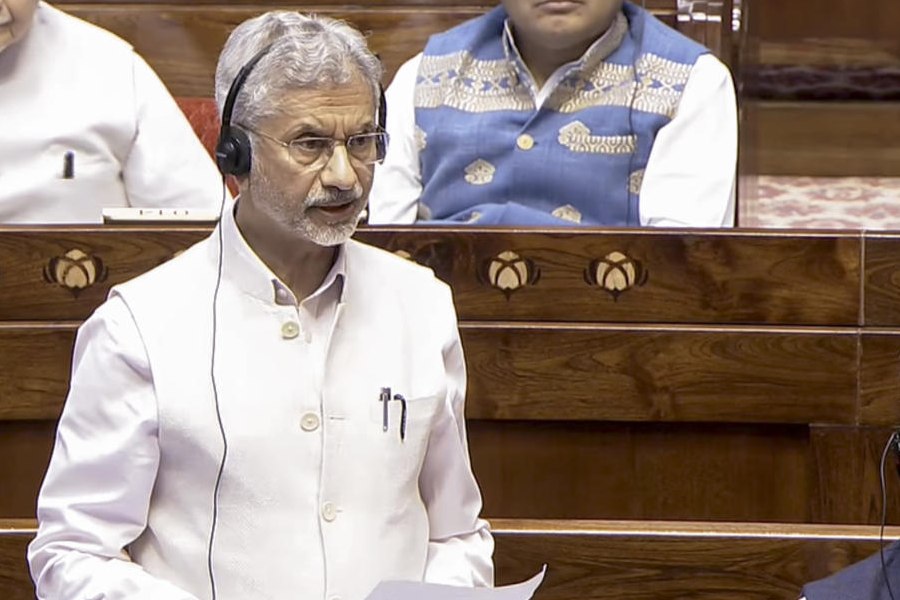
External affairs minister S. Jaishankar on Monday told Parliament that India had attempted to reach out to the Iranian leadership after the West Asia conflict erupted, but the situation in that country had made such efforts difficult.
Jaishankar appeared to be addressing the allegation that the Modi government was siding with the US-Israel combine and the widespread criticism of New Delhi’s reticence on the assassination of Ayatollah Ali Khamenei and the death of around 100 Iranian soldiers in a US submarine attack while returning from a naval event in India.
“While attempts have been made, contacts with Iran at the leadership level are obviously difficult at this time. I have, however, spoken to foreign minister Abbas Araghchi on February 28 and March 5. We will continue these high-level conversations in the coming days,” Jaishankar told both Houses of Parliament in a suo motu statement on the situation in West Asia.
Prime Minister Narendra Modi has spoken to the President of the UAE, the Amir of Qatar, the Crown Prince of Saudi Arabia, the Crown Prince of Kuwait, the King of Bahrain, the Sultan of Oman, the King of Jordan and the Prime Minister of Israel since February 28, when the US and Israel began bombing Iran. Modi is not known to have had any contact with the Iranian President since the war began.
In his lengthy statement, Jaishankar made no mention of the former Supreme Leader of Iran, Ayatollah Ali Khamenei, who was killed in an air attack on March 1. The only reference to him was an oblique mention of “casualties, including at the leadership level, in Iran”.
While India has stressed the need to respect the sovereignty and territorial integrity of all countries in the region, New Delhi has not condemned Khamenei’s killing or even commented on it publicly, barring the message written by foreign secretary Vikram Misri in the condolence book at the Iranian embassy in Delhi.
Jaishankar was silent on the Iranian naval vessel that was torpedoed in the Indian Ocean off the coast of Sri Lanka on Wednesday morning. While he did mention three Iranian ships, Jaishankar was vague about the details.
“The House will also be interested in the issue of an Iranian vessel that is currently docked in Kochi. The Iranian side requested permission on February 28 for three ships in the region to dock at our ports. This was accorded on March 1. IRIS LAVAN actually docked on March 4 in Kochi. The crew is currently in Indian naval facilities. We believe that this was the right thing to do and the Iranian foreign minister has expressed his country’s thanks for this humane gesture,” he said.
This apart, the statement dwelt at length on India’s call for diplomacy and dialogue, the steps taken by the government in the build-up to the conflict to ensure the safety and security of the one crore-plus Indians living and working in West Asia, and the support being provided to nationals across the Gulf since the conflict began.
“Our diplomats have also worked hard to assist stranded transit passengers in hubs like Dubai, Doha and Abu Dhabi. They have facilitated international border crossings for Indian nationals, including from the UAE to Oman and from Qatar, Kuwait and Bahrain to Saudi Arabia. Wherever there has been a partial opening of airspace, we have approved and undertaken commercial flights, including non-scheduled flights, to enable the return of Indian passengers. Our estimate is that as of yesterday, almost 67,000 of our nationals have done so,” he said.
On the economic impact of the conflict, Jaishankar pointed out that the Gulf is a major trade partner, accounting for almost $200 billion annually.
“In the last decade, there have been significant investments from the region into the Indian economy. Therefore, serious supply chain disruptions and climate of instability that we perceive are serious issues. Furthermore, these include attacks on merchant shipping where Indian nationals often constitute a large proportion of the crews. We have sadly already lost two Indian mariners and one remains missing in such incidents,” the statement said.