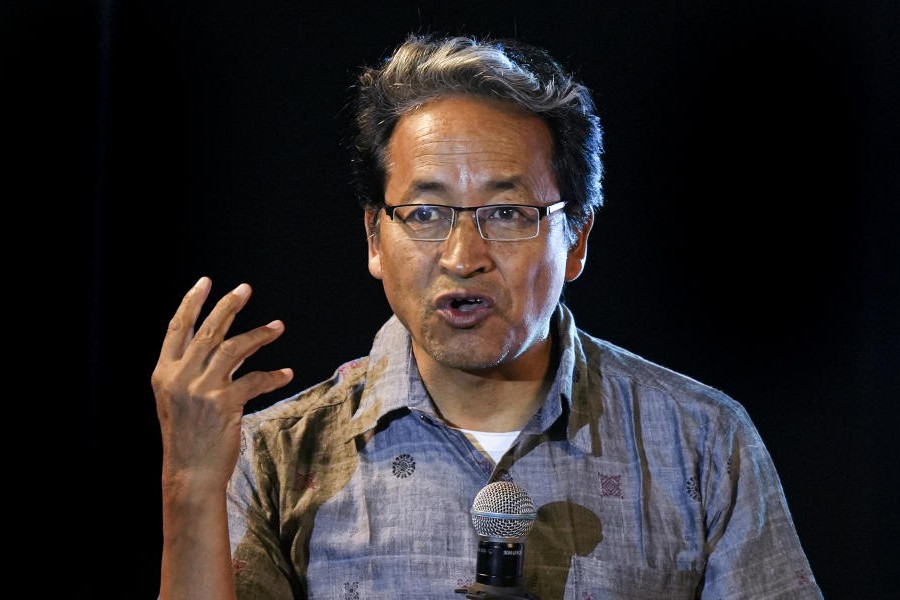
Jailed climate activist Sonam Wangchuk’s wife, Gitanjali J. Angmo, appeared before the Supreme Court on Thursday, arguing that the tenor of her husband’s speech was not meant to incite violence, but to quell it.
She claimed facts were being manipulated to portray him as a criminal.
Angmo also told the top court that Wangchuk was not provided with the "complete grounds" of his detention and was denied a proper opportunity to make a representation to the authority concerned.
The hearing in the matter remained inconclusive and will continue on January 12.
Wangchuk was detained under the National Security Act (NSA) on September 26, 2025, two days after violent protests demanding statehood and Sixth Schedule status for Ladakh left four people dead and 90 injured.
The government has accused him of inciting the violence. The NSA empowers the Centre and states to detain individuals to prevent them from acting in a manner "prejudicial to the defence of India".
The maximum detention period is 12 months, though it can be revoked earlier.
Senior advocate Kapil Sibal, representing Angmo, told a bench of Justices Aravind Kumar and Prasanna B Varale that Wangchuk was detained by the administration to prevent him from indulging in prejudicial activities.
Playing a video of Wangchuk’s speech in court, Sibal said the climate activist made the speech while breaking his hunger strike.
"I said I cannot accept this violence, and we should stop this violence, and I am appealing to you to stop this violence. That is the video I wanted to play to your lordship. You might remember that Gandhiji did the same when there was violence after the Chauri Chaura incident," Sibal said, adding that facts were being manipulated to show that Wangchuk is a "criminal".
"The tenor of the speech is not in any sense threatening the security of the state or that I will continue such activities or to propagate violence, but to quell it," he added.
The senior lawyer also stated that the video, which is available to the administration, was not placed before the detaining authority, with the intent to ensure that the order of detention was passed without the full context of what happened on September 24, 2025.
Sibal said the pen drive containing all documents except the four videos was supplied on September 29, 2025.
"Approximate causes that led to the detention order on September 26, 2025, were four videos relied upon by the detaining authorities. The videos were dated September 10, September 11, and two videos dated September 24. However, while the grounds of detention were supplied on September 29, the four videos were not furnished to the detainee," he alleged.
Sibal submitted that the grounds of detention were only supplied to Wangchuk after a delay of 28 days, which he called a violation of Article 22 of the Constitution. Article 22 provides protection against arbitrary arrest and detention.
Emphasising that the law mandates that if the grounds of detention are not supplied to the detainee, the detention order is "vitiated", Sibal referred to the laws on detention and the supply of grounds.
"The detainee has the right to be furnished with the grounds of detention along with the documents so referred. If there is a failure or delay in furnishing, it would amount to a denial of the right to make an effective representation," he said.
Sibal also contested the Leh administration’s reply to Angmo’s petition, arguing again that the pen drive containing all documents except the four videos was supplied on September 29, 2025.
Referring to one of Wangchuk’s letters dated October 21, 2025, Sibal said only screenshots and no videos were supplied to him along with the pen drive.
Earlier, Leh District Magistrate had told the apex court that Wangchuk indulged in activities prejudicial to the security of the state, maintenance of public order, and essential services, which led to his detention under the NSA.
In an affidavit, the Leh district magistrate denied that Wangchuk had been detained illegally or treated improperly, and submitted that the grounds of detention, along with the material, were communicated to him.
In her plea, Angmo said the unfortunate events of violence in Leh on September 24 could not be attributed to Wangchuk’s actions or statements.
She added that Wangchuk had condemned the violence through his social media handles and stated that violence would lead to the failure of Ladakh’s "tapasya" and peaceful pursuit of five years. She described it as the "saddest day of his life."